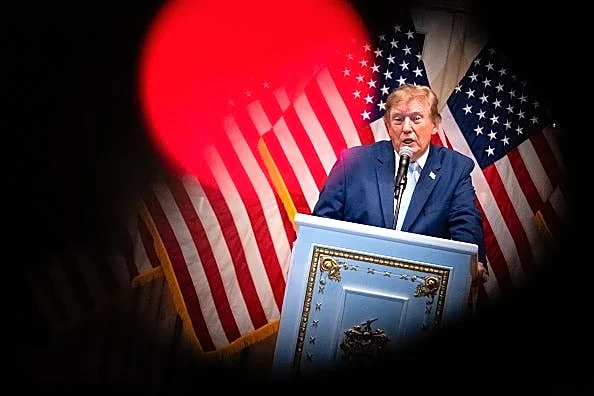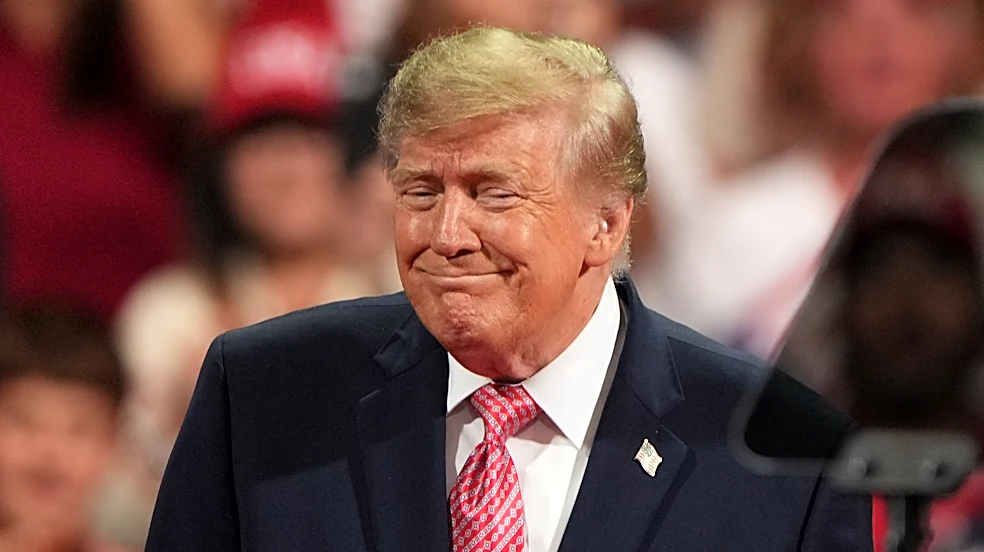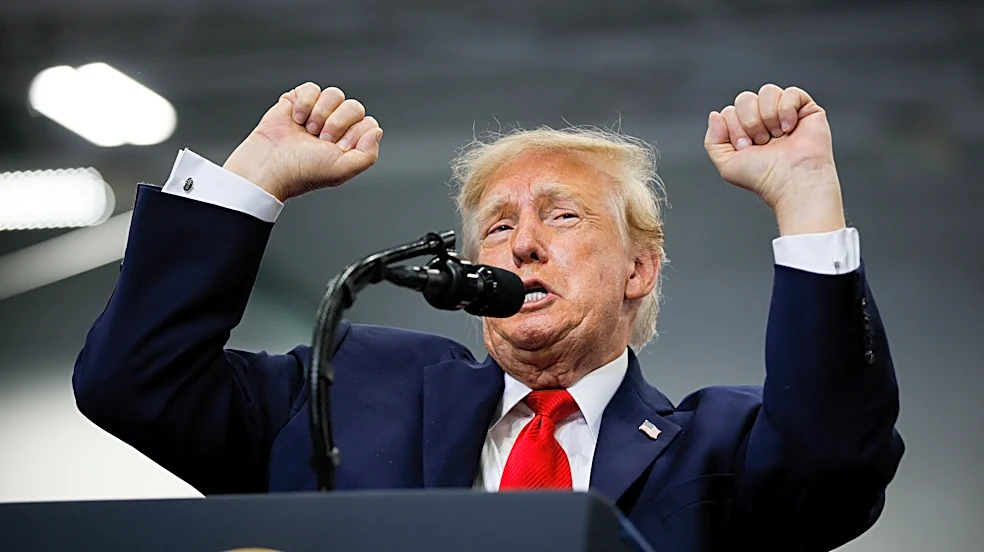




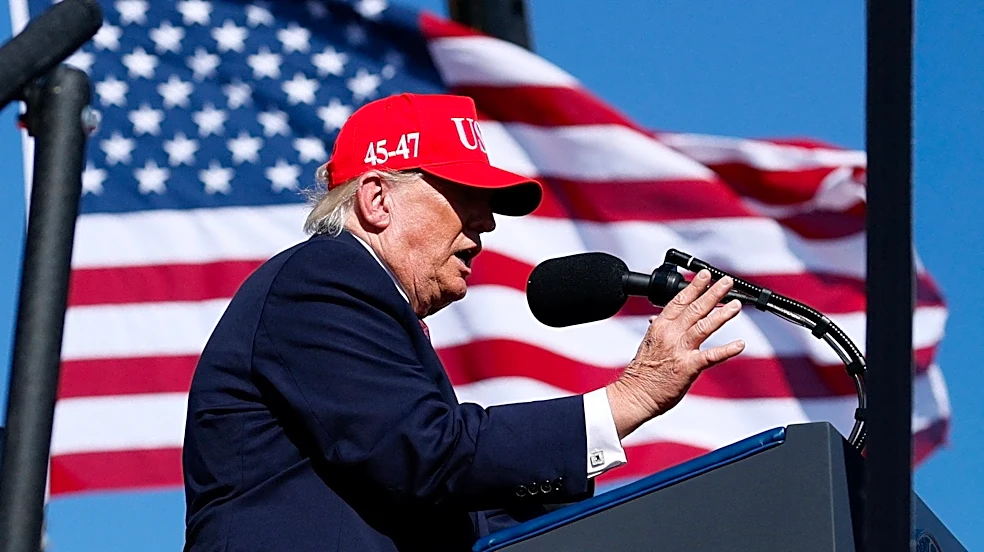
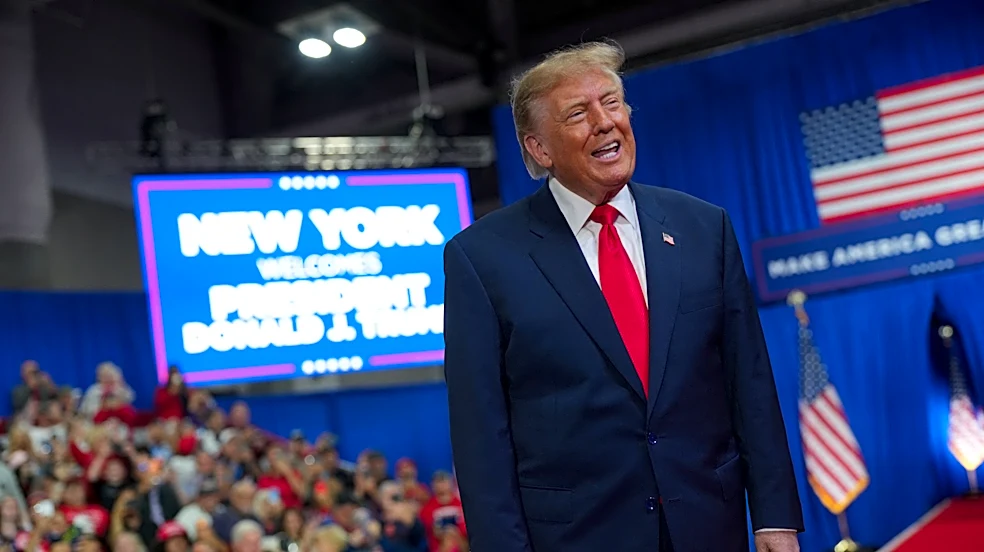

WASHINGTON – In a midterm election defined by Americans' pocketbook concerns, President Donald Trump veered off to a different topic as he spoke to supporters at a rally last week in Wasilla, Alaska.
"We will not let them cut our children," Trump said as he made a sharp cutting motion with his right hand. "It's called mutilization."
Trump was referring to gender-affirming surgeries, one of his go-to subjects to fire up the MAGA base. He then moved to another favorite attack on Democrats: transgender athletes in women's sports, spending several minutes telling stories of an undermatched female weightlifter and a swimmer who stood no chance against trans opponents.
"Who the hell ever thought we'd be fighting to keep men out of women's sports?" Trump
said.
The material isn't new for Trump, who ran anti-trans advertisements in the 2024 election and targets the trans community often during public remarks. But now, in the homestretch to the Nov. 3 midterms, the president is leaning harder on his daily campaign swings into a familiar mix of hot-button, culturally divisive issues ‒ from fears about migrants and Islamophobia to "transgender insanity" ‒ despite polls showing the economy and cost of living are at the center of voters' minds.

The focus is part of a broader strategy for Trump during a weeks-long campaign blitz that has taken him to mostly deep-red areas in Republican-leaning states. It's not about winning over new voters to support Republican midterm candidates. The goal is to energize low-propensity voters who backed Trump in three presidential elections and ensure that they will turn out in November when Trump is not on the ballot.
"They expected him to fix the economy, and he hasn't. So if you don't have the No. 1 issue, you have to pivot to a different issue," said Todd Belt, director of the political management program at George Washington University. He said Trump and Republicans want to shift the midterms from a referendum on the president, whose approval ratings have reached all-time lows, to a "choice election" against Democrats.
"This is trying to define the Democratic candidates, who they are and what they stand for," Belt said.
Trump's embrace of the culture wars comes as the president has struggled to convince Americans of an improving economy amid stubborn inflation and high gas prices caused by the U.S. war with Iran.
A Washington Post-ABC News-Ipsos poll last week found 75% of Americans believe the economy is poor. A poll this month from the Associated Press-NORC Center for Public Affairs Research found 65% of respondents blame Trump's policies for high costs more than other factors outside of his control. Seventy-three percent of Americans disapprove of the president's handling of the economy, according to the poll.
In the same speech in Alaska, Trump railed against Somali immigrants, saying they've "destroyed" and "fleeced" Minnesota. Trump urged Minnesotans to "fight back" against the Somali community in a recent social media post, accusing them of being responsible for "Violence, Murder, and Mayhem all over the State."
Trump pivoted to the Second Amendment at a rally in Dalton, Georgia. "He's going to take away your guns," Trump said, referring to Democratic Sen. Jon Ossoff, who is running against Republican Rep. Mike Collins.
And during a campaign rally in Youngstown, Ohio, Trump called Abdul El-Sayed, the Democratic nominee for Senate in Michigan, a "jihadist." He accused "radical left maniacs" of trying to take away Christopher Columbus Day. He also took aim at Haitian immigrants in Springfield, Ohio, saying, "they're being taken out and they're almost going to be gone."
"He's trying to use sort of a 'bandwagon effect' for his voters, to get them out, to energize the base," Belt said. "There's a lot of talk about how unpopular he is, and he's trying to counter that narrative by doing these rallies and playing the 'greatest hits,' as we would say, with immigration and the social issues."
Anti-trans rhetoric remains go-to attack
As he moves from one state to the next in his midterm blitz, Trump has not ignored the economy as a talking point. But instead of appealing to cost-of-living anxieties, he's mocked the term "affordability" as a creation of Democrats, falsely claimed inflation is down and touted the economy as the greatest in American history.
More than any other wedge issue, Trump and Republicans are betting on anti-trans rhetoric to try to stave off a blue wave. Democrats are widely favored to win control of the House of Representatives in the midterms, and close Senate races in several traditionally Republican states point to a potential Democratic takeover of the Senate as well.
Since Aug. 1, Republican candidates or pro-Republican groups have spent more than $100 million ahead of the midterms airing 200 ads that reference transgender issues, according to AdImpact, a firm that tracks political advertising.
Trump recently referred to South Carolina Democratic Senate nominee Annie Andrews by the anti-trans slur "Trannie" in a social media post.
During a stop in Kalispell, Montana, Trump accused Democratic congressional candidate Sam Forstag, who is running in a fiercely contested House race in the state, of personally fighting for the "transgender mutilization of Montana children (and) drag shows in Montana." The attack appeared to be a reference to Forstag's past work as a lobbyist for the ACLU.
"Does anybody like the idea of his paying for drag shows in Montana schools?" Trump said.

At multiple rallies, Trump has also singled out WNBA player Sophie Cunningham, who has been lauded on the right for her vocal opposition to trans athletes in women's sports. In Ohio, Trump called Cunningham a "beautiful young woman" and remarked to former NFL coach Jon Gruden, who was stumping for Trump at the event, "You probably wouldn't mind her on the team, not to help with points, but with attendance."
He followed it up by sharing on his Truth Social account a well-known photo of Cunningham pointing her finger at a basketball opponent.
At the same time, anti-trans ads have flooded the airwaves of midterm battleground states, where large donors and PAC money have given Republican Senate candidates a significant edge in television advertising.
A Senate Leadership Fund ad accuses Ohio Democratic Senate nominee Sherrod Brown of supporting sex changes for minors, citing an interview he gave in 2023 in which he said “a child’s health care decisions are between them, their parents, their families, their doctors – not politicians."
In Texas, ads funded by a PAC aligned with Senate Republican nominee Ken Paxton accuse Democrat James Talarico of supporting the use of "taxpayer dollars for sex change surgeries on young children.” The misleading ad references Talarico's vote as a state representative against legislation to broadly prohibit gender-affirming care, yet it does not mention that he voted for an amendment that sought to narrow the bill to ban surgeries.

Not all Republicans are on board with culture-war strategy
Trump relied heavily on anti-trans ads ahead of his 2024 election victory over Democrat Kamala Harris. But transgender rights groups predict they won't resonate with voters in next month's midterms.
“Voters are growing tired of the same recycled anti-trans attacks they’ve now seen for three consecutive election cycles," said Ramiro Sarmiento, national press secretary for the Human Rights Campaign. He said that while Republicans have pumped millions into ads focused on the transgender community, they've failed to address "what voters actually care about" ‒ the rising cost of living, gas prices, groceries and political corruption.
"With no solutions to offer, all Republicans have left is to manufacture a culture war that scapegoats the trans community to distract from their own failures," Sarmiento said.
A CNN/SSRS poll in September found transgender policies rank below 10 other issues in terms of importance for voters, with only 25% calling it "extremely important." Leading the way was the economy, with 68% of voters saying the issue is "extremely important."

Some Republicans are also skeptical about campaigning too aggressively on culture wars.
Texas state Rep. Dade Phelan, a former Republican speaker of the Texas House, questioned the effectiveness of an onslaught of anti-trans ads attacking Talarico and other Democrats in Texas, in addition to other Republican ads focused on "defund the police," "boys in girls sports" and Chinese investments in Texas land.
"This is messaging you do in a primary ‒ a real red meat, Republican knock-down, drag-out fight," Phelan told USA TODAY, though he theorized that the ads could help erase the enthusiasm gap Republicans face against Democrats in the midterms.
"But otherwise, I think the downside is it could be turning off the 10% of Texans who are going to decide this election. Those are your moderate voters, your swing voters, your lower-propensity voters, that are probably more motivated by the economy and cost-of-living," he said.
Phelan, a Paxton critic who plans not to vote in the Texas Senate race, said the ads are focused on "stuff that is just not occurring" in most Texas communities.
"In southeast Texas, I've never seen a boy play in girls sports. And quite frankly, no one knows anyone who can afford a transgender surgery," Phelan said. "You can run the risk of looking very out of touch."
Whit Ayres, a Republican pollster and strategist, said the avalanche of anti-trans and other cultural attacks are unlikely to prove as potent for Republicans in the 2026 midterms as they did in the 2024 election.
"Right now, the cultural issues that worked in 2024 are being overwhelmed by economic issues of inflation, economic growth and concern about tariffs, and the effect on the war on Iran," Ayres said. "So, the cultural issues are still present but they don't carry the same juice."
Meanwhile, with two weeks until an election that increasingly seems to favor Democrats, Trump this week found a new hot-button issue to pounce on: mass protests in France over education and the cost of living. Trump blamed unconstrained immigration in France for the riots, warning that the U.S. could be next if Democrats are put in control.
"If you want to see what is at stake in this election, just look at what's happening in France," Trump said in an Oct. 19 rally in Park City, Kansas. "A once-great nation that is being conquered, looted, and burned to the ground by migrants, jihadists and communists who hate Christianity. And they hate, frankly, the Western civilization itself.
"They're destroying that country, and we're not going to let that happen to this country," Trump said.
Reach Joey Garrison on X @joeygarrison.
This article originally appeared on USA TODAY: Trump hammers culture wars on campaign trail as economic pitch fizzles