




Thirty years later, Olympic swimming legend Janet Evans and Muhammad Ali’s widow Lonnie Ali remember the moment as if it happened only a few hours ago. Both of them, filled to this day, with the exhilarating jolt of trepidation and elation they felt that warm summer night in Atlanta’s Centennial Olympic Stadium.
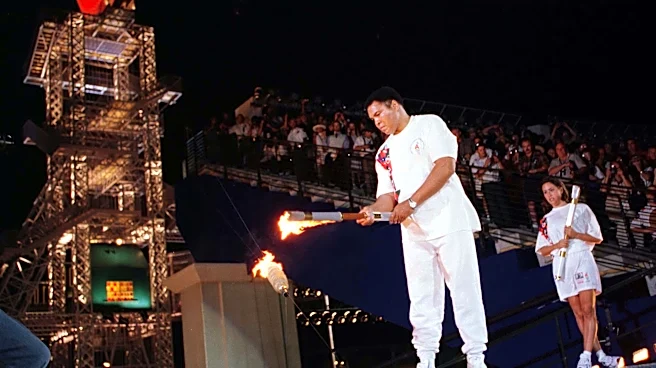
During the opening ceremony of the 1996 Olympic Games, there was Evans, then 24, running purposefully up a steep ramp while carrying a flaming Olympic torch, understandably nervous because a couple billion people around the world, give or take a few million, were watching her run. "I am a swimmer," she said. "I’m not a great runner.”
And in a booth high above the stadium, there was Lonnie Ali, her mind racing with visions of everything
good and bad that could happen in the next few minutes, knowing her husband, one of the most famous people on Earth, was going to have to light a fuse on a wire leading to the Olympic cauldron while holding a burning torch as his left hand shook from the tremors of Parkinson’s disease.
Then she heard the gasp.
More than 85,000 people in the stadium did not know what Evans and Lonnie Ali knew. They did not know that when Evans reached the platform below the cauldron, Muhammad Ali would suddenly emerge from the dark nighttime air into the glare of the stadium lights to join her so the flame she carried could ignite the torch he was holding.

Sitting in the press tribune, I was one of the people who gasped. I’ll never forget that sound, thousands stunned at the same moment, inhaling as one, as if everyone could suck the air out of an outdoor stadium. Ali’s appearance to light the cauldron was one of the best-kept secrets in Olympic history. I don’t think I’ve ever seen a more surprising and breathtaking moment in sports that didn’t happen on the field of play.
As the Summer Games return to the United States for the first time since Atlanta — to Los Angeles in less than two years — Ali and Evans, who is now the LA28 chief athlete officer, have come together to again tell their story and promote the 2028 Olympic torch relay, which will begin in Atlanta, end in LA and visit all 50 states.
Back in 1996, Evans, the winner of four Olympic gold medals and one silver in 1988 and 1992, was coming to Atlanta to compete at one more Olympics when Billy Payne, president and CEO of the Atlanta Committee for the Olympic Games, invited her to be the second-to-last person to hold the flame.
"This is going to be the greatest moment of your Olympic career,” Payne told Evans, she said. "And I said, ‘Ah, yeah, oh, whatever, Billy, you know, what's greater than winning an Olympic medal?”
That was then. This is now. "He was right,” Evans said. "Running the flame was a big part of that, but then passing it to Muhammad, and that moment witnessing him, changed me. It changed how I view the Olympics. It changed how I approach a lot of things in my life. …
“I tell people I’d give up every medal to do it again. There is something magical about the Olympic flame and bringing people together, and it overshadows anything I ever did in the swimming pool. It was hands down the greatest moment of my Olympic career.”
It carried significant meaning for Muhammad Ali as well. “It was probably the final greatest moment of his life,” Lonnie Ali said. “When you think about the global impact at that moment, and what it said and him being on center stage … it was the final momentous occasion in his life.”
Ali, a 1960 Olympic boxing gold medalist and professional heavyweight champion, died in 2016 at the age of 74.
What made the moment all the more powerful was how her husband handled his illness and successfully lighted the fuse for the cauldron, Lonnie Ali said.
“You could see the visible tremor in his arm. And even though he had had his Parkinson’s meds, nothing could have prevented that because it was stress, the nervousness. For him to have the courage to be out there in front of everyone, the world, they remembered Muhammad as this beautiful, physical person moving through the ring with grace, almost like a ballet dancer, this gorgeous body and perfect specimen of physicality. And now you see him with this torch held high, but with the tremor and the real full effects of Parkinson’s that has set in.”
Later in the stadium, some dignitaries were in tears when they greeted Ali, and for a time, it perplexed him.
"I remember when we got to the hotel, Muhammad had the torch and he was sitting in a chair and he was slowly turning it in his hand … just looking at it,” Lonnie Ali said. "So I said, ‘Muhammad, what do you think?’
“They were sad,” he replied. “I heard them (gasp).”
“No,” Lonnie Ali said, “that was because they were so excited that you were there.”
As she recalled, in a joint phone interview she and Evans did with USA TODAY Sports, “He thought that people were sad because of the Parkinson’s and that's why they were crying and that's why he heard the gasp. I go, ‘No, those were tears of joy.’
“At first, he thought people were feeling bad for him. But when he realized really what it was, he was so elated to have gotten that kind of response throughout that entire stadium, that they were so surprised to see him and really applauding him for the courage that he was exhibiting at that moment.”
As Evans passed the flame to Ali, no one knew exactly what was about to happen, so she was ready to help.
“Billy (Payne) was in the tunnel with me,” she said. “The last thing he whispered was, 'If Muhammad has trouble, that torch is made not to un-light,’ and he said, ‘Just help him.’
“I was prepared to do that, but also when I got up there and there was a moment — it was brief — that I was passing him that flame, and obviously we weren’t speaking because the noise was so overwhelming … I looked in his eye and I knew. He just had this look in his eye, and maybe it was an athlete thing, but I just looked at him and I thought, ‘Oh, he's got this, man. There is not a doubt in my mind.’
"It was beautiful and it turned out exactly as it should have.”
This article originally appeared on USA TODAY: Muhammad Ali was the Olympics' best-kept secret. 30 years later, the women who knew remember the gasp