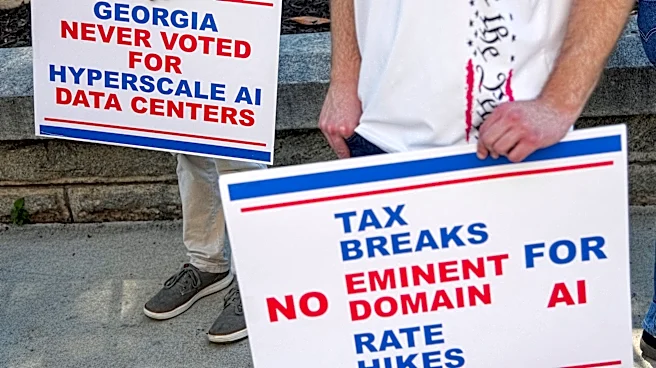








Companies like Meta, Microsoft and Google have brought the data center fight to Georgia. From Palmetto to Douglas County, communities across the state are navigating what new data centers mean for their residents.
Data centers are physical buildings that store vast amounts of computer servers, data storage and networking equipment for things like cloud stage and artificial intelligence. While technology companies have said the centers are necessary to keep advancements in tech moving forward, concerns about their social and environmental impact have led many states to pause new developments.
As the future leadership of the state is undecided (thanks to an ongoing governor's race), the City of Atlanta is trying to stay a step ahead with a new task
force that brings together industry stakeholders and diverse voices in deciding if a data center is right for Atlanta.
Here's what to know.
Atlanta City Council approves Data Center Task Force
Resolution 26-R-3853, establishing a Data Center Task Force in Atlanta, was approved by the City Council on Monday following an initial approval from the City Utilities Committee on Aug. 11.
The task force will "examine national and global best practices in the development, siting, and regulation of data centers, which includes impacts on electric grid capacity, water supply, noise, the City's ad valorem tax digest, and ratepayer costs," the city council said.
The group, made of 23 members, will have an initial feasibility 150 days to create a report for Mayor Andre Dickens, and a final report 30 days later.
The task force will include representatives from the Mayor's Office of Sustainability and Resilience, the Mayor's Office of Technology and Innovation, Atlanta City Planning, Transportation, and Watershed Management departments, District 3 Georgia Public Service Commissioner Peter Hubbard, MARTA and other community stakeholders.
The task force will orchestrate six public meetings and two public hearings before delivering a report to Dickens.
“We’ve heard so many concerns about the negative impacts of data centers on utility bills, the environment, heat islands, and public health," District 2 Councilmember Kelsea Bond, the resolution’s lead sponsor, said in a statement. “Data center developers and big tech companies are pushing local governments hard to approve new facilities, and it’s the responsibility of policymakers to be fully informed about the consequences of data center expansion as we consider land use and zoning decisions in the City of Atlanta.”
Where are data centers in Georgia?
The Microsoft Fairwater Atlanta data center in Palmetto, Georgia has been operational since 2025, about 25 miles southwest of Atlanta.
The Google Stonecrest facility is also just outside Atlanta in Lithonia, Georgia, on the city's southeast side. Google also operates a data center in Douglas County, and it was one of the first built by the company back in 2007.
Meta's Newton County facility is also now operational, according to Brockovich's data. The facility is outside Social Circle, where a massive ICE detention center is also being constructed.
There is one data center in progress but not yet operational in Douglas County from Microsoft, expanding their presence in Georgia.
According to a data center tracker, created by American consumer advocate and environmental activist Erin Brockovich, Project Bunkhouse (Taurus/Digital Reality) has proposed another center in Stilesboro, Georgia in Bartow County north of Atlanta. Another proposed data center, the Hillwood '75' Campus, is further south in Spalding County near Griffin, Georgia.
There have also been a significant number of "community reported" submissions to Brockovich's data of other data centers across the state, but they have yet to be independently verified.
Where do top candidates stand on data centers?
The direction of data center development in Georgia could largely be determined by which candidates win major races this November as part of the midterm election cycle.
Democrat incumbent Senator Jon Ossoff, running for reelection, previously launched an investigation into consumer pricing in Georgia as it relates to data centers, including in an open letter to the Federal Energy Regulatory Commission questioning how increased costs from data center development would be managed.
His opponent, Republican Rep. Mike Collins, said in a recent campaign stop that data center development should "be a local decision."
"Do we need data centers? We sure do; we're in a race for AI against China. But if it's going to hurt local infrastructure, then those people don't deserve for that to happen."
Former mayor of Atlanta Keisha Lance Bottoms is running for governor, and she recently told reporters she supported a "pause" on data center development.
"I want us to gather all the information, factual information, and then make a determination on how we move forward. I can tell you when I'm moving around the state, a lot of people are concerned about the environmental impact. They're also concerned about the rising cost of utility bills."
Her opponent, healthcare CEO Rick Jackson, took a similar stance to his fellow Republican, Collins, in recent comments to reporters.
"First of all, every community needs to have control of whether they have a data center or not, full stop," Jackson said. "No property taxes for the data centers, or don't have one. It's totally up to them. As a business person, I just want to give them that option so that they know both sides of the street."
Irene Wright is the Atlanta Connect reporter with USA Today’s Deep South Connect team. Find her on X @IreneEWright or email her at ismith@usatodayco.com.
This article originally appeared on USA TODAY: City of Atlanta to establish 'Data Center Task Force.' What does it do?