

On a cold day in December 1982, a man wandered into a catholic church in Boise, Idaho, while the priest was hearing confessions; hours later, he was found dead from cyanide poisoning in the church, and for nearly four decades, his identity eluded Idaho law enforcement agencies.
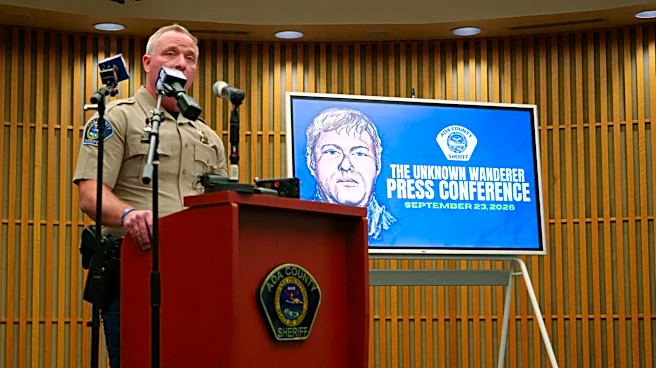
However, on Sept. 23, the Ada County Sheriff’s Office announced via a press conference that its cold case detective had not only identified the "unknown wanderer" as a "brilliant" California scientist, but also found potential connections to one of America's deadliest unsolved killings — the 1982 Chicago Tylenol murders.
Tim Cooper, Ada County Sheriff’s Office Cold Case Detective, explained during the conference that the department used a set of keys and DNA evidence to
identify the man as Dr. Mathew Francis Betkouski, an organic chemist interested in studying cyanide and the grandson of former Los Angeles City Councilman Martin Betkouski.

Before his rediscovery, Betkouski's family had lost touch with him after he moved to Florida to pursue a Ph.D. at the University of Florida. In 1982, his family filed a missing-person report after losing contact with him. At the time of his disappearance, he was living in Jacksonville, Florida.
For the next few years, nothing happened in his case. He was ultimately declared deceased in absentia in 1989.
And that's where his story lay for the next few decades.
Ada County reopens the case of the "unknown wanderer"
In 2019, Detective Cooper reopened the investigation into the "unknown wanderer" after a church member asked him to revisit the case.
For nearly four decades, this case had stumped law enforcement officers and agencies, primarily due to the lack of details and identifying evidence on the man at the time of his death.
On Dec. 4, 1982, a man had wandered into the Sacred Heart Catholic Church in Boise, Idaho. He did not provide the priest with his name. He carried no form of identification. All he had was a set of keys, a pocket full of cash, a silver bolo tie and a typed note in his pocket signed “Wm. L. Toomey.”
Hours later, he was found dead in the church. An aide from the Ada County Coroner ruled his death a suicide via cyanide poisoning. Beyond his manner of death, investigators also noted several aspects of his attire and person seemed unusual.

"He didn't appear to be a man that had been living on the street. Whoever he was up until the moment he walked into that church, he'd clearly been taking care of himself," Matt Clifford, Ada County Sheriff, said during the conference.
"But none of that told us his name."
Although detectives tried to solve the case over the years, they had few threads to follow. Even the name on the letter, "Wm. L. Toomey," revealed nothing about the man.
But in 2019, Cooper found a clue that finally led to a breakthrough. Hidden among the nearly 30 keys found on the man's person was a single engraved key that belonged to a residential property in Jacksonville, Florida.
The detective then pulled the property records and identified one of the previous property owners as Betkouski, a man who had disappeared in 1982. Cooper then contacted Betkouski's only surviving brother, who lived in Los Angeles, and collected DNA evidence. Tests later revealed that the "unknown wanderer" was Betkouski.
Ada County detectives learn who Dr. Mathew Francis Betkouski was
With the "unknown wanderer" officially identified, detectives began learning about Betkouski in hopes of revealing how he wound up dead in Idaho.
Betkouski came from a "prominent Los Angeles area family," held a Ph.D., and "by all accounts, was a brilliant man."
"Dr. Betkouski had a documented fascination with chemistry and the use of explosives from a young age and he did put others at risk on more than one occasion," Cooper said during the press conference.
Upon further digging into his past, detectives learned he had mental health issues, which made him struggle with connecting with people and got worse after a "traumatic brain injury" in 1974.
In 1975, while Betkouski worked at a flavors and fragrances company in the Jacksonville area, a few of his coworkers reported disturbing comments he had made.
"Dr. Betkouski was discussing the perfect crime and how cyanide could be used as a less messy means of taking one's life," Cooper said. "Dr. Betkouski was observed talking to himself on occasions and had fears that he was being tracked"
As a result, in 1978 Betkouski was placed in inpatient psychiatric treatment at the UCLA neuropsychiatric institute in Los Angeles, where he stayed for a little over a year.

In late 1979, Betkouski was hired by Lockheed to work on a NASA-related project at the White Sands Test Facility in New Mexico. However, he would eventually be fired from this position in 1982 after an interaction with local police.
He was attempting to obtain pills or capsules from a Los Cruces pharmacy for "an experiment" when the police were called on him. Officers then escorted him back home, where they found "unauthorized material" that he had taken from the NASA lab.
"It's believed that these two events contributed to his termination," Cooper said.
Prior to his firing, a former colleague recalled reporting him for making comments about how "poison could be introduced into over-the-counter capsules if a person wished to do so."
Upon further investigation, Ada County detectives then learned that the Los Cusus Police Department had an unsolved cyanide poisoning from May of 1982. Although they could not connect Betkouski to that crime, this revelation piqued their interest.
In 2021, detectives searched Betkouski's former property that was kept at his family's home in Los Angeles. Inside his desk, detectives found a map of Chicago that was likely made in the 70s, and a small bottle of cyanide with a handwritten label.
Notably, the cyanide inside the bottle was sodium cyanide, a "different type of cyanide" than the type used in the Chicago area deaths of 1982.
Specifically, between September and October of 1982, seven people in Chicago died from a series of poisoning-related deaths due to drug tampering. Each of the victims had consumed Tylenol-branded capsules, which had been tampered with potassium cyanide.
No suspects have been charged in connection with the poisoning.
Although Ada County detectives could not determine Betkouski's whereabouts in late 1982, they did locate photos of him visiting the Chicago area in December 1981.
With that being said, Ada County detectives fell short of officially naming Betkouski a suspect in the 1982 Chicago Tylenol murders; however, they did note there were some "possible connections" with Betkouski and the killings.
During the press conference, the Ada County Sheriff's Office brought out Park Dietz, a forensic psychiatrist, who consulted with the FBI on the Tylenol murders in 1982 to speak on the new development.
"Now, law enforcement is being careful not to use the word suspect in connection with Dr. Betkouski. But I'm not bound by the same rules," Park said.
Park explained that he presented the detectives' findings to a group of forensic psychiatrists and forensic psychologists, who "overwhelmingly" said they believed Betkouski was "a viable suspect."
"A few were convinced that he was the killer," Park said.
Regardless, the Ada County Sheriff's Office wants this story to reach the nation in the hope of finding more leads that could firmly connect Betkouski to Chicago.
“Mathew Betkouski lived in five states over the course of his life — California, Texas, New Mexico, Ohio and Florida,” said Cooper. “We’re hoping that getting his story out generates new leads, not just for this case, but for others we may not even know about yet. I’m especially interested in learning more about his movements between October 15 and December 4, 1982.”
Noe Padilla is a Northern California Reporter for USA Today. Contact him at npadilla@usatodayco.com, follow him on X @1NoePadilla or on Bluesky @noepadilla.bsky.social. Sign up for the TODAY Californian newsletter or follow us on Facebook at TODAY Californian.
This article originally appeared on USA TODAY: California scientist has possible connections to 1982 Tylenol murders