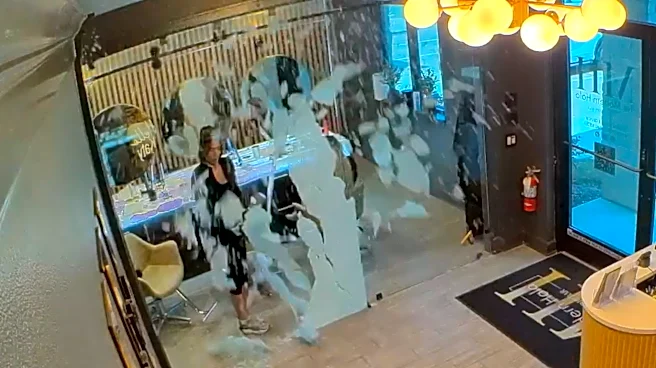






A new employee at a Texas salon was stunned when the glass sliding door she was closing exploded.
But her immediate reaction was even more surprising for those watching the now-viral video of the incident.
"Me when I pull the door handle and it shatters," she deadpanned, surrounded by broken glass as her eyes scanned the damage in disbelief. On social media platforms like X, users called her turn of phrase "insane," "incredible" and the "funniest thing she possibly could have said."
"Maybe one of the greatest things anyone has ever said seconds after completely shattering a glass door," one user quipped. "One of the best 'me when' of all time," another wrote.
But it also sparked a conversation on how social media has impacted the way young people
speak, with some experts referring to this lingo as "Gen Z speak."
"Social media has changed the structure of communication itself," explained Dr. Don Grant, a media psychologist who researches social media and adolescence. "Gen Z isn't just consuming memes. Many have become fluent enough in meme culture that they occasionally think, react and even speak in meme structures during everyday life."
'Gen Z speak' and how the internet shapes slang
One commenter on the viral video said that they can "just tell when people use Twitter."
Social slang has existed in every generation, but the virality and speed of the internet have accelerated the way Gen Z and Gen Alpha’s slang spreads and evolves. For those who grew up using online, viral tweets or Instagram posts crept into everyday language.
"Young people are increasingly speaking in formats that originated online, such as reaction memes, captions, screenshots, and short-form video conventions," Grant said. "In some cases, they're not just using internet language, they're organizing their thoughts through internet language."
Popular phrases that originated online but entered the mainstream can include "me when," "POV," "it's giving," "not me" and "the way that," according to Grant. Instead of speaking in traditional conversational formats, people may use this "internet-native language" and frame their speech in the structure of memes, captions, reaction posts and short-form videos.
This is, in part, due to Gen Z "viewing experiences through a lens of potential shareability," Grant added. "The immediate reaction is sometimes not simply, 'What just happened?' but also, 'How would this moment be captioned, understood, or joked about online?'"
This can lead to people "narrating events as if they're already content," he explained. However, this is not a phenomenon unique to Gen Z − it's part of a broader discussion on how the internet impacts culture across generations.
People use humor to cope with stressful situations
The salon worker's reaction − though comical or strange to some viewers − is actually not that atypical. After a potentially traumatic or frightful event, the brain needs a moment to process the situation and determine if there is an actual danger, Grant explained.
Part of what drew viewers into the video was the seemingly humorous reaction to a scary event.
"Witness the mind seamlessly incorporate a traumatic event into the self-concept in realtime," one user wrote on X while reposting the video.
But it's not uncommon to lean on humor. Amy Morin, psychotherapist and author of "The Mental Strength Playbook," previously told USA TODAY that using humor can be a strong coping skill, and a "strategic way to deal with social awkwardness."
Cracking a joke can also help someone "regain emotional control and reduce stress" in a stressful moment, according to Grant.
"In this case, the woman appears momentarily stunned and then produces a humorous observation before transitioning to assessing safety," he said. "That sequence is not unusual. The brain is attempting to make sense of an unexpected event while simultaneously regulating (emotions)."
Contributing: Rachel Hale
This article originally appeared on USA TODAY: A scary moment in a salon and why it's sparking a conversation about Gen Z lingo