


Whether it’s Miami complaining about a trip to Stanford or Southern California grumbling about a cross-country trek to Rutgers, college football’s expansive and largely unnecessary conference realignment has created travel headaches from coast to coast.
But none of those inconveniences can hold a candle to what Hawai'i is about to do.
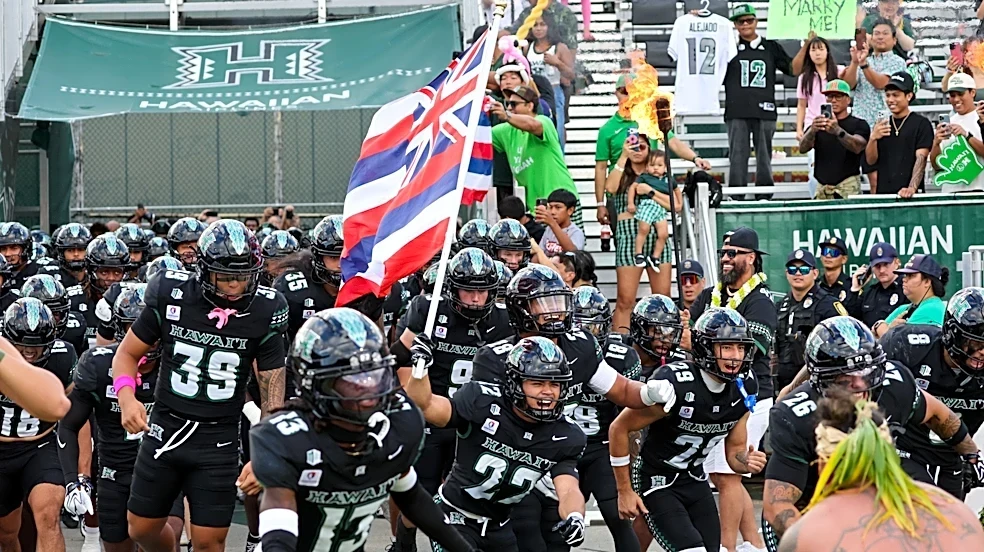
The Rainbow Warriors are accustomed to marathon trips to the mainland. This one, however, is particularly absurd: Hawaiʻi will travel from Honolulu to DeKalb, Illinois, to face Northern Illinois in a Mountain West conference game.
The 4,255-mile trip will
be the farthest any FBS team has traveled to play a conference game in the United States.
Long-distance travel is nothing new for Hawaiʻi, which sits roughly 2,400 miles from the continental U.S. The Rainbow Warriors have made 25 trips of more than 4,000 miles for games.
What makes this one different is why Hawaiʻi is traveling so far. Its first game in Illinois will come in Week 8 because, somehow, Northern Illinois is now a conference opponent.
Chalk it up as another absurd consequence of conference realignment. Northern Illinois joined the Mountain West despite DeKalb being nowhere near the Mountain West, geographically or topographically. The Huskies left the MAC in hopes of expanding their brand and generating more revenue, while the Mountain West needed new members after several schools departed for the rebuilt Pac-12.
The result? Even the most travel-tested program in college football is finding new ways to rack up the frequent-flyer miles.

Hawaiʻi's plans for longest conference game travel
Hawaiʻi’s typical road routine is straightforward: Leave Thursday morning before a Saturday game and arrive by that evening.
This trip requires a little more work.
Hawaiʻi will leave Oahu at 10 p.m. local time Wednesday, Oct. 21, fly to Oakland for a brief refueling stop, then return to the air and land in Chicago around 1:30 p.m. Central on Thursday, Oct. 22, Hawaiʻi spokesperson Neal Iwamoto told USA TODAY Sports.
In all, it’s about 10½ hours of travel.
“Obviously the flight sucks,” quarterback Micah Alejado said.
Which is why Hawaiʻi plans almost everything that happens aboard it.
Director of football sports performance Bobby Thomas crafted a schedule that calls for players to eat before boarding and again about an hour after takeoff. Around 11:30 p.m. Hawaiʻi time, players will try to sleep, aided by sleep packs containing items such as magnesium and melatonin.
Iwamoto said refueling is common for Hawaiʻi on trips beyond the Rocky Mountains. The Oakland stop takes roughly 45 minutes, and nobody has to leave the plane. Around the midpoint of the Oakland-to-Chicago leg, the team will eat again to prepare for landing.
“We know these things are going to happen, so we prepare the way we do,” coach Timmy Chang said. “We schedule the things the way we do, and we give our guys the best chance to go out there and execute and be prepared on Saturday.”
And the journey isn’t over when the plane touches down.
Northern Illinois is more than an hour from the airport, so Hawaiʻi will stay in Naperville rather than near campus. The Rainbow Warriors will make the roughly 45-minute drive to DeKalb only for the game, Iwamoto said.
If that sounds exhausting, well, welcome to Hawaiʻi football.
“We’re not one to make excuses and this and that,” Iwamoto said. “But you’re right, it is a grind. There’s no doubt about that.”
When every road game begins with at least a five-hour flight, you learn a few things about traveling.
Outside of this being a conference game in the middle of the season, Iwamoto said the logistics aren’t drastically different from Hawaiʻi’s other trips this year, including games at Wyoming and UTEP.
That expertise suddenly became valuable when conferences such as the Big Ten, ACC and Big 12 stretched from one side of the country to the other. Iwamoto said athletic departments regularly called Hawaiʻi looking for advice on how to handle long-distance travel.
Few programs know how to live out of a suitcase better. The trick is turning all those frequent-flyer miles into wins.
Hawaiʻi is 5-20 when traveling more than 4,000 miles for a game, including losses in its past three and seven of its past eight. Of those 20 defeats, 16 came by at least 20 points.
Three of the five victories came at Louisiana Tech during the WAC days, Army in 2010 and UMass in 2017. That UMass trip, coincidentally, was the farthest Hawaiʻi has ever traveled for a game in the United States at 5,095 miles.
Ending its recent long-haul losing streak would come at an especially good time. Hawaiʻi is 1-6, its worst start since 2013, but draws a Northern Illinois team that is one of only two winless programs in FBS, along with UL Monroe.
The trip will be brutal. A first Mountain West victory, earned in perhaps the most geographically unlikely place imaginable, would make those 10½ hours in the air feel a little more worthwhile.
“It’s a great opportunity traveling that far and seeing places that we never saw,” Alejado said. “But up there to handle business and try to get back on track.”
This article originally appeared on USA TODAY: Hawaiʻi is about to travel 4,255 miles for college football’s strangest conference game