




The First Amendment does not come with an antitrust loophole. President Donald Trump’s Justice Department nonetheless appears determined to find one.
The Justice Department’s Antitrust Division recently launched an investigation into five major television networks – ABC, CBS, CNN, NBC and Fox News – under the Sherman Antitrust Act, a federal law prohibiting agreements that unlawfully restrict competition. Their alleged offense? Briefly suspending their shared White House coverage in protest after the administration abruptly revoked press credentials for reporters from CNN, MS NOW and Politico.
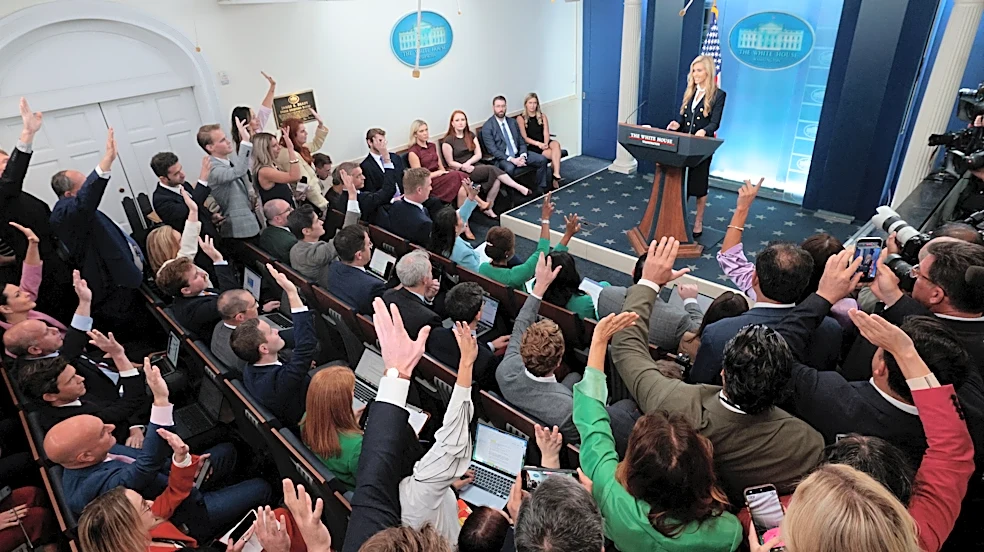
The networks take turns recording presidential events and sharing the footage, an arrangement known as pool coverage. The Justice Department says it is
investigating a group boycott among commercial competitors. However, the reported circumstances point to something else: retaliation against constitutionally protected protest, with the investigation itself serving as punishment.
The First Amendment protects private news organizations’ editorial discretion, giving them freedom to decide what to cover and publish. In landmark cases such as Miami Herald Publishing Co. v. Tornillo, the Supreme Court made clear that government cannot compel newspapers to carry speech against their will.
Right to publish is also a right not to publish

When the networks suspended pool coverage, they were not conspiring to manipulate prices or exclude rival news organizations. They were conducting a politically motivated, nonviolent boycott in solidarity with their banned colleagues. The Supreme Court has long recognized constitutional protection for such protests, including in NAACP v. Claiborne Hardware Co.
News organizations must obey antitrust laws, and a political message does not automatically protect an otherwise unlawful commercial agreement. But rebranding a collective defense of press freedom as a Sherman Act violation misuses a law designed to protect competition and consumers.
Antitrust enforcement should not force media organizations to provide a platform for the government.
This investigation represents a dangerous evolution of what has been called the “new jawboning,” or censorship by proxy: using regulatory threats to pressure private organizations into suppressing speech.
Presidential administrations increasingly recognize the constitutional barriers to direct censorship. To get around them, they use the broad authority of regulatory agencies, including the Federal Trade Commission, Federal Communications Commission and now the Justice Department, to pressure the companies through which Americans receive news and exchange ideas.
The government need not win a lengthy court battle for this pressure to work. Federal antitrust investigations can impose substantial legal costs, exhaustive document demands and public pressure. Those burdens can change editorial judgments, discourage future dissent and push networks toward compliance.
As the Supreme Court reaffirmed in National Rifle Association v. Vullo, government officials cannot use their authority to coerce private parties into punishing or suppressing views the government disfavors.
Calling that pressure law enforcement does not erase the constitutional problem.
News media must be free to make mistakes

The marketplace of ideas depends on independent organizations making editorial decisions without government direction. That system is imperfect. News outlets make mistakes, show bias and exercise judgment that readers and viewers may reasonably question.
But as the Supreme Court explained in Moody v. NetChoice, the worst alternative would be to let government decide when speech is “imbalanced” and use its power to rebalance it. Americans should judge competing voices for themselves, rather than let officials decide which voices deserve a platform.
The administration cannot credibly champion free speech while deploying the Justice Department to punish media outlets for exercising their constitutional rights. If every joint editorial stand invites an antitrust investigation, press independence becomes conditional on avoiding the president’s displeasure.
The public, and courts if necessary, should recognize this investigation for what the reported facts suggest: an attempt to disguise retaliation against the press as antitrust enforcement. Protecting freedom of speech requires more than stopping outright censorship. It also requires preventing officials from using regulatory harassment to shape public debate.
That principle should hold, regardless of who occupies the White House or which networks face scrutiny. The freedom to challenge the government cannot depend on whether officials approve of the challenge.
Ben Sperry is lead counsel and a senior scholar at the International Center for Law and Economics.
This article originally appeared on USA TODAY: Trump's DOJ is using antitrust law to punish the free press | Opinion