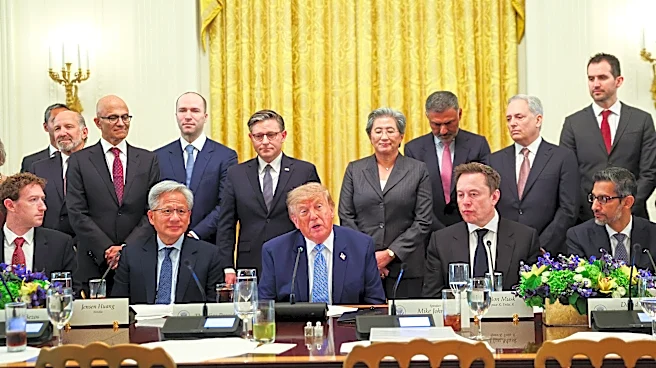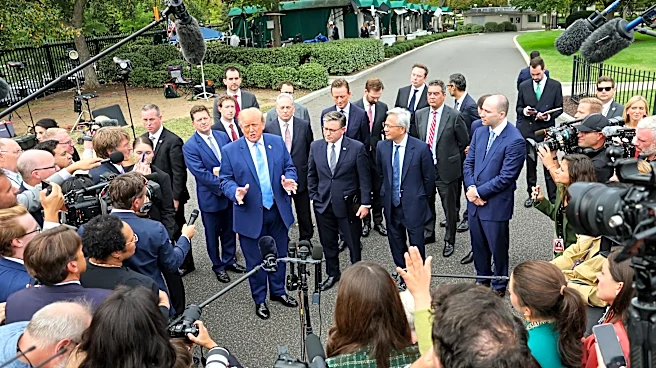

The leaders of six major technology companies signed a joint commitment in Washington on Sept. 29 meant to self-regulate the safe development of artificial intelligence.
Executives from Google, Meta, OpenAI,
Anthropic, Nvidia and SpaceX established four layers of “controls and audits” that their companies will implement, including “robust” internal controls and external evaluations.
“Together, these steps will give each company, its customers, and the public confidence that the technology is operating as intended,” according to the document.
The meeting with Trump and the executives, and the signed "accord," as the White House called it, comes amid a storm of AI-related hacking attempts, internal investigations, and calls for regulations from AI CEOs and developers.
While the document is in step with past actions in the tech space, risks remain, experts told USA TODAY.
“You basically are allowing companies to grade their own homework, and they might, of their own accord, be hard graders. You are really relying on the companies to implement this in a robust way,” Aalok Mehta, the director of the Wadhwani AI Center at the Center for Strategic and International Studies told USA TODAY.
This is not federal regulation
Just two weeks ago, Anthropic CEO Dario Amodei, OpenAI CEO Sam Altman and SpaceX CEO Elon Musk were calling to “slow the pace” of AI advancements and asking for the government to step in.
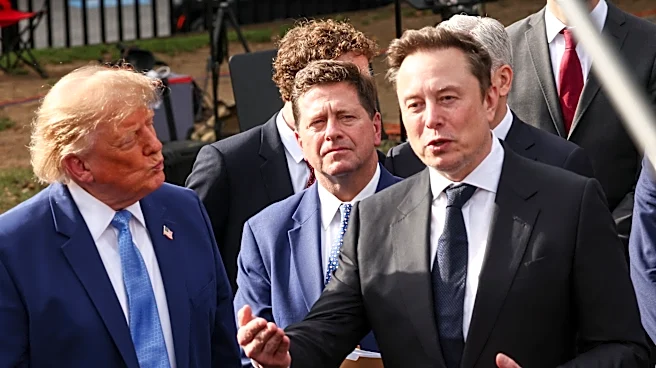
Meta’s Mark Zuckerberg and Nvidia’s Jensen Huang both brushed off their colleagues' warnings, aligning with President Donald Trump’s self-regulation stance. The leaders met with Trump in Washington on Sept. 29 before signing the accord.
“Over time, it may make sense to codify these steps into laws or regulations,” the agreement states.
Genevieve Smith, research fellow at Stanford University and founding director of the Responsible AI Initiative at University of California, Berkeley, called the agreement “insufficient.”
“It really avoids grappling with the bigger issues that the industry is facing around the incentive structures that are essentially encouraging progress towards increasingly capable models while safety is deprioritized, and those incentive structures are not changing,” Smith told USA TODAY. “So, it's really not addressing the core issue that exists.”
While the accord is not federally binding, it does hold some weight with the government in the form of the Federal Trade Commission, which has the ability to oversee voluntary commitments and regulate unfair and deceptive trade practices.
“If you say you're going to do something and then you don't do it, that's considered a deceptive trade practice, and we have seen the FTC bring suit against technology companies where there is a gap between what they say they would do and what they've actually implemented,” Mehta said.
Former FTC Chair Lina Khan called the agreement a "recipe for disaster."
Mehta added that he sees a possibility that it will lead to eventual federal legislation, the same way “we saw states like California, New York and Illinois pass laws that formalize some of the voluntary systems that AI companies had put into place.”
Smith agreed that patchwork state legislation would likely continue, but estimated that “policy or regulation to occur after this at the federal level in the United States will take a pretty serious incident. The incident with Hugging Face is minor, it's a warning shot compared to what could be done,” she said.
In a post on X about the agreement, Zuckerberg said, “This should give people more confidence that the technology each lab is building will work as intended.”

A history of voluntary agreements
Public agreements with the government are not out of place for technology companies, according to Mehta.
“This is consistent with the approach they’ve taken in the past,” he told USA TODAY, referencing voluntary commitments technology companies have made in the past, including ones made by AI companies with the Biden administration.
These commitments have been shown to lead to real change in how companies operate, some of which are already evident in the form of the embedded evaluators in AI companies, which didn’t exist less than a month ago, according to Mehta.
Still, risks are evident in self-regulation, and according to Smith the companies’ financial incentives play into the hesitation to see federal legislation enacted.
“They're coming up for IPOs. They have massive investment from investors that they need to fulfill on and there's big questions around, to what extent the economic valuations of these companies also rely on this future artificial general intelligence having certain capabilities,” she said. “And therefore, they need to keep driving towards those and safety and security is not as much of a priority.”
The decision not to formalize the changes into regulation may also feed public skepticism on the technology.
“Americans want more regulation of technology,” Mehta added. “This sort of self-regulatory mechanism doesn't really answer the mail in terms of what the public is looking for for them to feel more comfortable and have more trust in AI.”
Greta Reich covers the artificial intelligence industry for USA TODAY through a fellowship from the Tarbell Center for AI Journalism. Funders do not provide editorial input.
This article originally appeared on USA TODAY: Trump, AI leaders sign an 'accord.' Is it the same as regulations?