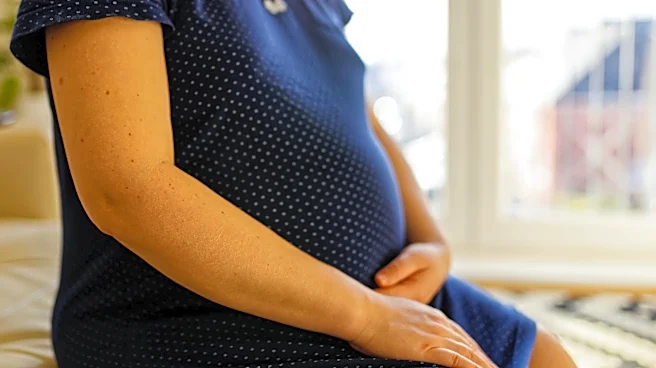

A British news show host announced she’s pregnant at age 59, leaving her co-hosts speechless on live television.
Dr. Renée Hoenderkamp, a GB News co-host and National Health Service nurse practitioner,
revealed during a Nov. 14 broadcast that she’s 12 weeks pregnant with her third child, nearly four decades after the birth of her first.
“I’m a mother of a grown-up boy and a very young girl. And I have some news to break to the panel today that they’re not aware of or anybody else for that matter: I’m actually going to be a mother of three shortly,” Hoenderkamp said during the show.
Hoenderkamp is mom to 37-year-old Calum and an 8-year-old Alice.
While the news clearly stunned her co-hosts and many who saw the news online responded with similar levels of surprise, in recent years, research shows that more and more women are having kids into their 40s and 50s.
For example, in the United States, while birth rates are down, fertility rates have risen among women 40 and older. From 2023 to 2024, birth rates declined for women aged 15-34, stayed unchanged for women aged 35-39 and rose 2% for women aged 40-44, according to data released in July of 2025.
Famous faces like Anne Hathaway, 44, and Hilary Swank, 52, have also made headlines in recent months for their pregnancies. Swank who is expecting her third child, addressed shock over her pregnancy during a Nov. 17 appearance on U.K. show "This Morning": “It’s time to get with the times! We’re so advanced in our world, people are living so much longer, you know, and so many women are wanting to wait until later. It’s becoming quite a normal thing to have children later.”
‘The double standard is hard to miss’
Later in the broadcast, Hoenderkamp explained that she had frozen eggs in her 30s and traveled to Poland to have the eggs implanted through in vitro fertilization.
Since her announcement, Hoenderkamp hit back on comments calling her selfish, sharing that she feels more prepared to be a mother now than in her youth.
“Now I am back (online), for all of the thousands of messages congratulating me on the news of my new daughter - THANK YOU!!!! For the rest - I don’t care what you think,” she wrote in a Nov. 15 post on X.
She spoke out further in essays she penned for the Daily Mail and GB News on Nov. 17, in which she shared that she had her first child when she was 21 and her second child at 51.
She wrote, “I know I have been a better mother in my fifties than when I was 21,” explaining that “age, wisdom, patience and financial stability do make for better parenting.”
Hoenderkamp wrote that the reaction to the news has been “interesting.”
“Alongside the kind messages there have been words like ‘disgusting,’ ‘revolting,’ ‘selfish’ and ‘wrong,’” Hoenderkamp said. “The objection appears to rest on a number on a birth certificate.”
She pointed out that the baby’s father is now 66, but “almost no one” has commented on his age.
“He has been able, because of the stage of life he is in, to be a present father rather than the man who brings home the money and is rarely seen,” Hoenderkamp wrote. “Society rarely objects when men become fathers at 70 or 80. The double standard is hard to miss.”
What to know about later-in-life pregnancies
Family planning is personal, and there are myriad reasons why more women are waiting to have kids, Dr. Lora Shahine, a reproductive endocrinologist at Ivy Fertility’s Pacific Northwest Fertility clinic in Seattle, previously told USA TODAY. A 2022 survey from the Institute for Family Studies found that among women aged 18-55 who want more children, 44% cited not finding the right partner as a barrier, 36% cited affordability and 25% cited lifestyle or career.
Factors like affordability and lack of familial support can impact that decision.
Shahine said she sees a lot of women who are trying to plan their pregnancies several years, or even a decade, in advance and making "really thoughtful decisions about when and how they build their family." Some of them are scared about the health risks involved in older pregnancies.
While it's routine and possible for women to have children in their 40s, Shahine said age does impact fertility and how long it might take to get pregnant, including the risk of miscarriage.
"I think there's a common assumption that fertility treatment can overcome anything," Shahine said.
And women who become pregnant later in life face increased risks of gestational diabetes and preeclampsia, as well as complications that require cesarean delivery, according to John Hopkins Medicine. The risk of miscarriage, frequently due to fetal chromosomal abnormalities, also increases with age, as do preterm birth and stillbirth.
Egg freezing and in-vitro fertilization are important tools to help with fertility struggles in older mothers, Danielle Melfi, CEO of Resolve, a fertility patient advocacy group, previously told USA TODAY. More women are choosing to freeze their eggs than ever before, she said.
"While egg freezing isn't a guarantee," Melfi said, "it does help women feel like they have more time to make some of these decisions."
Everyone is different, Shahine said, and women shouldn't make assumptions about their fertility based on the women in their family who have become mothers before them.
"Our biggest piece of advice is consulting with your doctor," Melfi said.
Rachel Hale’s role covering Youth Mental Health at USA TODAY is supported by a partnership with Pivotal and Journalism Funding Partners. Funders do not provide editorial input. Reach her at rhale@usatoday.com and @rachelleighhaleon X.
Madeline Mitchell's role covering women and the caregiving economy at USA TODAY is supported by a partnership with Pivotal and Journalism Funding Partners. Funders do not provide editorial input. Reach Madeline at memitchell@usatoday.com and @maddiemitch_ on X.
This article originally appeared on USA TODAY: A TV host announced she's pregnant at 59. How motherhood is changing