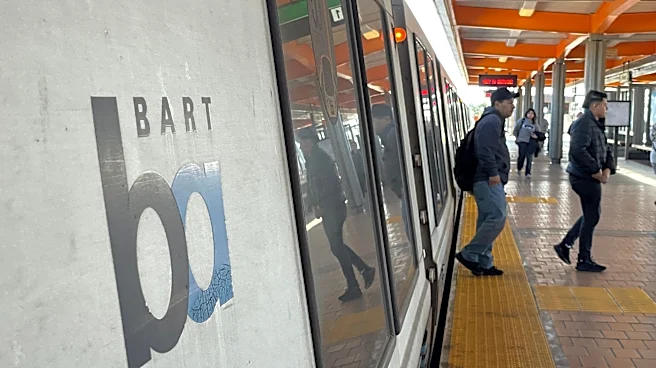







Bay Area residents who frequently travel across the Bay Bridge may see their commutes nearly double if the region's transit systems fail to secure new funding and instead enter a "fiscal death spiral," a new report finds.
The San Francisco Bay Area Planning and Urban Research Association (SPUR) released a report on Tuesday, Sept. 22, evaluating the potential consequences for regional traffic if the Bay Area's largest transit systems - Bay Area Rapid Transit (BART), Caltrain, Muni, and Alameda-Contra Costa Transit District - have to cut service as a result of two new funding-source ballot measures failing to pass in November.
"The impacts would be dramatic," the report reads. "Our analysis finds that reduced transit service would push more people
into cars, worsening congestion on already-strained highways and increasing travel distances, parkingdemand, driving costs, and greenhouse gas emissions."

For years, the Bay Area's regional transit system has struggled to maintain consistent ridership and rebound to pre-pandemic utilization levels. As a result, several major transit systems face significant financial challenges that didn't become apparent to the public until earlier this year, when BART, Muni, and Caltrain announced plans to cut service to meet their reduced budgets.
To address these budgetary shortfalls, Bay Area residents will have the opportunity to vote on Regional Transit Measure, which would create a five-county tax and generate close to $1 billion annually for the next 14 years, and Proposition H, which would create a new property tax that would generate $177 million annually to help fund the San Francisco Municipal Transportation Agency for the next 15 years.
If these two propositions pass, the new tax will help address much of the financial deficit BART, Muni, Caltrain and AC Transit face.
However, the San Francisco Bay Area Planning and Urban Research Association wanted to evaluate the potential long-term effects on the region's traffic, transit system, and quality of life if these propositions do not pass this November.
The biggest repercussions of a decline in the Bay Area transit system would be a significant spike in traffic delays for Bay Area residents, especially at major highway bottlenecks, including the Bay Bridge, the Caldecott Tunnel, and along I-580, I-680, I-880, State Route 4, and U.S. 101.
"Some transit riders could have to drive an average of 10 additional miles each way simply to reach an open station," the report reads.
Regardless of which highway residents use, the report estimates that, on average, drivers should expect their commute delays through one of these designated "bottlenecks" to double. For example, drivers commuting on I-680 for their a.m. or p.m. route should expect an additional 15 to 20 minutes beyond their normal daily delays.
"Across the region, transit cuts could generate 498 million additional vehicle miles traveled each year — the equivalent of adding 68,200 vehicles to the road — and produce another 184,000 metric tons of carbon dioxide annually," the report reads.
Additionally, SPUR estimates that the average Bay Area transit rider will likely see costs increase by an additional $3,280 per year if they shift to vehicle transportation.
The report estimates that close to 430,000 people living near a BART or Caltrain station could lose access to their nearest stations if these agencies fail to find a new funding source, which would likely result in "low-income communities that rely heavily on public transportation would be disproportionately impacted."
In response to SPUR's report, San Francisco Mayor Daniel Lurie reaffirmed his support for Prop H and Prop RTM, noting that the report "confirms what we all know, and that is we have to pass Prop H and the Regional Transit Measure."
"They are essential to our economic recovery. And what we learned from this report is that traffic will increase exponentially for those that commute into San Francisco," Lurie said.
"More traffic means longer commutes, higher costs for families, and a direct threat to our economic recovery."
However, not everyone is sold on SPUR's findings.
Gregg Dieguez, president of the Committee for Affordable Bay Area Transit, a local group that opposes the measures, told NBC Bay Area that "we want fixes before funding."
Dieguez questioned why the report did not explore alternative ways to close the transit agencies' funding gap by reallocating funds.
"Before asking Bay Area residents for another $1.2 billion a year, the transit establishment should demonstrate that it has considered the full range of lower-cost transportation revenue and network design alternatives," Dieguez told NBC Bay Area.
Noe Padilla is a Northern California Reporter for USA Today. Contact him at npadilla@usatodayco.com, follow him on X @1NoePadilla or on Bluesky @noepadilla.bsky.social. Sign up for the TODAY Californian newsletter or follow us on Facebook at TODAY Californian.
This article originally appeared on USA TODAY: Bay Area traffic could double if transit measures fail, report finds