
Many actors have epitomized Aileen Wuornos,a hitchhiking sex worker who became one of the most notorious female serial killers.
Jean Smart played the down-on-her-luck killer in the 1992 TV movie "Overkill:
The Aileen Wuornos Story." Charlize Theron earned an Oscar for her unrecognizable turn in "Monster." And most recently, Sarah Paulson played the foul-mouthed Wuornos in "Monster: Lizzie Borden Story." Several documentaries have also been released, including "Unmasking A Monster: Aileen Wuornos," which blurs the line between Artificial Intelligence and an actor's performance.
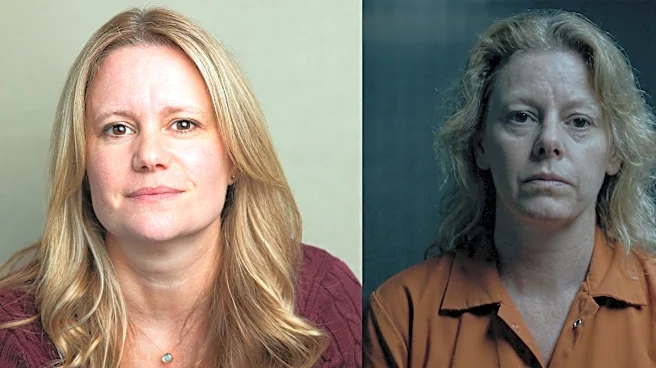
Investigation Discovery's "Unmasking A Monster: Aileen Wuornos" (airing on ID and HBO Max on Sept. 30 at 8 p.m ET/PT) used VFX techniques and digital replication to bring the killer to life, reenacting jail cell calls, her testimony in an interrogation room and childhood memories. In the three-part documentary, produced for Investigation Discovery by Arrow Media (a Fremantle company), actor Morag Peacock played Wuornos; her performance was molded around a "digital mask" and based on archival transcripts, documented evidence and firsthand accounts.
In 2019, ID released "Aileen Wuornos: Mind of a Monster," without help from AI. When asked how the documentary will affect the push toward more AI projects, Stephen Dost, vice president of content at Arrow Media, countered that AI cannot act alone, but it can "take something real and transform it."
"I would draw a clear line between what we're doing and something like [AI actor] Tilly Norwood, which I think is awful," Dost says. "They are clearly trying to straight up replace actors. People do not want actors replaced. We love actors."
Creating a 'digital mask' of Aileen Wuornos
Wuornos had a dark childhood, rife with poverty, child abuse and neglect. At a young age, she began working as a prostitute, pocketing cash for drugs, cigarettes and food. Although admitting to seven killings, Wuornos wasconvicted of murdering six menalong Florida highways in 1989 and 1990 and sentenced to death. In 2002, Wuornos was executed by lethal injection at Florida State Prison.
Over the course of three years, the production team used AI to motion capture Peacock's every detail, like her facial expressions and her movements, to create a digital likeness. When signing on to the project, Peacock, a member of the United Kingdom's arts and entertainment union Equity, had no prior experience working with AI, not even for personal use.
"I'm either too much of a boomer or I'm just not up with the trends," Peacock quips.
After learning about how AI was used for the project, she welcomed the opportunity to match the killer's mannerisms, from the way Wuornos smiled to how she raised her eyebrows.

"It was clear that this project is trying to get something as close to her as possible," Peacock tells USA TODAY. "So that was a challenge for me."
After viewing a part of the digital replica, Peacock admits it was "strange," identifying parts of herself like her brown beady eyes, from the digitized serial killer. Despite this, she stands behind her digital performance.
"I'm not a fool," Peacock says. "I know some people will not like this at all and there'll be others who won't mind. But for me, it was just important that it sat right with me and my boundaries."

Who is wearing a 'digital mask?'
Along with Peacock's portrayal of Wuornos, "Unmasking A Monster: Aileen Wuornos" applies a digital mask to other performers like the actors portraying childhood friend Dawn Botkins, Wuornos' defense attorney Steven Glazer, and investigators Brian Jarvis and David Taylor.
"Think of it as a three-dimensional mask," Dost tells USA TODAY. "What it does is it translates one for one every single thing that she does, as if on the day we had an amazing prosthetic and wig and could make it look exactly like her. Even prosthetics aren't capable of doing that because that's about bone structure; it's about things that you can't change with makeup."
The production team received consent from both the people, along with the actors taking on the real-life roles. The documentary also prompts the viewer when generative VFX was not used to portray a character. For example, they did not use AI to depict Tyria Moore, the girlfriend of Wuornos, and Mike Joyner, an undercover cop. They did not receive their permission, Dost adds.
Documentaries have adopted AI technology before. Anthony Bourdain documentary "Roadrunner," released in 2021, used AI to clone the late chef and TV host's voice, which received backlash. Netflix's "The Investigation of Lucy Letby" used AI to anonymize contributors in the documentary. The latest Wuornos depiction marks a rare occasion where true crime uses generative VFX to bring archival footage and evidence in a reenacted way, says Jason Sarlanis, the president of ID.
Like their competitors embracing AI, Sarlanis says the best stories are told at the confluence of emerging tech and filmmakers eager to adapt it. Viewers will notice some uncanny moments as "digitally masked" characters interact with real actors and as archived photos awaken from their frames, smiling and laughing. At the very least, he hopes the doc will stir up a conversation.
"This is very handcrafted," he says, "even though one of the tools used to craft it is AI."
This article originally appeared on USA TODAY: New doc uses AI to bring serial killer Aileen Wuornos to life. The results are controversial