




Elle Crofton was 37 when she finally held her son.
Twelve years earlier, she spent her 25th birthday waiting at The University of Texas MD Anderson Cancer Center for doctors to confirm what earlier tests had already suggested. The exhaustion she had blamed on 70-hour work weeks and intense CrossFit workouts wasn't burnout.
It was myelodysplastic syndrome, a rare bone marrow cancer most often diagnosed in men over 65.
Chemotherapy and a stem cell transplant offered Crofton the best chance of surviving. But they also threatened her chances of becoming a mother.
“It was going to be really heartbreaking if this didn't work,” Crofton, now 38, says of trying IVF. “The mental load was heavy.”
As more young adults are diagnosed with cancers that once largely
affected older adults, young people like Crofton are facing unexpected questions in their twenties about preserving their fertility ahead of treatment. From 2010 to 2019, the incidence of 14 cancer types increased among people younger than 50, according to the National Cancer Institute. There's no exact cause known for the rise in cancers among young people, according to UChicago Medicine, but researchers are trying to figure it out.
“Knowing that a stem cell transplant was in my future at some point, and knowing that involved really intense chemotherapy, I think that's where I started thinking about fertility and thinking about the future,” Crofton says.
Though the cancer mortality rate has declined for decades, an increasing number of young adults are being diagnosed. About 80,000 adults aged 20 to 39 are diagnosed with cancer in the United States each year.
Both the cancer itself and the treatments to fight the disease can impact the reproductive system, according to Terri Woodard, a professor in the Department of Gynecologic Oncology and Reproductive Medicine at MD Anderson Cancer Center who leads the center’s Oncofertility program.
Ovarian, testicular, and uterine, cervical and endometrial cancers may affect reproductive organs and a person's ability to carry a pregnancy, while chemotherapy and radiation can damage eggs and sperm or injure reproductive tissues.
“When I'm talking to people, there are quite a few of them that don't realize it's an issue in the context of their cancer diagnosis,” Woodard says. “They're like, oh my gosh, I've never even thought about that.”
‘We weren't really sure it would even work’
When Crofton froze her eggs in 2015, fertility preservation was still an emerging part of cancer care. Woodard says egg freezing has since become commonplace, and fertility preservation has become increasingly integrated into cancer care in the past decade. Major cancer centers have launched programs dedicated to fertility, including Johns Hopkins in 2021 and NYU Langone in 2024.
Woodard emphasizes that talking about fertility preservation isn’t a commitment to being a parent. It’s about leaving the possibility open.
“There are even people that will flat out say ‘no, we weren't intending to have kids, this was not even on the radar, but now that this is here, I don't want to give up that potential opportunity,’” Woodard says. “Fear of regret is one of the biggest drivers of all of this.”
On the other hand, even if patients don’t decide to freeze their eggs, Woodard says it’s a misconception that they’ll never be able to have children, and that they’re immune to needing contraception. She’s seen patients still get pregnant spontaneously, while others have successfully used donor eggs or embryos or adoption.
Crofton, an early childhood educator who spent years working as a nanny, always knew she wanted children. So when she learned cancer could affect her fertility, she worked with Woodard and the team at MD Anderson to freeze her eggs.
The summer after she was diagnosed in May 2013, Crofton began taking a maintenance drug that doctors hoped would stabilize her condition for five years. She thought she had time before needing a stem cell transplant. But after 18 months, the drug stopped working.
As her body struggled to produce healthy red blood cells, her condition worsened, and a stem cell transplant became urgent. That also meant she needed to quickly think through her fertility process.
“The conversation was also like, can I manage a whole IVF cycle of saving eggs and not get too sick?” Crofton says. “I can't have a child if I'm not even alive.”
While factors like age, timing and cost all impact fertility preservation, specialists typically aim to freeze as many eggs as possible. Eggs can be lost at each stage of the process, from thawing to fertilization and embryo development, before resulting in a successful pregnancy.
For cancer patients, however, time is often limited. Chemotherapy or stem cell transplants can’t always be delayed long enough for multiple egg retrieval cycles before treatment begins, according to Woodard.
Women in their early 30s generally need about 14 mature eggs for a roughly 70% chance of one live birth, according to one estimate cited by the American Society for Reproductive Medicine.
The financial burden can also be a barrier. A single egg-freezing cycle typically costs between $8,000 to $12,000 dollars, and insurance rarely covers it, according to Woodard.
“For the majority of people this is coming out of their pocket, and especially if they're young, they might be in school or just starting out, they don't have these extra funds to pay thousands of dollars for egg freezing,” Woodard says.
Woodard says these costs, between the process, storage, shipping and eventually the warming, creation and transfer of the embryo can run between $15,000 and $20,000.
In March of 2015, Crofton’s team delayed the transplant long enough for her to complete one egg retrieval cycle, which yielded nine eggs. Doctors explained to her that the chances for success were uncertain, adding another layer of stress to an overwhelming process. Crofton says she even wondered whether, if she couldn’t have children, it would become too painful to continue her career path working with kids.
“We weren't really sure it would even work,” Crofton says. “The process is stressful for most people, but it kind of just added this layer of unknowing to it.”
Why fertility conversations matter
Over the following years, Crofton completed treatment, moved from Houston, where she had been living at her parents during treatment, back to Philadelphia, and arranged to have her frozen eggs shipped across the country. Her cancer changed the parenting timeline she had once imagined for herself.
“From 27 to 30 I was living at home, recuperating, regaining my life back,” Crofton says. “When I moved back to Philly, I was like, ‘Oh my God, all of my friends are partnered. All of my friends have houses, or are in the process of living with their partners.”
By age 35, she decided she didn’t want to wait any longer to become a parent, even if she was doing it on her own. After choosing a sperm donor, she had her frozen eggs thawed a few weeks before her 37th birthday.
Ultimately, three eggs survived the thaw and were fertilized with donor sperm. Of those, just one developed into a viable embryo suitable for transfer into her uterus.

That one embryo went on to become her son, Harry.
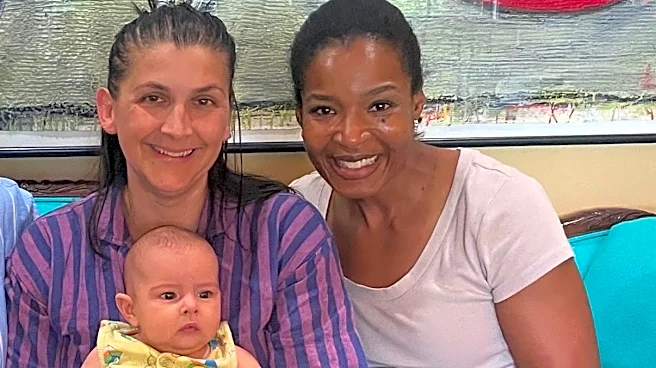
On May 30, Woodard rang the doorbell of Crofton’s parents’ house in Houston to meet him.
Standing before her was Crofton and a baby with the “biggest cheeks” and “the most chunky legs.” In that moment, Woodard recalled the determined 25-year-old she had met more than a decade earlier.
“Talk about delayed gratification,” Woodard says. “I just couldn't be more thrilled for her.”
Rachel Hale’s role covering Youth Mental Health at USA TODAY is supported by a partnership with Pivotal and Journalism Funding Partners. Funders do not provide editorial input.
Reach her at rhale@usatoday.com and @rachelleighhale on X.
This article originally appeared on USA TODAY: She was thinking about her future. Cancer made fertility an emergency