



Editor's note: This column is part of Changing Minds, a USA TODAY Opinion series. Ahead of the November midterm elections, we talked with people who changed their political beliefs after years of seeing things a certain way. We'll publish their stories over the next few days.
Lewis Cantwell, who goes by his middle name Easton, is the Forrest Gump of an alternative universe.
Like the character portrayed by Tom Hanks in the eponymous movie, Cantwell tells an epic tale that starts with being born in a Southern town, includes a stint in the military, sees him repeatedly romantically stymied, features a remarkable foot journey, and puts him – unintentionally, he insists – in the middle of history.
Also like Gump, Cantwell remade himself through a series
of different professions and business ventures – though his plot had less of Gump’s fortuitous falling up and more oscillating peaks and valleys – such as when federal prosecutors presented video evidence of him in the middle of a mob battling police at the U.S. Capitol on Jan. 6, 2021. And when President Donald Trump pardoned him and more than a thousand others with convictions linked to the attempted election overthrow.
After regaining full citizenship rights, Cantwell opened a bar selling kava (a nonalcoholic Pacific Island drink). His new establishment is in Asheville, North Carolina – which might seem sensible, given residents’ reputation for wide and varied tastes. But along with restaurants, the city is also known for its progressive politics, and many declined to put out a welcome mat for a Jan. 6 participant.
The backlash came after a negative social media post highlighting his history. Cantwell was pilloried online, and his business was shunned, cutting his sales in half, he said, and forcing him to take on an additional job.
"What did you think would happen if you opened up a place up in Asheville? Next time think twice before storming the capitol," one May 14 Google review read, according to the Asheville Citizen Times.

Cantwell, now 41, calls participating in Jan. 6 “the biggest regret of my life." He also regrets supporting Trump and said he's changed his mind about the integrity of the 2020 election as well as the criminal justice system. While he still holds a mix of conservative and liberal beliefs, he said he no longer wears them on his sleeve.
"I'm not really political anymore," Cantwell said.
He said he tries to maintain that same atmosphere in his kava bar, where patrons – some of whom are his friends – range from far-left liberal to Trump-leaning conservative.
His past, though, continues to haunt him, and while Cantwell said he has tried to explain himself to his critics, he has no good venue to do it.
Cantwell's story includes growing up with 'Kennedy Democrats'

This is the story, as told to me over hours sitting at an outdoor bench (again, Forrest Gump), of the case he is trying to make for himself. It is about how Jan. 6, 2021, changed – and didn’t change – Cantwell, a conservatively raised Floridian who said he had worked as a dancer in a gay nightclub, joined the Army out of tradition, supports gun rights and voted twice for both Presidents Barack Obama and Donald Trump.
“I've always been very socially liberal and very fiscally conservative,” he told me over one of our long meetings at a kava bar, though not the one he owns. “I feel like two gay men should be able to guard their marijuana plants with their AK-47s.”
Cantwell grew up in Fernandina Beach, Florida, in a family, he said, of conservative Baptist “Kennedy Democrats,” many of whom served in the military.
He first voted in 2004, backing wartime Republican President George W. Bush, but soured on him as the Iraq occupation dragged on. In 2008, he voted for Obama, “because it seemed like he was going to induce change.”
'I always considered myself very patriotic'
Living with LGBTQ+ college roommates led Cantwell to question his upbringing regarding morals and sexuality, as did a lucrative stint as a gay nightclub dancer, he said. At 19, he left college and joined the Army, training to be an airborne ranger until he injured his knee.
His tattoos from that time include the phrase "Molon labe,” inspired, Cantwell said, by legendarily defiant ancient Spartan warriors, but whose translation, “Come and take them,” has become a militia-linked anti-gun regulation rallying cry.

“I’ve also got the American flag here and a picture of the Constitution. I always considered myself very patriotic,” he said, defending the tattoo.
He left the Army at 23, twice divorced, with a daughter from the second union. (Cantwell said he was able to reunite with his daughter and they now have a close relationship.)
Jobs and relationships took him around the Southeast for years, where he worked on the 2010 Deepwater Horizon oil spill cleanup and sold semitrucks, RVs and even antiques, he said. In the tiny racially divided town of Ehrhardt, South Carolina, he had mostly Black friends, played on an otherwise all-Black softball team and volunteered for the fire department.
But wherever he lived, drugs and alcohol were consistently part of social life, and at one jobless low point he decided to start over in the mountains of North Carolina, a place he had visited on a camping trip and whose beauty has drawn thousands of recent transplants (including me).
In one of the odder parts of his unusual story, Cantwell told me he ditched a dying car and walked with his girlfriend more than 400 miles, camping and treading on parts of the Appalachian Trail until they reached North Carolina.
Why Cantwell said he went to the US Capitol on Jan. 6, 2021
Eventual economic stability allowed Cantwell to open his first kava bar, Sip' Sum in Haywood County. And when COVID-19 hit in March 2020, the conservative government of Jackson County, where the business had relocated, didn’t impose lockdowns. The maskless operation thrived, he said, drawing customers from Asheville to the east where businesses faced stricter rules.
That same year Cantwell broke up with his girlfriend and, for the second time, voted for Trump.
“I definitely was a huge Trump supporter at the time,” he said, pointing to the first-term Republican’s then-condemnation of “forever wars” and promise of tougher immigration enforcement. Despite the animosity between Obama and Trump, Cantwell insists the two were similar in how they presented themselves as change agents.
When Trump lost to Democrat Joe Biden, Cantwell said he had “serious doubts about the validity of the election."
But it wasn’t Trump's warrantless claims of fraud that motivated Cantwell to go to Washington, DC, that Jan. 6. Rather, he said, it was an invitation from a new girlfriend’s stepfather he wanted to impress.
He recalled for me an uncomfortable eight-hour overnight ride in a rented van with the stepfather’s Christian group that took them to Trump’s "Stop the Steal" rally. Cantwell's description of the Washington landmarks he saw while walking in a “sea” of people made it sound more like a sightseeing tour than an insurrection.
“We’re going around a corner and this lady says, ‘There’s going to be more speakers at the Capitol.' "
Eventually, his girlfriend’s stepfather turned back out of fatigue. Cantwell, who had never been to the Capitol, pushed on. “I thought, I’d love to go and, you know, get a picture," he said.
But then he took to social media and started posting videos, doing so, he said, at the urging of friends who knew he was there.
“I was talking s---. And I should have never been talking s---. And I said, 'Liberty or death.' Just running my mouth.”
Cantwell received one of the harshest J6 sentences
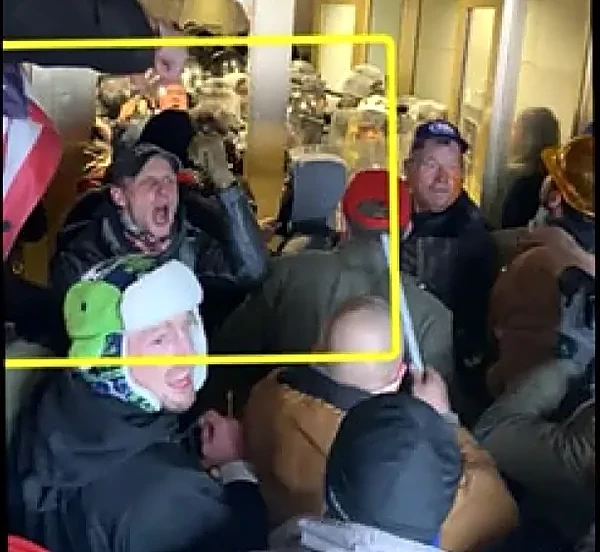
That video became evidence against him. As did another of him in a mob trying to push through police officers in what prosecutors called one of the most violent areas of the riot. Pictures and video show Cantwell raising a fist and yelling, “Fresh patriots to the front.”
At least 174 officers were injured in the riot at the Capitol, with five dying in the days and months that followed, four by suicide.
Cantwell insists much of the evidence was taken out of context, including when prosecutors said he helped “propel” a flagpole toward police but was only keeping it from hitting his head. He also said he didn’t intend to stop the election and didn’t even know Congress was in session. Still, his attorney advised him not to go to trial.

Indicted by a grand jury on six charges, including aiding and abetting civil disorder and obstructing an official proceeding, he pleaded guilty to one: felony obstruction of law enforcement during the commission of civil disorder.
His attorney, Nic Cocis, argued for no prison time, citing deep childhood trauma, Cantwell’s military service and letters of support from customers of his now-closed Sip' Sum kava bar in Jackson County. Cocis also said Cantwell attempted to help a police officer, whom Cantwell believed might have been Michael Fanone – a Washington, DC, officer who testified in a congressional hearing about being overwhelmed by rioters and threatened with his own gun.
Fanone, who suffered a traumatic brain injury and heart attack in the assault, did not respond to questions from the news media about Cantwell.
Prosecutors rebutted the claim, and Cantwell received a five-month active sentence, one of the harshest imposed on Jan. 6 participants outside of those convicted of organizing the attack. By the time Trump granted the 2025 mass pardon, Cantwell had already served his time.
Since then, Cantwell said, some of his opinions have shifted.
'It's important to be able to say when your view has changed'
After learning more about the 2020 election, Cantwell said, he does not believe there was widespread fraud and agrees that Biden won. And following his incarceration, he believes the criminal justice system should be drastically reformed so that nonviolent offenders aren’t imprisoned, and that those with mental illness get effective treatment.
“It’s important to be able to say when your view has changed as you’ve had more time and information,” he said.
He remains an adamant Second Amendment supporter and thinks immigration enforcement is necessary. But he is disturbed by tactics under Trump and the killing of immigrants and protesters, particularly Minneapolis nurse Alex Pretti, an incident he said should be independently investigated.
Cantwell said he was also changed by his losses. His conviction cost him his first kava business and his job with a high-speed internet company, whose owners declined to keep him on.
“It completely ruined everything I worked for,” he said.
Once out of prison, Cantwell tried to rebuild his life and forge new relationships. Like other Asheville residents, he lived through the historically deadly and destructive Hurricane Helene in 2024, volunteering with many people he knew through kava bars to provide aid.
His second kava business, Moon & Root Apothecary in downtown Asheville, was to be a new start.
He said he wishes people would be open to hearing what he now believes, and said it did happen on one occasion, an encounter confirmed by friend Sean Hill, who is also a frequent patron.
“I had a female member of the LGBTQ community come in and she directly confronted me about all this – the only person from the online spectrum, who’s come in and been like, ‘Hey, what the f--- is this all about?’
“When she left, she said, ‘I do not see you as this person they made you out to be.’”
Joel Burgess is a Voices editor for USA TODAY Opinion.
This article originally appeared on USA TODAY: He went to prison for Jan. 6. It changed his life – and his mind | Opinion