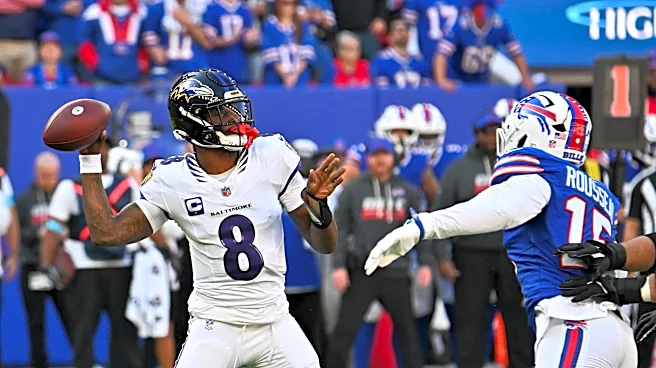


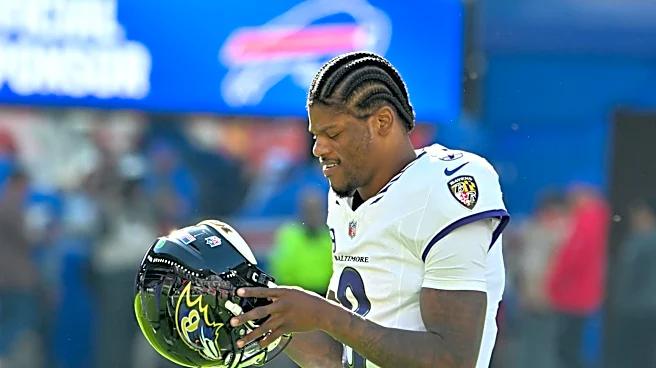

How the Baltimore Ravens answer the question of Lamar Jackson's future in Charm City can and will shape the franchise over the next five to 10 years.
To paraphrase The Clash: should he stay or should he go?
On its face, the thought of the Ravens parting with Jackson – a two-time MVP, second-winningest quarterback in franchise history, No. 2 all-time rusher and passer for the franchise – seems ludicrous. Looking around the league at other teams stuck in quarterback purgatory, why would Baltimore choose to subject itself to an uncertain future?
To answer a question with a question: do the Ravens want to pay their star quarterback a base salary of more than $50 million in 2027, with the knowledge of his unlucky history with injuries and that he could
walk away in 2028?
Ravens general manager Eric DeCosta and head coach Jesse Minter face a major decision heading into this offseason. Should they get it wrong, the rest of the 2020s might be real rough for the Ravens.
Here's a closer look at Jackson's contract details as he misses more time in the penultimate year of his current deal, as well as arguments for why the team should or should not stick with him:
Lamar Jackson contract details
- Term: Five years
- Total value: $260 million
- Average annual value (AAV): $52 million
- Guaranteed money: $185 million
Jackson is in the fourth year of the five-year extension he signed with the Ravens in 2023. The veteran quarterback is due to hit free agency after 2027, but his deal also includes three void years in 2028, 2029 and 2030. As a result, there will be a $42.5 million dead cap hit that accelerates onto Baltimore's books in 2028, barring a further extension.
The biggest other note about Jackson's contract is that his 2027 cap hit is projected to be larger than the dead cap the Ravens would have to eat in a trade or (unlikely) release. The quarterback's deal is responsible for either an $84.3 million cap hit next year or $74.8 million in dead cap.
Assuming the Ravens choose to keep Jackson in Baltimore next year, another contract restructure to lighten the load of the cap hit would be all but certain. If the team does want to move on from the quarterback, a post-June 1 trade (or release) would be the likely result. The post-June 1 designation would spread out the dead cap hit into more manageable hits: $32.3 million in 2027 and then $42.5 million total (including accelerated void years) in 2028, per Over The Cap.
Why the Ravens should part with Lamar Jackson
Two main reasons here: injuries and money.
Jackson's latest injury – of the thumb variety and "potentially" season-ending, according to Minter – is already his second this season and the sixth significant injury of his career. With the thumb injury due to land Jackson on injured reserve, he's guaranteed to miss at least four games in a season for the fourth time in the last six seasons.
The impact of those injuries on the Ravens is significant. This year, they're 3-1 with Jackson and 1-3 without him (we're counting Week 8 as "without him" since he played exactly one snap).
Prior to this year, the team went 1-4 without Jackson in 2021, 2-3 without him in 2022 and 2-2 with Jackson missing in 2025. Baltimore missed the playoffs by one game in 2021 and 2025. In 2022, they narrowly made the postseason thanks to an 8-4 start under Jackson, but the Ravens lost immediately in the wild-card round without him.
Baltimore might want to move on from a quarterback whose durability is coming into question – especially given how much they're set to pay him next year.
Jackson is due more than $51 million in base salary next year, and his contract will carry a cap hit of $84.3 million in 2027. As things stand, that would be the largest cap hit for a single player in history – by a wide margin. Dak Prescott and the Cowboys hold the record with his $50.5 million hit last year.
The Ravens have a way out of Jackson's big-money extension after this year. A pre-June 1 trade or release would result in a $74.8 million cap hit. That's an unlikely solution, but it would save the team more than $9.5 million in cap space.
A more likely solution would be a post-June 1 cut or trade. Such a move would save the Ravens $52 million in cap space in 2027.
And trading Jackson could be particularly enticing for the Ravens. The quarterback's contract includes a provision that states the team cannot designate him with a franchise or transition tag (again) once the deal expires after the 2027 season. That means Baltimore doesn't have much of a safety net if it fails to reach an extension with Jackson, who represents himself, and he could walk in free agency in 2028 with no return for the team.
A trade would allow the Ravens to get a huge haul of picks for Jackson and set up their future. They'd undoubtedly receive multiple first-round picks and more for the two-time MVP, who won't turn 30 until January.
Why the Ravens should not part with Lamar Jackson
Seriously? Besides the injuries and cap hit, pretty much every single other reason.
Off the bat, here's an easy answer to their cap woes: they could sign the quarterback to an extension that will help relieve the $84.3 million hit the team is set to take on next year. Jackson didn't want to engage in negotiations before the 2026 season, but with him due to miss significant time and enter a walk year with no deal in place, signs point to a more willing negotiator.
Let's say that cap situation doesn't get solved quickly and easily. There are still plenty of reasons to hold onto Jackson.
First, let's focus on the 31 other teams that aren't the Ravens. How many have no clear future at quarterback heading into 2027? How many teams that believe they have a franchise quarterback still wish they had Jackson leading their offense instead?
Baltimore has the luxury of already knowing they got it right at quarterback. When Jackson is healthy and playing well – as he was for three and a half games to start the year – he's an incredible talent as a rusher and as a passer. His ceiling, we already know, is unanimous MVP winner.
In eight-plus years in the league, Jackson is 18 wins away from surpassing Joe Flacco to become the Ravens' all-time wins leader. He's also second in franchise history with 23,575 passing yards and 193 passing touchdowns. His 102.7 passer rating is the best in Ravens history, as are his 7.9 yards per attempt.
That's only as a passer. Jackson is also a game-breaker with his legs. He ranks second in Ravens history with 6,666 rushing yards and fourth with 36 career rushing touchdowns. The quarterback's 6.1 yards per rush attempt are second-most of any Raven with at least 100 rush attempts (he has 1,100), and his 55.1 rush yards per game rank ninth all-time for the franchise.
Here are a few more quick-hitting insights into Jackson's impact from just this year, courtesy of USA TODAY Sports' Nate Davis:
- Baltimore has 14 touchdowns in the 14 quarters Jackson has played this year, discounting Sunday. The Ravens have six TDs in the 19 quarters without him.
- Running back Derrick Henry averaged 104.5 yards from scrimmage in the season’s first four games – mostly with Jackson – and scored seven TDs. Since? It’s been 72.3 yards per game and two end-zone trips.
- The last playoff game the franchise won without Jackson was at the end of the 2014 season, nearly three years before he was drafted.
Giving up Jackson to pursue another quarterback in a trade invites unnecessary uncertainty into Baltimore's future. Sure, the next quarterback could turn out to be anything – even the next Lamar Jackson – but why risk it?
The free-agent quarterback class is headlined by Deshaun Watson, Aaron Rodgers (who says he's retiring), Kyler Murray and (with his likely release) Kirk Cousins. Baltimore could roll the dice on Anthony Richardson if he hits the open market, or rely on Mac Jones having a Sam Darnold-like renaissance after spending time with Kyle Shanahan, but those are risks.
Then there's the draft, which features a quarterback class that looks weaker every week of the college football season that passes. Maybe the Ravens hit on finding a franchise QB in the draft for a third time in a row. But why invite that risk with Jackson – a two-time MVP looking like he could have competed for a third this year before his injury – already in-house?
USA TODAY Sports' Nate Davis contributed.
This article originally appeared on USA TODAY: Should Ravens move on from Lamar Jackson after 2026? The case for and against it