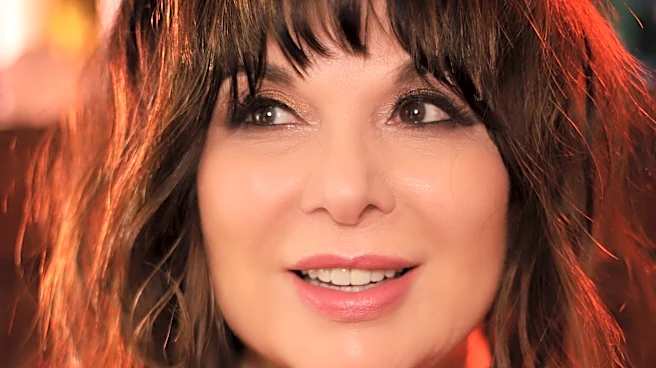

As the muscular voice of Heart, Ann Wilson spent five decades singing her feelings.
In her new documentary, “Ann Wilson: In My Voice,” the veteran behind durable classics “Magic Man,” “Barracuda," "Alone”
and dozens of other hits, truly has her say.
The 75-minute film, available to stream Nov. 25 on Prime Video, iTunes and Apple TV, offers a tidy snapshot of Wilson’s life, from growing up a military brat in a house always filled with music to the rampant sexism she and sister Nancy experienced in Heart to stage fright, addictions, adoptions, marriage, a recent bout with cancer and her current state of reflection at 76.

“I had a few ups and downs along the way, but I got to write my own script,” Wilson says in the documentary.
Observations are incorporated from former Heart members and the quartet of musicians in her latest collaboration, Tripsitter, as well as young artists (“She paved the way for me vocally,” says Chappell Roan) and voices from her past (Wilson called the ‘80s “the dress up years,” says former MTV VJ Mark Goodman).
A surprise commentator is longtime Howard Stern radio show partner Robin Quivers, also a cancer survivor, who shares, “I know what it’s like to have cancer. What gets her out of bed is what she does.”
Not included in the film is sister Nancy, the yin to Wilson’s yang in Heart.
“She has her own stories to tell. So be it,” Wilson says in the film with a smile.
Calling from Nashville, where she moved 2 ½-years ago with husband Dean Wetter, Wilson talked with USA TODAY about some of the revelations shared from her life story.
Ann Wilson shares more about her cancer diagnosis in documentary
Wilson addresses the cancer that removed Heart from the road in 2024 (they returned the following year), but says the diagnosis wasn’t a catalyst for the documentary.
“It didn’t feel more urgent,” she says of the timing of the film. “I just think it allowed me to go ahead and speak and not be afraid to scare or offend anyone. People don’t like to hear that you have cancer. If you want to talk about it in a public way, you have to be gentle with people.”
Wilson says she is cancer-free and is sanguine about her experience.
“Things like that happen in life and you have to roll with it," she says now.
One of the songs on Wilson’s album with Tripsitter is called “Bone Pain,” which she wrote at the end of her treatment (she’s never disclosed the type of cancer she battled).
“I was in a kind of treatment they give you to try and protect against recurrence. And that was really uncomfortable,” she says. “It was really not fun. I felt terrible, as anyone who has gone through chemotherapy and radiation can tell you. Your body is being attacked. So there is that song and one that everyone thinks is about cancer – which it isn’t – called ‘I Will Not Be Coming Back.’”

Why Nancy Wilson isn't in Ann Wilson's documentary
Though Nancy opted not to be part of “In My Voice,” the Wilsons’ oldest sister, Lynn, pops up several times.
“She was a tortured teenager,” Lynn says of her middle sister in the documentary.
Ann says now with a laugh that Lynn was a willing participant because “she loves to talk.”
The absence of Nancy might raise some eyebrows given the sisters’ publicized falling out after a family incident in 2016, but Ann is adamant that all is well between them (the pair performed a few weeks ago at a concert in celebration of Aerosmith in Los Angeles).
“She just wanted it to be my thing,” Ann says of the documentary. “It was a very genuine, wonderful thing that she did. It was, I guess, a statement of independence because we’ve always been lumped together and joined at the hip. That’s not a bad thing at all, but we’re also individual people. So every once in a while we get to venture out.”
How becoming a mother helped Ann Wilson shed insecurities
The sexism that Heart experienced, particularly in the male-dominated rock music scene of the ‘70s that trickled into their ‘80s resurgence, isn’t necessarily new territory for Wilson to explore.
But she knows that current female singers are paying more attention – “watching and listening” – about having more agency over their music and careers.
“I think the pitfalls are pretty obvious. The only thing I would say to (fledgling female artists) would be to keep a hold of who you really are,” Wilson says. “Other than that, it’s a bunch of theater and stagecraft and costume sets and stuff.”
Wilson says she really liberated herself from needing to be validated by others when she adopted her children, Marie (in 1991) and Dustin (in 1998). She raised them as a single parent and brought them on the road during Heart tours.
Dustin says in the documentary that, “For it being a rock ‘n’ roll family, we had an amazingly normal upbringing in a loving household."
Wilson says now that toting the kids on tour was actually ideal considering their exposure to varied activities and locales.
“The road was a great place for kids because there’s something new every day. They could go play miniature golf or visit the local aquarium, all kinds of stuff,” she says.
Ann Wilson says life is better when she's singing
Michael Flicker, who steered Heart in their early years and produced the band’s first five albums, jokes in the film that Wilson has “lead singer disease.”
She does not disagree.
“I don't know what to do if I can't be singing. It just seems like everything in my physical world and my (overall) world just goes better when I'm singing. Because a lot of the tension and anxiety and stuff works itself out when you sing,” she says, adding that the “big burst of love” from audiences is “very addictive.”
“You don’t do seven nights in a row, you do two, or one night and a day off. I’m not going to be sick and exhausted and all of that stuff can happen out there,” she says, then adds with a laugh, “I have to live in a bubble.”
Tripsitter heads to Australia Nov. 24 for a handful of shows and Wilson has found ways to travel “in an intelligent way.”
This article originally appeared on USA TODAY: Heart's Ann Wilson on cancer, sister Nancy and finding her own voice