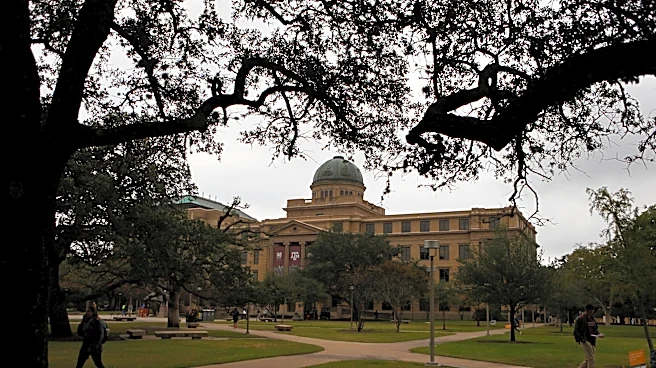








A group of professors sued the leaders of the Texas A&M University System in federal court, alleging that a new system policy restricting classroom discussion of race, sexual orientation and gender violates their First Amendment rights.
The American Civil Liberties Union of Texas, the national ACLU and Houston law firm Yetter Coleman filed the suit on Monday night, Aug. 3, on behalf of the American Association of University Professorsand four faculty plaintiffs in the U.S. District Court for the Southern District of Texas.
“This policy directly harms Black, Brown, LGBTQIA+ and all other Texans who have historically been discriminated against by subjecting discussion of their rights, identities, and indeed very existence to heavy-handed censorship,”
said Chloe Kempf, staff attorney at the ACLU of Texas.
The lawsuit challenged the policy as unconstitutionally vague and as violating the First Amendment by discriminating against certain viewpoints.
This lawsuit comes after AAUP also sued the leaders of the Texas Tech University System on July 8 for the same reasons, amid a growing number of protests by students, faculty and staff at major Texas universities over state-imposed limits on controversial topics.

“This policy has impacted my ability to do my job, my students’ ability to learn, and my colleagues’ ability to teach without fear of reprisal. The chilling effect of this policy is vast and immeasurable, and it poisons the very soul of what a university should be: a place where ideas are free to roam, and debate is uninhibited by the political winds,” said Leonard Bright, lead plaintiff, professor and president of the Texas A&M College Station chapter of the AAUP.
USA TODAY reached out to Texas A&M for comment on the lawsuit but has not heard back.
Here's a look at how higher education works in Texas, the policies and the growing trend across the sector.
How does higher education work in Texas?
Texas academic and health care universities operate jointly in what is known as a system within the state, with seven:
- University of Texas System — based in Austin.
- Texas A&M University System — based in College Station.
- Texas Tech University System — based in Lubbock.
- Texas State University System — based in Austin.
- Texas Woman's University System — based in Denton.
- University of Houston System — based in Houston.
- University of North Texas System — based in Denton.
Under the Texas Education Code, the state legislature established a comprehensive framework that vests control of each of the system’s component universities in its respective board of regents.
Under the law, the governor appoints the nine regents of each system — with the consent of the Texas Senate — for staggered terms. From there, the regents are empowered to hire the chancellor and university presidents, and set policy and admission standards, among other things.
Why was this censorship policy created?
The system policy was adopted by the system's Board of Regents and went into effect in November 2025, affecting all entities and divisions of the 12 universities within the Texas A&M University System.
The University of Texas adopted a similar policy in February 2026, and Texas Tech did the same in December 2025.
The policy comes after the Texas Legislature passed Texas Senate Bill 37, enacted in 2025, which empowers politically appointed governing boards of higher education systems to review course materials to determine whether they comply with recent bans on diversity, equity and inclusion and gender identity topics.
Then-state Sen. Brandon Creighton wrote the bill before he was selected by Texas Tech System leadership to serve as its current chancellor in November 2025.
Creighton also authored what was known as Senate Bill 17 in 2023 during the 88th Texas Legislative Session, which banned diversity, equity and inclusion offices, hiring practices and statements in university syllabi starting Jan. 1, 2024.
Texas students, faculty protest academic censorship
Last academic year, there were several protests from faculty and staff at major public universities in Texas, including the University of Texas and Texas Tech.
On May 6, Texas Tech protesters wore mourning attire outside the site where the system's leadership was convening for its quarterly meeting, holding a mock funeral for academic freedom across the system.
Tara Findley, a public relations major from Lubbock, told the Lubbock Avalanche-Journal, part of the USA TODAY Network, that the clothing symbolized what demonstrators see as the death of academic freedom at Texas Tech.
"Academic freedom was murdered when certain topics were censored out of our curriculum, topics involving psychology, biology, social work, women and gender studies in the name of career readiness," Findley said. "It's partisan censorship."
Days later,on May 20, the University of Texas students and faculty held their own mock funeral.
Mateo Rosiles is the Texas Connect reporter for USA TODAY and its regional papers in Texas. Got a news tip for him? Email him at mrosiles@usatodayco.com.
This article originally appeared on USA TODAY: ACLU, professors sue Texas A&M over race, gender teaching limits