




The best Beatles album debate has raged for decades: “Sgt. Pepper,” “Abbey Road” or “Revolver”?
But is it time to consider “Rubber Soul”?
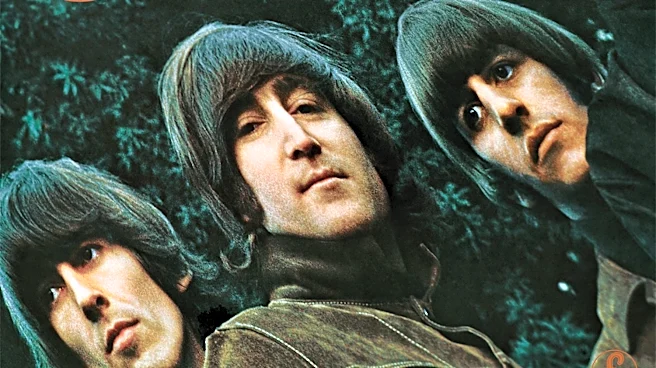
The often-underrated 1965 landmark, beloved by the faithful for its introspective and experimental songs and distorted Robert Freeman cover art, is getting the lavish reissue treatment on Oct. 2.
Quickly recorded in just a month to hit record stores in time for Christmas, the Beatles didn’t consciously set out to make a masterpiece.
“They're writing internal songs about themselves. It's an album about breakup and rejection, a lot of it − the rejection of their fans. They didn’t enjoy really playing live anymore,” says Giles Martin (son of Beatles producer George Martin), who remixed the special edition with engineer
Sam Okell. “It is the emergence of the Beatles out of the pupa into sort of psychedelic butterflies.”
As the band soaked up Bob Dylan and Motown, “they took the world that was around them and stuck it back onto a 12-inch vinyl," he says.

The slyly titled “Rubber Soul” – a punny play on the record’s R&B inspirations and rubber-sole shoes − became a statement about where the Beatles were musically.
Up until then, "the single was the State of the Union," says Beatles scholar Martin Lewis. “ ‘Rubber Soul’ was the first time that the album became the State of the Union."
A lost John Lennon song is the 'Rubber Soul' reissue's biggest surprise
The expanded set includes never-released takes and (in the super-deluxe edition) a hardbound book with an introductory essay by Paul McCartney. A banter-heavy recording of the Fab Four working through George Harrison’s “Think for Yourself” and McCartney’s demo of “We Can Work It Out” will appeal to superfans, though the biggest draw is an unfinished − and until recently, unknown − John Lennon song, “Little Girl.”
A working version of the song is captured in Lennon’s cheeky demo. “The Beatles would have ideas, and they'd have these reel-to-reel tapes and they'd record over them, wipe over them,” Martin says. “Paul played John his idea, or vice versa. That's what they started doing. ... So it's one of those.”
Was there any thought to completing the song in the vein of “Now and Then,” billed as the last Beatles song? Martin says no: “In the true Beatles universe, you never do the same thing twice.”
That the song never developed into something more didn’t surprise Lewis – certainly not on an album where Lennon looked inward on extraordinary songs like “In My Life” and “Nowhere Man.”
“Their years were like centuries, there was so much happening,” he says. “And John was never satisfied. It didn't matter how great a song was, he would denounce it shortly afterward as not being any good.”
Why 'Rubber Soul' may be better than 'Sgt. Pepper'
So where does “Rubber Soul” rank in the Beatles pantheon?
Rolling Stone’s 2023 update of its 500 greatest albums of all time list puts it at No. 35, just ahead of Michael Jackson’s “Off the Wall.” The fan site Best Ever Albums ranks it No. 30, behind “Abbey Road,” “Revolver,” “Sgt. Pepper’s Lonely Hearts Club Band” and the White Album.
“For me, the triumvirate is ‘Rubber Soul,’ ‘Revolver,’ ‘Sgt. Pepper,’ ” Lewis says. “ ‘Rubber Soul’ has much more heartfelt songs and lyrics and it's really emotionally connective.”
“Revolver” is “wonderful” but “it’s a little brittle, it's a little metallic … There’s an enjoyable hard edge.”
And then “Sgt. Pepper” is “florid,” he says. “It’s like you're going from black and white at the beginning of ‘The Wizard of Oz’ into glorious Technicolor, but the songs aren't as good. They're lovely, they're enjoyable, but they don't connect emotionally in the same way.”
By contrast, on “Rubber Soul,” "you'll find a mixture of heart and muscle. That's a very, very unusual mixture."
The secret of 'Rubber Soul's enduring appeal
What is clear, 60 years on, is that “Rubber Soul” feels intimate in a way that later Beatles albums don’t.
Soon after, "the mantle is thrust on them that they are leaders of a counterculture," Lewis says. "In '65, there's no filter. They're just writing plainly out of their hearts."
Unlike many records tied to youth, the self-reflection of “Rubber Soul” becomes more meaningful as listeners grow older. That hasn’t diminished its appeal for the band’s ever-replenishing audience of younger fans.
“This is a really good band playing live in the studio,” Martin says. “The energy comes from a bunch of 25-year-olds in a room with a bunch of microphones. And that's it.
“The immediacy of the creation then creates vibrations and a legacy that lasts, what, 55 years? Longer. That’s really exciting, because in the time we've done this interview, they recorded ‘In My Life.’ "
This article originally appeared on USA TODAY: Why 'Rubber Soul' may be the Beatles' true masterpiece