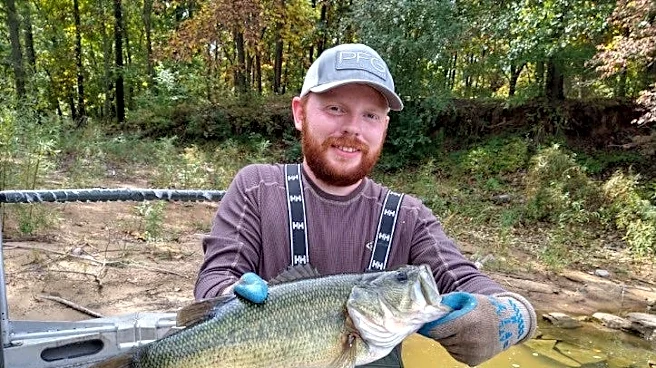





Hyler Pence often went hunting as a kid growing up in rural Illinois.
"My dad would bring my brother and me," the 28-year-old remembered. Their father took each of them for the required hunting safety courses when they were around 12 or 13, and, he said, "we were kind of expected to hunt."
But as he moved into his teens, he found he was more interested in school and often too busy to make time for hunting. There were too many other things to do.
He wasn't alone: A 2022 study by the U.S. Fish and Wildlife Service found that 49% of hunters were 45 and older; just 16% were between the ages of 16 and 24.
The low number of young people hunting comes as communities reckon with a decline in numbers in traditionally busy fall hunting seasons. Pennsylvania
tried to rejuvenate its deer rifle season in 2019 by changing the first day – abandoning the traditional Monday after Thanksgiving by moving opening day to a Saturday. That move may have backfired.
“It remains unclear whether moving opening day delivered any real benefit,” state Sen. Lisa Boscola said in a news release. “What is clear is the toll it has taken on families and communities across Pennsylvania. I’ve heard firsthand from families with generations of hunters how devastating the change has been (for) Pennsylvania’s rich hunting tradition, as well as the small businesses that sustain rural areas.”
The news release suggests the move has further jeopardized the state's "Deer Day" – an informal tradition across multiple states of canceling school for the first day of deer rifle season.
Meanwhile, demographics appear to give a clue about the future of hunting in America.
"Baby boomers have the highest participation rate," said Dan Storm, a data research scientist with the Wisconsin Department of Natural Resources. Boomers, those between the ages of 80 and 62, are more likely to be hunters than the generation before them, and, Storm said, research has shown each successive generation, from Generation X to millennials to Gen Z, have progressively been less likely to engage in hunting.
Justin Aycock, director of youth engagement programs for Ducks Unlimited, a nonprofit dedicated to wetlands conservation, agreed that hunting is on the decline.

"Across the board, hunting numbers have been declining over the last 30 to 40 years," he said.
Why Americans are hunting less
There are several reasons fewer young people take up hunting, Pence, Storm and Aycock each said.
More young people are moving from rural areas to urban areas, and even in rural regions, there's less land that's publicly available in which to hunt. As people move further from the lands where they might be able to hunt, the pastime becomes more of an activity that needs to be planned, and travel can take up time that would otherwise be spent tracking game.
Hunting is often passed from grandfathers to fathers to sons, Storm noted, but today's boys are often involved in youth sports year-round, and the fathers who might otherwise take their boys hunting are instead coaching their baseball or football or soccer teams, or watching them play in weekend tournaments.
"We’ve done demographic analysis with lapsed hunters and life constraints and family are the most cited reasons, just people having so many other commitments," Storm said. "The connections are weakening, and barriers to entry are increasing."
"The digital age is part of the problem, too," Pence said. "My dad's generation wasn't spending a Saturday playing video games."
Hunting isn't a hobby "you can just decide to do," either, Pence said: Seasons differ by state and species. There are permits to be obtained (and paid for), weapons to be bought (and mastered), required safety courses and rules around when, where, how and what to hunt. "It can be daunting for some people."
Seeing hunting 'through a new lens'
For Pence, it wasn't until he took a biology course in college that included a focus on sustainability and conservation that his interest in hunting ‒ now as a way to ensure his food was locally sourced and minimally processed ‒ was rekindled.
"I saw hunting through a new lens," he said. He took classes where he learned about food scarcity, the hormones and additives sometimes added to meat, factory farming and other realities of our modern food chain. Now 28, he's back into hunting, but he's not doing it for sport. Instead, the deer he hunts become meals.
"I think there's a strong belief among a lot of my generation that we see hunting as a viable option for organic food and sourcing," Pence said. In 2023, while working as an intern for the state, he wrote an article for the Illinois Department of Natural Resources' Outdoor Illinois Journal about his evolving attitudes toward hunting and how it dovetailed with his growing interest in the locavore movement.
Storm said he's seen anecdotal evidence of that in Wisconsin, as well. "You'll see these 'Field to Fork' events across the country, and in our learn-to-hunt programs, people seem more food-focused ... not just for novelties like jerky and snack sticks, but staples like venison."

"It's more of a provider mindset," he added. "Understanding the connection to food. They can feed their community through things like deer meat donations to food banks. The community can benefit from a robust deer harvest."
"We've grown as a population very separated from where we get our food," Pence said. He grew up in a rural area and in a family that didn't have much money, so he said deer hunting "was a way to put food on the table when times were tough."
"The locavore movement is definitely something we see," Aycock said. "Especially within the last 10 to 12 years, younger people are more concerned with where their food comes from. They feel the disconnect from farms in our society and (hunting) gives them a sense of ownership."
Conservation concerns
Some animal rights groups say hunting is cruel and unnecessary. The American Society for the Prevention of Cruelty to Animals, for example, is opposed to hunting, it says on its website, "even if the animals killed in this way are subsequently consumed." The nonprofit says it understands "that wildlife management may be necessary in situations where animal and human interests collide, but urges that management strategies be nonlethal wherever possible and never include avoidable suffering or distress."
Though it may seem counterintuitive, conservation is another consideration for younger hunters, especially with species like deer and waterfowl, which can overrun some areas and have few natural predators. Fewer of the animals can mean healthier populations ‒ and not just among the animals that are hunted.
Overpopulation among deer can lead to more collisions with vehicles, making even suburban roads more dangerous. Too many deer in a forest can impact the entire ecology: They eat vegetation that sustains other species, and sometimes can consume trees before they have a chance to grow and renew forests.
Storm said hunters also bring in crucial revenue that goes toward conservation efforts, through permit fees and licenses as well as taxes on firearms, ammunition and archery equipment.
Ducks Unlimited focuses on peer-to-peer recruiting, Aycock said, because young people are more likely to take up hunting if their friends are doing it. They encourage mentorship to engage and keep young people interested in hunting since, he said, "it's not something you can easily start doing on your own."
Phaedra Trethan is a national correspondent for USA TODAY, writing about history and Americana. Contact her by email at ptrethan@usatoday.com, on X @wordsbyphaedra, on BlueSky @byphaedra, or on Threads @by_phaedra.
This article originally appeared on USA TODAY: Going hunting? Young people are disrupting old traditions