







Scientists cannot predict exactly when and where the next earthquake will strike. But a decade-long experiment suggests some forecasting models can reliably predict patterns in earthquake activity, offering new evidence that could help agencies better communicate seismic risks.
Researchers evaluated 27 earthquake forecasting models using more than 51,000 forecasts generated between 2007 and 2018. They compared the forecasts with 597 earthquakes recorded in California, testing whether the models accurately described the number, locations and magnitudes of seismic events that occurred after each forecast was issued.
The findings come from a decade-long experiment in California that tested 27 earthquake forecasting models against nearly 600 recorded
earthquakes. The study, published in Nature Communications in August and highlighted in the university's Oct. 15 news release, could help scientists improve systems used to communicate changing earthquake risks.
The study does not offer a way to predict the next major earthquake. Instead, it provides evidence that some models can consistently estimate patterns in earthquake activity when tested against future observations rather than relying solely on past events.
Can scientists predict when an earthquake will strike?
No scientific method can currently predict the exact time, location, and magnitude of an impending earthquake with reliable accuracy, according to the U.S. Geological Survey.
Scientists can, however, calculate the probability of earthquakes occurring within a particular area and time frame. These forecasts can help researchers and public officials understand how seismic risk changes, including after a major earthquake when aftershocks may follow.
“We’ve provided a model ‘recipe’ identifying elements that can be considered when developing forecasts consistent with the observed number, spatial locations and magnitude distribution of earthquakes," said lead author José A. Bayona, Early Career Leverhulme Research Fellow in the University of Bristol’s School of Earth Sciences. "We’ve also provided an open-source software package containing the code, data and documentation needed to transparently replicate the study’s analyses, figures, and results.”
The distinction matters because an earthquake forecast does not guarantee an earthquake will occur. It estimates the likelihood or expected distribution of seismic activity based on available information.
For example, a forecast might estimate the likelihood of additional earthquakes in the day after a significant seismic event. It would not necessarily identify the precise time or location of the next earthquake.
The California experiment focused on these probabilistic forecasts, evaluating how well models described earthquake activity over the following 24 hours.
How did researchers test earthquake forecasts?
The study was conducted through the Collaboratory for the Study of Earthquake Predictability, an international scientific collaboration that evaluates earthquake forecasting models using transparent, prospective testing.
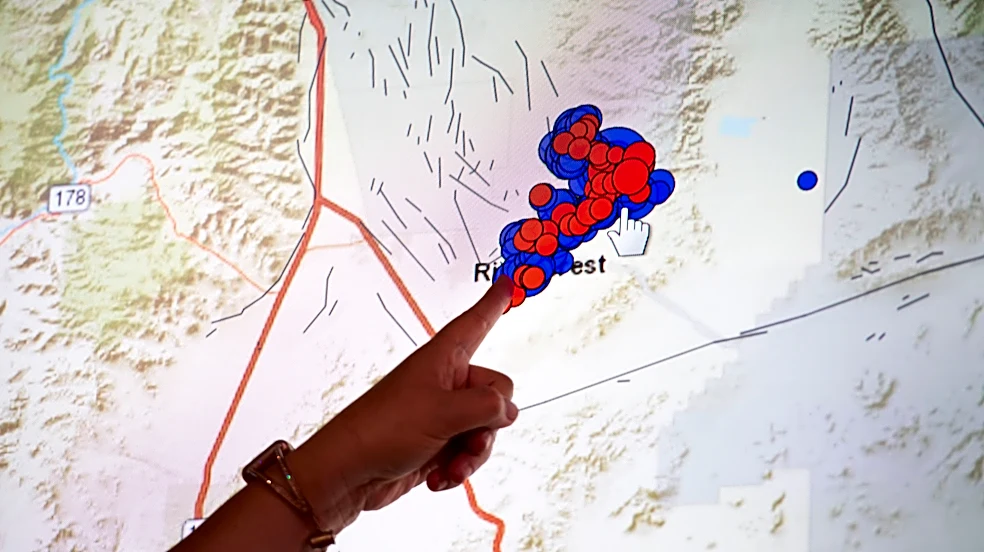
Between August 2007 and August 2018, the researchers' forecasting systems generated 51,625 next-day forecasts for California. Each forecast used previously observed earthquake activity to estimate the number, locations and magnitudes of earthquakes expected over the following 24 hours.
Researchers then compared the forecasts with observations collected during the testing period, including 597 earthquakes of magnitude 3.95 or greater within the study region.
Because the forecasts were generated before the subsequent earthquakes occurred, researchers could assess their performance against new observations rather than simply checking whether a model could reproduce patterns in the data used to develop it.
This distinction matters in earthquake research. A model may appear successful when tested against historical data but perform differently when applied to future events.
The experiment also included several model types, including methods that account for earthquake clustering and the likelihood of additional seismic activity after previous earthquakes.
How accurate were the earthquake forecasting models?
The results varied depending on which aspect of earthquake activity the researchers examined.
Approximately 95% of the models produced forecasts statistically consistent with the observed number of earthquakes. About two-thirds matched the locations of recorded earthquakes, while about 95% matched the distribution of earthquake magnitudes, according to the study.
Those percentages describe how many models passed statistical consistency tests. They do not mean the models predicted 95% of earthquakes correctly.
However, the models did not perform equally well across all measures. Earthquake locations proved harder to describe consistently than their numbers or magnitude distributions.
The findings also do not establish that these models can reliably forecast every earthquake sequence or identify when a major earthquake will occur. They show that selected models performed consistently with observations under the study's statistical tests.
How worried should Californians be about the 'Big One'?
California has long waited for another major earthquake along some of its most dangerous faults.
The last major rupture of the southern San Andreas Fault occurred in 1857, when a magnitude 7.9 earthquake ruptured roughly 225 miles of the fault. Known as the Fort Tejon earthquake, it produced shaking that lasted an estimated one to three minutes and killed two people.
The state looks very different today. California's population has grown dramatically since 1857, with millions of people now living in densely populated areas near active faults.
Researchers have long said another major earthquake will eventually occur in Southern California. The question is when.
A 2026 study from researchers at the University of Hawaiʻi at Mānoa found that stress levels on the southern San Andreas and San Jacinto fault systems are at their highest levels in roughly 1,000 years, based on physics-based modeling of the region's earthquake history.
The finding adds to scientists' understanding of the region's earthquake risk, but it does not mean a major earthquake is imminent.
“Right now, with stress at historically high levels across the region and more than 160 years elapsed since the last major rupture, the system is in a critically loaded state,” study lead author Liliane Burkhard said.
Does a burst of earthquakes mean the 'Big One' is coming?
Not necessarily.
Earthquake swarms and clusters of smaller earthquakes happen in California and elsewhere. A stretch of heightened activity does not give scientists a reliable way to determine whether a larger earthquake is about to occur.
Scientists can identify faults that are capable of producing large earthquakes and estimate the likelihood of future activity, but they cannot predict the exact time, location and magnitude of an earthquake.
That means hundreds of small earthquakes do not amount to a countdown clock for the next major quake.
Brandi D. Addison covers weather across the nation as the Weather Connect reporter for the USA TODAY Network and contributes to Texas Connect coverage across the state. She can be reached at baddison@usatodayco.com. Follow her on Facebook here.
This article originally appeared on USA TODAY: Can scientists forecast earthquakes? A 2026 study offers clues