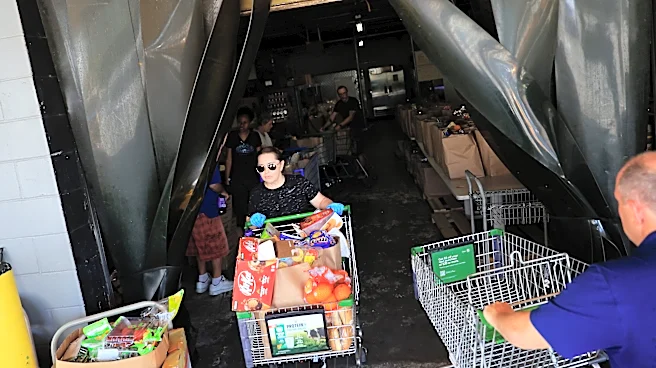








More than six million Americans who qualify for food aid because they receive other social safety net programs would lose food assistance under a rule proposed this month by the U.S. Department of Agriculture.
The aid recipients would have to apply separately for the Supplemental Nutrition Assistance Program, and USDA estimates that nearly 17% of all SNAP recipients would not be approved.
Current policy allows states to use “broad-based categorical eligibility” to authorize people who receive non-cash services funded by the Temporary Assistance for Needy Families program to participate in SNAP.
States have flexibility under the policy to modestly raise SNAP’s federal income limit and ease its asset test so working families who earn slightly above
the cutoff, or who have managed to save a little, can still get food assistance.
The proposed rule would end that option, limiting automatic eligibility just to households receiving cash assistance through Temporary Assistance for Needy Families (TANF), which provides financial assistance and support services to low-income families with children.
Agriculture Department spokesman Harry Fones said it is a long overdue fix to a "loophole" that's added millions to SNAP rolls.
"It has allowed states to take short cuts, error rates to balloon, and those households with income and assets far above federal limits access to a benefit meant for the neediest among us," Fones said.
Public comments are due Dec. 10. More than 17,500 had been submitted by Friday.
SNAP enrollment has already fallen by more than 5 million people since Trump signed the GOP tax and spending bill in July 2025, including seniors and families with children, according to the U.S. Department of Agriculture. The bill increased state SNAP costs, tied how much the federal government will pay for the program to state payment error rates and added stricter work requirements
As part of the bill, states are already being forced to take on additional administrative costs for running the SNAP program. The proposed rule would require states to process thousands of addition SNAP applications every year.
Broad-Based Categorical Eligibility
Most states have opted to use broad-based categorical eligibility. Kansas, Mississippi, Missouri, South Dakota, Tennessee, Utah and Wyoming do not.
In states using broad-based categorical eligibility, households can qualify at modestly higher income levels and are generally not subject to SNAP's standard asset limits.
Roughly 17.6% of SNAP participants, or 1 in 6 users, would lose benefits by Oct. 2028 under the proposal “because their income or resources exceed” congressional limits, according to USDA’s analysis. The proposal would also slash federal SNAP spending by close to $45 billion between fiscal 2027 through fiscal 2031.
Eyang Garrison, managing director for domestic policy at child aid charity Save the Children, said it is peculiar to drop millions of people from SNAP when people nationwide are struggling to afford food.
"It couldn't come out at the worst time for families in need. We're talking about several million people losing access to food and it's not an insignificant number," she said.

Other social safety net programs, including free and reduced price lunches and food aid for infants, allow people to qualify if they receive food stamps without making them reapply. USDA estimates 1.8 million children could lose automatic access to school meals and Summer EBT, while another 5,500 women, infants and children could lose WIC benefits.
USDA's analysis ignores administrative burdens created by the 2025 spending bill, said Gina Plata-Nino, SNAP Policy and Advocacy Director at The Food Research & Action Center. The bill requires states to take on an additional 25% of administrative costs.
The Food Research & Action Center, which advocates for protecting and expanding SNAP, has broken down the estimated impacts by state. It estimates California would lose the most recipients, while Tennessee would see the largest percentage decline at more than 36%.
"Just think about what that means in terms of state agencies having to process all of these new applications, notifying individuals, individuals having to reapply, showing all of these proofs (of income)," she said.
Plata-Nino also questioned whether USDA has the authority to issue this rule at all.
"It's trying to sidestep Congress in terms of its intent and it's beyond USDA's authority,” she said.
The role played by Congress
Congress established the policy decades ago to reduce paperwork and make sure low income people wouldn't reject work options that might lead them to immediately lose food benefits.
Republicans have repeatedly sought the change, including the Trump administration in 2019, but retreated amid opposition from Democrats with Republican support, have repeatedly blocked it.
In a Nov. 16 letter, Senate Agriculture Committee Democrats argued the proposal conflicts with congressional intent, noting lawmakers have rejected similar efforts in 2005, 2014 and 2018. House Democrats warned in a Nov. 19 letter that the rule would undermine states' flexibility and harm beneficiaries.
"USDA repeatedly claims that it is aligning SNAP rules with congressional intent, but the legislative history clearly demonstrates otherwise," the Senate letter said. "States have relied on this flexibility for decades to serve low-income households and administer SNAP more efficiently."
This article originally appeared on USA TODAY: Millions face loss of food aid under new USDA plan