



It’s been nearly two decades since he sat behind the wheel of a racecar, but Dale Jarrett has seen it all.
Across a Hall of Fame career in NASCAR that spanned from 1982 to 2008, Jarrett saw the sport change in real time — not just in popularity, but with safety innovations too.
Jarrett was racing at the top level of the sport when restrictor plates were introduced at the largest and fastest tracks, Daytona and Talladega, in 1988. Later came roof flaps, the mandated use of the HANS (head and neck support) device, and then the installation of SAFER (steel and foam energy reduction) barriers at all NASCAR tracks. A driver has not died from a crash in the Cup Series since Dale Earnhardt’s death at Daytona in 2001.
While the sport of stockcar racing
can be thrilling, it remains risky. Drivers put themselves in perilous situations at high speeds every week, which makes what wheelmen like Jarrett were able to accomplish all that more impressive. In addition to winning 43 races and the Cup Series championship in 1999, Jarrett captured three Daytona 500 victories, two Brickyard 400 wins and a Coca-Cola 600 checkered flag in 1996.
“The side of it that we tend to forget sometimes is the dangerous side of the sport,” Jarrett told USA TODAY Sports recently. “Even though things had improved somewhat with safety initiatives as I came along versus what my dad and many of those competed in, it is a dangerous sport and competition to do.”
The treacherous nature of racing and the long-term impacts from it have been on Jarrett’s mind for two reasons recently.
Jarrett, 69, will be one of several prominent athletes honored on Monday, Oct. 5 in New York City. The Buoniconti Fund to Cure Paralysis' 41st Annual Great Sports Legends Dinner aims to raise awareness and millions of dollars for research and treatment of paralysis and other neurological conditions.
Founded by Pro Football Hall of Fame linebacker Nick Buoniconti, the Buoniconti Fund is a non-profit organization whose mission is to help the Miami Project, which has been conducting cutting-edge research into traumatic spinal cord, brain and peripheral nerve injuries, and neurological diseases and disorders including Alzheimer’s, Parkinson’s, ALS, Multiple Sclerosis and stroke.
“I'm just humbled and honored to be a part of this and be able to be a part of a celebration that will not only help bring the funds that are needed, but the awareness also,” Jarrett said. “The Miami Project and everything they do, it’s just so fascinating.”
And Jarrett is also thinking about one of his contemporaries, a fellow Hall of Fame driver, Darrell Waltrip.
Last month, the family of the 79-year-old said in a statement that Waltrip was taking a step back from public life after he had been diagnosed with frontotemporal degeneration (FTD) complicated by possible Chronic Traumatic Encephalopathy (CTE) due to injuries he suffered from a racing career that spanned from 1972 to 2000.
Before going on to have an iconic broadcasting career with Fox Sports, Waltrip won 84 races in NASCAR’s Cup Series, a mark which still ranks fifth all-time. Waltrip won the 1989 Daytona 500, the 1992 Southern 500, and took five checkered flags at the Coca-Cola 600 in Charlotte, making him the winningest driver of NASCAR’s longest crown jewel race.
“First and foremost, every one of us that have known Darrell for many years and understand the impact that he had in helping grow the sport of NASCAR, we're saddened by what we were told and what we know at this point, and we're all thinking and praying for him,” Jarrett said. “But Darrell Waltrip was – and still is – one of the most recognizable names, faces and voices that NASCAR has had throughout the years. He had such an outstanding racing career and was a tenacious competitor on the track.
“Unfortunately, it probably won't be a situation that will get better, but Darrell has always been one to face every battle and every challenge that he's ever had.”
According to the Mayo Clinic, CTE is a brain disease likely caused by repeated head injuries that gets worse over time. Currently, it can only be definitively diagnosed after death during an autopsy of the brain. After he died in 2024, NASCAR Hall of Famer Fred Lorenzen was diagnosed with CTE by researchers at Boston University.
“I think that, now that we know more about (CTE), as these things happen, we will hear of more (former drivers) that are willing to give their brains (to science),” Jarrett said. “I feel 100% sure that there were a number before that had no idea that may have been part of the cause of what they went through before their passing.”
One of the documented concussions Jarrett had came at Kansas in 2001, when he spun near turn 2 and hit the outside wall hard after getting some contact from Bobby Labonte. Two years later, another hard crash for Jarrett — this one at New Hampshire — sparked a rule change for NASCAR, ending the practice of drivers “racing back to yellow” after a caution flag dropped.
Jarrett played football in high school before his racing career began in earnest, and he remembers hard hits being classified as “getting your bell rung.”
“There was never even a thought that it might have been a concussion,” Jarrett said. “But once you understand what concussions are, you find out the impact of them and how many you may have had.
“I go back to, you know, we used to hit concrete walls at well over 150 miles-an-hour and sometimes close to 200 miles-an-hour. And so, I'm not surprised. I know things that I go through myself from concussions through the years.”
Since retiring from racing, Jarrett has remained close to NASCAR by working on television, emulating a post-racing career similar to what his late father had. Ned Jarrett, a two-time champion, Southern 500 winner and Hall of Famer, was a longtime broadcaster for CBS and ESPN. He died earlier this year at the age of 93.
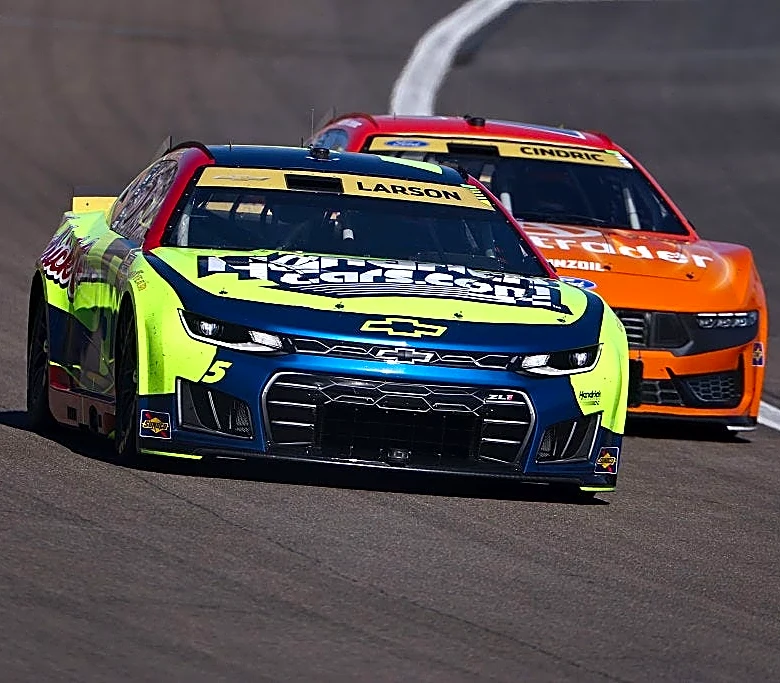
Dale Jarrett was previously an analyst for ESPN and NBC, and is now part of the broadcast crew for USA Network, which carries the postseason Chase. During race weekends when he’s not in front of a camera, Jarrett can walk through the garages and chat with racers like Kyle Larson and Ryan Blaney.
Through his relationships with current drivers, he’s seen more strides that NASCAR has made when it comes to safety.
“There always is more to do and there’s many doctors involved. (Concussions) will certainly be something that will always be at the forefront, even though it may not be talked about a lot. It is something that is happening behind the scenes,” Jarrett said. “The drivers now have much more help in that regard than what has ever been available to NASCAR drivers through the years.”
In 2023, a team at Wake Forest University developed a mouthpiece sensor that collects data and measures what happens to a driver’s head during a crash, similar to a “black box” inside of a car. During practices, data is recorded to evaluate how the head reacts during laps without impacts and to measure bumps. During a race, recordings are triggered when a threshold of 4Gs is exceeded to capture data for analysis. Larson and Blaney are among the many drivers who have voluntarily used it.
Still, Jarrett wouldn’t be shocked if other drivers have unknowingly battled CTE or other brain diseases – particularly those who competed alongside him and Waltrip in the 1980s and 1990s, before many of NASCAR’s crucial safety innovations and technologies were implemented.
“I can assure you that many of us have been told that the possibility (of CTE) is there because of either the severity of some of the concussions that we may have had, or maybe just the sheer number of concussions,” Jarrett said. “It wasn't just getting your bell rung or just a headache. There was much more involved.”
This article originally appeared on USA TODAY: Dale Jarrett reflects on the dangers of NASCAR: ‘It wasn’t just getting your bell rung’