





Laura Berlin watched images of immigration agents rounding up people and flying them to a Latin American prison without due process – and she knew she had to do something.
“That situation really haunted me,” she said.
She asked herself: “Who owned these chartered airliners that were flying the men to a Salvadoran prison? Who owned these detention centers where men were being held along the way?" In short, what companies were taking money from the government to help deport people? Berlin needed to know.
Using her background in nonprofit communications, she built an interactive Google Map titled, “Who is Profiting from ICE?” It plots the contractors across the country who work with Immigration and Customs Enforcement to carry out the Trump administration’s
deportation policies.
Activists found her online database and have used it to organize hundreds of protests across the country against these companies, shaming them into cutting ties with ICE. In one case, an East Coast bank broke with two prominent detention center contractors after account holders – including Jersey City, New Jersey – withdrew more than $350 million.

The U.S. government found her website, too – and labeled it a tool for domestic terrorism, according to a secret intelligence bulletin obtained by USA TODAY. It's the latest example of the Trump administration cracking down on dissent it says could veer into political violence.
“The egregious, dehumanizing rhetoric the administration and its allies have relied on to manufacture support for cruel and ill-advised policies was always going to ripple out and hurt people, including kids, in all kinds of ways,” Berlin said.
The anonymous Texas mother of two teenagers has been pulled out from behind her laptop into an uncomfortable spotlight.
Small research project caught fire after ICE shootings
When Berlin began her research in April 2025, two big names immediately caught her attention.
GEO Group and CoreCivic were awarded nearly $1 billion combined by ICE in the first year of the Trump administration’s crackdown in 2025. The two companies provide staff for detention centers, beds to house them, and ankle monitors to surveil those out on bond awaiting their hearings.
Berlin went down the research rabbit hole and discovered that Wells Fargo and Bank of America pledged to stop working with the pair, so she wondered – who is still lending to these companies?
She scoured corporate filings and found her answer: Citizens Bank, a Rhode Island institution with more than 1,000 branches on the East Coast.
She posted her research on boycottcitizens.org, and included a detailed Google Map that shows the nationwide web of companies, law enforcement agencies and politicians with ties to ICE.
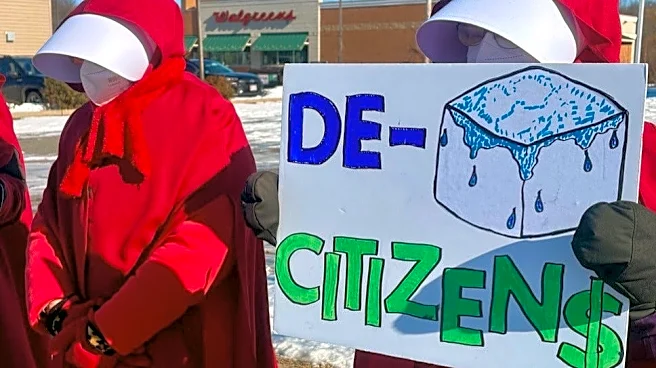
It attracted a trickle of attention at first. But one group of organizers in Boston found her website and created De-ICE Citizens Bank Coalition. The group had already successfully pressured Avelo Airlines to end its ICE contract for deportation flights in January.
De-ICE planned its first protest against Citizens Bank on a cold Jan. 7. That same morning on a snowy side street in Minneapolis, an ICE agent shot and killed Renee Good.
Berlin’s obscure website exploded. Website traffic surged from a few thousand visits to nearly 10 million hits. De-ICE Citizens recruited dozens of new volunteers. And they launched three dozen protests.
Days later, on Jan. 24, Border Patrol agents shot and killed Alex Pretti, a 37-year-old nurse, fueling further outrage.
By March, 70 protests were planned at Citizens banks. By June, it was up to 140, spanning 17 states. The group collected individual withdrawal pledges from Citizens’ customers totaling $25 million.
They attended Citizens’ annual board meeting in person. They bought billboards in Rhode Island and Pennsylvania – and even hired a pilot to drag a banner over Citizens Bank Park in Philadelphia during the MLB All-Star game in July.

For decades, Citizens Bank had a hard-earned reputation on the East Coast as a socially responsible lender, said Peyton Flemming, a spokesman for De-ICE Citizens, which partnered with Berlin. He pointed to a Citizens program to work with low-income borrowers.
That standing was stained by the loans to CoreCivic and GEO, Flemming said.
“The reputation damage was part of the strategy, and clearly the bank was upset with tarnishing their reputation,” Flemming said.
The strategy worked. In June, Jersey City officials said they’d pull $265 million from the bank, citing GEO’s operation of Delaney Hall, a detention facility which had drawn widespread condemnation. On July 14, Montclair voted to pull an additional $90 million.
The bank relented.
Three days later, Citizens posted a blog lamenting being targeted by activists and wrote that it would cut off the two contractors. It insisted it was not a decision influenced by the political campaign.
“This is a business decision based on changed commercial circumstances and does not reflect any change in our view regarding these companies’ business models or operations,” the unsigned blog read. Citizens Bank declined a USA TODAY interview request.
Days earlier, CoreCivic announced that it sold two California facilities back to DHS – freeing up more than $1.5 billion to inject into the company – and lowering the need for bank credit.
Citizens said it felt squeezed by the “debanking” effort. The Trump administration’s Office of the Comptroller of the Currency issued controversial guidance to banks, warning of “fair access” violations for those who cut off loans to fossil fuel providers, gun manufacturers and private prisons.

Berlin didn’t stop there. Her research includes a searchable map of ICE’s contracts with other major U.S. companies that span the nation: AT&T, Comcast, Dell, Deloitte, FedEx, Motorola and Palantir.
And that caught the attention of the Department of Homeland Security.
DHS flags site in nationwide surveillance
To Berlin, her online database is an important tool for transparency, protected as free speech.
To DHS, it’s information that could be used by “anarchist extremists.”
That’s according to a secret intelligence bulletin DHS sent to local and federal law enforcement in February, specifically targeting Berlin’s website.
“Anti-ICE threat actors, including local anarchist extremists, may escalate otherwise peaceful direct action by carrying out acts of vandalism, often using spray paint, projectiles, blunt and edged objects and improvised incendiary devices,” the bulletin reads.
DHS used the same alert for Berlin’s website that it reserves for domestic terrorists. In the past, DHS has used this code – HSEC SIN 8, which stands for Homeland Security Standing Information Need 8 – to flag information on ISIS beheading videos and pipe bombs in cities.
Berlin says she was unaware her site was the subject of a law enforcement intelligence bulletin.
“At first, my stomach dropped,” she said. “But then I couldn’t help but laugh at the absurdity of it.”
The bulletin concedes, in red letters, that “some of this information describes First Amendment-protected activities.”
DHS’s warnings against Berlin echo the administration’s pressure on Apple to remove the app ICE Block, where anonymous users could crowdsource ICE activity. DHS investigated left-leaning labor union and climate change groups in Minnesota it described as "violent opportunists and agitators." And a New York man was investigated for "criminal activities" after he emailed ICE Director Todd Lyons.
A spokesperson for DHS did not address the specific bulletin, but said information from local partners “helps sharpen the national threat picture.”
A spokesman for the Philadelphia Police Department, which sent the information to DHS, said the bulletins are compiled to identify “emerging threats and hazards” aimed at situational awareness, “not to characterize lawful activity or constitutionally protected speech as criminal conduct,” Sgt. Eric Gripp wrote.
DHS is targeting “even the mildest anti-ICE dissent as extremism and terrorism,” said Ryan Shapiro, executive director of the open government group Property of the People, which obtained the document.
"This has nothing to do with public safety,” Shapiro said. “It’s about deploying law enforcement as a taxpayer-funded security force for ICE's corporate enablers and profiteers.”
For their part, the protest groups maintain they had two rules: to remain peaceful and abide by all laws.
Berlin said she’s undeterred.
Site shines light on federal, state, local politicians
Berlin isn’t stopping at shaming corporations. She wants to make sure American voters know which elected officials are getting money from the largest ICE contractors.
Berlin found that more than 450 candidates across the country had taken campaign contributions from some of the three biggest government contractors working with ICE – GEO, CoreCivic and Management and Training Corporation.
Her website database shows contributions to candidates ranging from tiny county GOP committees to national elections.
In Arizona alone, the companies contributed to nearly 80 candidate campaigns. More of their money is flowing toward influencing local elections, according to the data.
In 2025, GEO spent $1.7 million on federal and national candidates and $2.3 million on state and local elections. CoreCivic spent $1.7 million federally and $1.6 million on state and local lobbying. Both companies disclose their political activity annually.
The companies declined to release information ahead of their 2026 disclosures.
“We welcome the opportunity to support any political leaders who are open to the solutions our company provides to serious national challenges, including providing safe, humane care for people going through the civil immigration process,” wrote Ryan Gustin, a CoreCivic spokesman, who said the company has contributed to both parties across multiple administrations.
Berlin said users might be surprised to see candidates from both parties who have taken money from the PACs she targets. They range from President Donald Trump, Republican Texas Gov. Greg Abbott and GOP Alabama Sen. Katie Britt to a swath of Democrats: U.S. Sen. Jeanne Shaheen, N.H.; U.S. Rep. Bennie Thompson, Miss.; Rep. Sanford Bishop, Georgia; and Kentucky Democratic Gov. Andy Beshear. She also draws attention to local sheriffs’ races and local boards.
Politicians have a choice when taking campaign cash, and more Americans should pay attention, said Bianca Tylek, executive director of Worth Rises, an advocacy group that monitors private prison contractors.
“This industry is trying to utilize political connections to extract as much as possible from taxpayer coffers,” Tylek said.
Researcher is undeterred
For Berlin, this work is personal.
The images that sparked her into action – ICE’s rough treatment of people of color being rounded up, former DHS chief Kristi Noem posing in front of shirtless men in a Salvadoran prison – hit close to home.
Her sons are part Guatemalan, and she has seen how differently the world sometimes treats them, especially the one who has darker skin.
“I’d be lying if I said I’m not angry about all this or afraid about what it means for my own kids,” Berlin said.
Berlin says she’ll continue her website’s goal of highlighting companies that work with ICE. Next up: She’s researching companies that gather data to help identify and locate immigrants.
“This information is available from the government’s own databases,” Berlin said. “It’s troubling that DHS would portray a tool meant to make public records more accessible as potentially threatening.”
Berlin said she’s motivated by changing the nation into a better place for children like hers. And that If the government insists on its bareknuckle approach against political dissent, she has the First Amendment on her side.
This article originally appeared on USA TODAY: A mom's website shows who profits from ICE. Why Feds call it a 'threat'