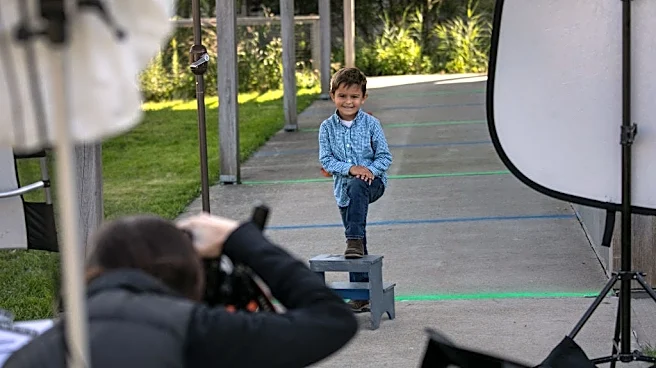







The price of school photos is leading some parents to create their own at home with the help of AI image generators.
Parents are taking to social media to share affordable "hacks" for do-it-yourself-style school portraits. Some snap a smartphone photo of their kids in front a white wall before uploading the photo to a software like ChatGPT, asking the chatbot to regenerate the photo "like a school picture." Others are using AI to remove watermarks from proofs, a workaround that could have more serious consequences.
And chatbots aren't the only way parents are evading watermarks, which are usually the name of a photographer or photography company placed on a photo before parents purchase copies. A simple Google search results in a long list of AI-powered
websites that market tools to easily remove watermarks like Watermark Remover, OpenArt and Fotor.
As high gas and grocery prices send parents looking for more wallet-friendly options, there are some drawbacks they should consider before turning to a chatbot.

How much are school pictures in 2026? Why are they so expensive?
The price of professional Picture Day portraits varies per company. Capturely, a photography company that offers virtual photo sessions, estimates that most families spend $25-60 per child on professional school pictures.
Here's a sampling of prices, according to USA TODAY staffers:
- Strawbridge Studios charged a family in Bargersville, Indiana, $65 for a digital download, two 5x7s, two 4x6s and 16 wallet-sized photos.
- Swan Lake Studio charged a family of elementary students in Kalispell, Montana, $43 for two 8x10s, two 5x7s, two 3x5s, eight wallet-size photos and eight 1x2 wallet-size exchanges.
- Photo Texas Photography charged a high school student family $60 for a digital download, two 8x10s, six 5x7s, four 3x5s, four 2x3 magnets and eight wallet-sized photos.
There are several factors at play when it comes to the price of school pictures. First and foremost, the photographers must get paid. Photographers don't just press a button. They provide expertise, logistical planning, backup equipment and the ability to work with kids, Blaire Ring, owner of Virginia photography business Second Ave Photography, wrote in a blog post. The average Lifetouch photographer is paid anywhere between $16.71 and $20.36 per hour, per Indeed and ZipRecruiter.
After capture, each school photo goes through color correction, cropping, background standardization and often yearbook ID formatting for the schools, Ring wrote. But printing and packaging is often where the hefty prices come in, as photography companies must manage lab printing; sorting by school, classroom and student; packaging and delivery, Ring continued.
In some cases, schools even earn a commission on ordered photos, according to Ring and Capturely.
USA TODAY reached out to Lifetouch, Strawbridge and Jostens, companies that offer professional school portraits, about pricing and online "hack" trends.
Removing photo watermarks is a violation of copyright law
The method of using AI to remove watermarks could actually get parents in hot water.
As of Sept. 28, several social media posts on TikTok and Facebook encouraged parents to download proofs of their children's school portraits, upload the photos to an AI chatbot like ChatGPT and prompt the chatbot to generate the portrait without the watermark.
"Parents, if you wanna save some money, get your children's school pictures and (upload) them to ChatGPT. Ask (ChatGPT) to remove the logos and bam! Thank me later," one TikTok account shared in a video.
But removing copyright watermarks is a violation of both the Copyright and Digital Millennium Copyright Acts, Erin Russell, attorney with The Russell Firm in Chicago, told USA TODAY. If, in the case of school photos, a parent removes a company's watermark from proofs provided before digital or physical purchases are made, the photography company could sue the parent under these federal laws.

"I know people think sometimes, 'Well, it's a picture of my child,' and the problem is that the copyright belongs to the person who pushes the button on the camera," Russell said. "The moment the image is created, the person who takes the picture owns the rights to the picture, unless they explicitly transfer those rights to somebody else."
Often when purchasing school photos from major photography companies like Lifetouch for example, customers are provided a copyright release. The release allows the customer to print and reproduce the photos for noncommercial use. However, the copyright release, in the case of Lifetouch, doesn't transfer the rights of the photos to the customer, according to Lifetouch's terms and conditions. Lifetouch retains the rights of the photos.
Getting caught removing watermarks can come with a price.
Daliah Saper, principal attorney at Saper Law Offices in Chicago, said whether a photographer or portrait company decides to pursue legal action against an individual depends on the scale and scope of the infringement.
The photographer or company has up to three years to bring forward a claim, which in this case, would be for statutory damages for copyright infringement under the Copyright Act, Saper explained. Statutory damages are a minimum of $750, Saper said, and can go all way the way up to $150,000, if a court can determine "willful infringement," that the violation was intentional. Saper said in this case, of a parent removing a watermark logo, "willful infringement" could likely be argued.
Uploading photos of children to AI could pose bigger concern
Despite the costly ramifications of copyright infringement, Russell told USA TODAY she would be more concerned about uploading photos of children to an AI chatbot than the risk of getting sued.
"Anything you put into ChatGPT is not privileged. It can absolutely be subpoenaed and people subpoena ChatGPT all the time for stuff," she said. "Even on the simpler level of families doing it, everything people put in ChatGPT is out there and they have no control over where it goes. I think people act like ChatGPT is in their phone. That's not how that works. It is very much not contained."
When uploading a photo to an AI chatbot like ChatGPT, the photo is not just used for a user's request than discarded. It remains in the OpenAI system − ChatGPT's parent company.
The image may be used to help train the AI to generate more refined content in the future. When it comes to images of people, this personal data can be saved because it can help identify those in the photos, as reported by Wired.

And even if users delete the chat used to create or edit the photos of their children, the images aren't deleted instantly. Photos uploaded to ChatGPT are saved until the user deletes them, but chats remain on OpenAI's systems for up to 30 days, even after they are deleted on the user end, according to OpenAI's ChatGPT retention policy.
Saper echoed Russell's comments about privacy.
"Depending on how AI is training on the materials you are uploading and the nature of the AI you are using, whether it's a closed or open system, then yes, you're basically seeding your child's image into a large language model and who knows how that can be manipulated or used to train or create future images," Saper said.
How can parents save money on school pictures
Consumer Reports offers up the following advice for saving money on school portraits (without using AI):
- Order the smallest photo package. Parents tend to over order resulting in stacks of extra prints tucked away and forgotten about.
- Buy just the digital download, then send that file to friends and family or print yourself at a retailer with a photo printer. Make sure to read the full photo release to ensure you can print the photos yourself.
- Snap your own photos at home, either on a white wall or outside. That "school photo" background doesn't need to be a necessity.
- Work with a local photographer who will offer more personalized portraits.
There are even websites like Capturely, which pairs a customer with a "professional photographer" to capture a studio-like headshot via smartphone in 10 minutes. On video call, a photographer walks the subject through how to find good lighting and pose like at a studio. Photos are captured through the smartphone, edited (including the addition of a professional backdrop and blemish removal) then sent to the subject. An individual session with Capturely cost $79 for three edited photos, delivered within 24 hours of capture.
Greta Cross is a national trending reporter at USA TODAY. Story idea? Email her at gcross@usatoday.com.
This article originally appeared on USA TODAY: Parents use ChatGPT to dodge pricey school pictures. But should you?