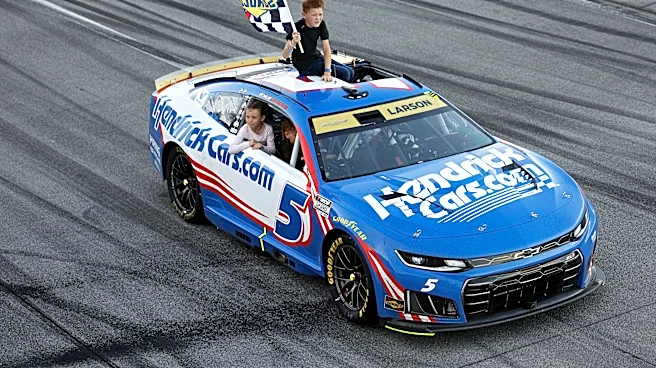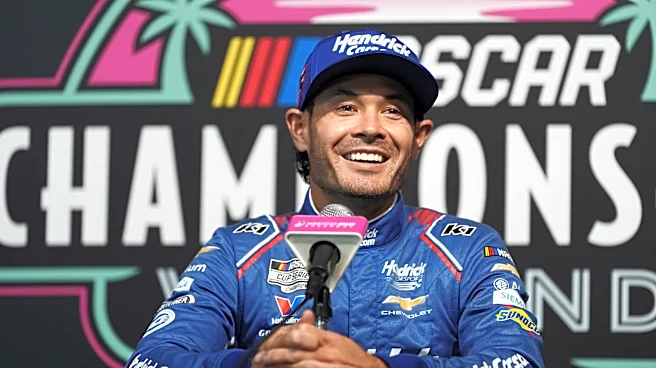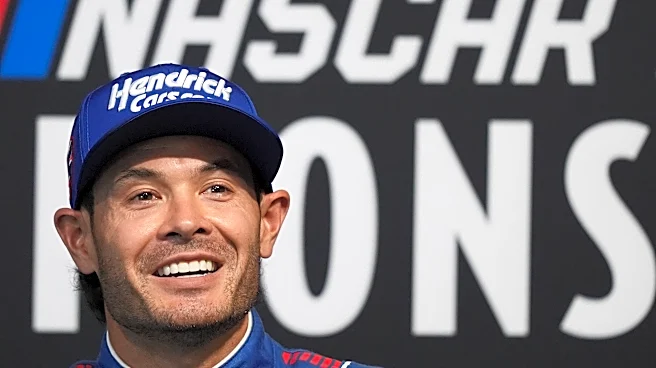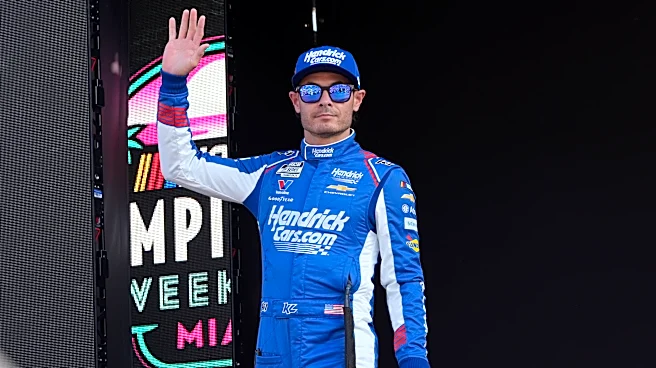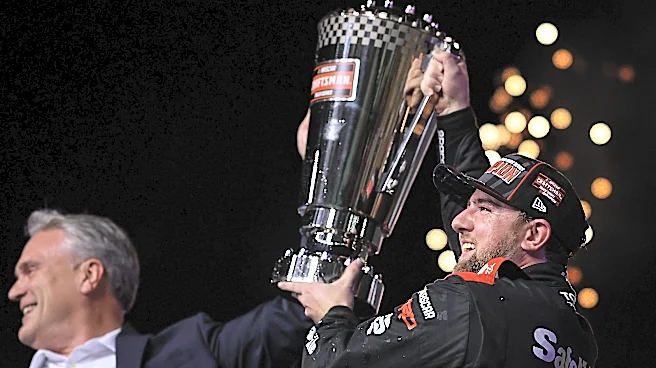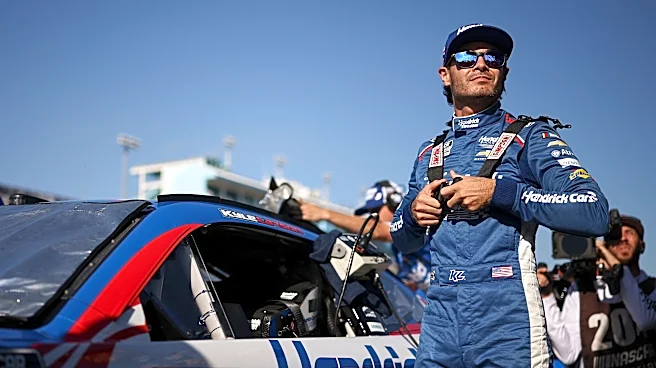


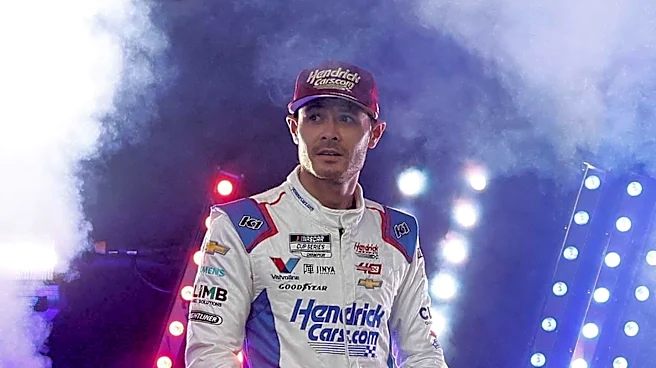
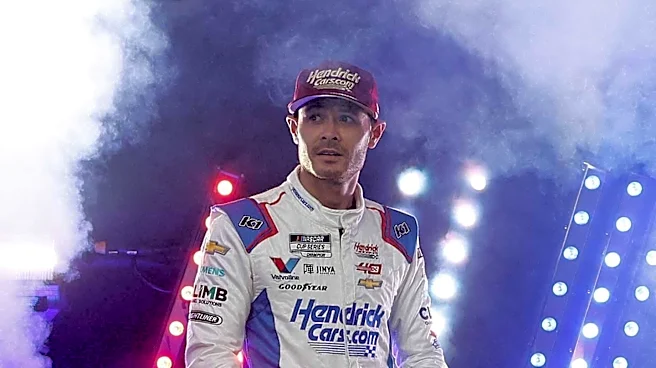
Kyle Larson didn’t need to do much on Sunday, Nov. 8 to capture the 2026 NASCAR Cup Series championship.
With comfortable leads over Christopher Bell and Denny Hamlin, all the 34-year-old native of Elk Grove, California had to do was earn eight stage points or without stage points, finish the race in 28th place or better at Homestead-Miami Speedway.
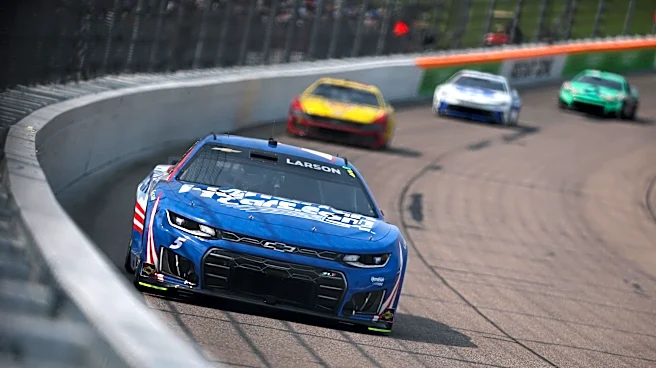
At arguably his best track on the circuit, where he’s led more laps than any other driver, Larson left no doubt. He put the pedal to the floor on his No. 5 Hendrick Motorsports Chevrolet and clinched the championship by finishing fourth in Stage 1 of the final race of the season. The seven stage points Larson scored put Hamlin and Bell out of reach of passing him in the standings.
After doing some quick
math, NASCAR informed Larson's crew chief, Cliff Daniels.
"They've declared it," Daniels told Larson. "We got it."
Surprised, Larson responded: "It's done? ... Well that was anticlimactic."
Indeed, for the third time in his career – and the first time in the revived Chase format – Larson is the champion of NASCAR’s top-level Cup Series.
"I think when the 5 team is in contention, other teams can feel that pressure, and it seems they kind of caved into that pressure a little bit. But we just stayed focused on us, and I think that was good," Larson said. "This one I’ll remember forever because of just the season that it was and the struggle that it was, and then just building as a team to be ready for the Chase, and then to go execute like we have."
Larson now joins an exclusive group of drivers to win at least three championships in the Cup Series. His name is now alongside legends and Hall of Famers of the sport like Lee Petty, David Pearson, Richard Petty, Cale Yarborough, Darrell Waltrip, Dale Earnhardt, Jeff Gordon, Jimmie Johnson, Tony Stewart and Joey Logano. Larson is the 11th driver in the history of the sport to own at least three titles.
And Larson’s crew chief Cliff Daniels became just the second crew chief to win three Cup Series titles in his first seven seasons. The other to accomplish the feat is Ray Evernham, who won three championships with Gordon in the 1990s.
The common thread there is that Daniels and Evernham both chiefed cars from Hendrick Motorsports, often considered the New York Yankees of NASCAR. Gordon is now the Vice Chairman of the dominant team, which celebrates its 16th championship with Larson. No NASCAR organization has as many titles as Rick Hendrick’s Chevrolet team.
Larson also becomes just the 11th driver to win back-to-back championships, and the first since another Hendrick driver, Jimmie Johnson, ripped off five consecutive titles from 2006 through 2010.
"Just the way Cliff leads us, and I don’t know what the word for our identity is, but I don’t think there’s a team like ours that’s ready for moments like our team is," Larson said. "I’ve said it a lot throughout my career at the 5 team, but it’s due to Cliff, and he’s always evolving as a leader, and there’s no better leader in the sport than him. I have a lot of trust in that."
How Kyle Larson overcame early struggles
For Larson, the season was not a dominant one from February at Daytona to November at Miami. The No. 5 team struggled and was inconsistent at times. Between the Daytona 500 and the Iowa Corn 350 on Aug. 9, Larson had three DNFs and logged five other finishes of 30th or worse. There were some strong results in that span, including eight top-five finishes, but the No. 5 hadn’t entered victory lane and something seemed off.
The tide seemed to turn for Larson, Daniels and the group on Aug. 15 at Richmond. After a rough start, Larson charged forward and placed sixth, notching his first top-10 finish since June 28 at Sonoma. As soon as the race ended, Larson unbuckled his belts, hopped out of his car and sprinted towards his hauler. He was in a hurry to get to the Knoxville Nationals sprint car event and had to catch a flight to Iowa to make the rain-delayed start. Larson led all 50 laps to win his 16th race at Knoxville and a $200,000 prize.
A return to his roots in dirt racing, and winning a meaningful race, seemed to reactivate Larson’s focus. He got collected in a multi-car wreck in the regular-season finale at Daytona, but then placed fifth in the Chase opener at the Southern 500 in Darlington. The next week at Gateway, he ended a 51-race winless streak, taking the checkered in a race that featured a track-record 18 caution flags.
"I really had no confidence, zero, before the Chase. Hope, but no confidence," Larson said. "I would really look at Darlington as that (being) the turning point of my confidence. I know we didn’t win, but I feel like we executed a really good day. I remember leaving that race thinking, 'Man, that’s the first time it’s felt like the 5 team in forever.' We were calling a race to win."
And then Larson kept running well. He placed second at Bristol to snatch the points lead away from regular-season champion Denny Hamlin and would never relinquish it. Larson padded that lead with a win at Kansas, a second-place finish at Las Vegas and a sixth-place day at Charlotte. His mulligan of the Chase came at Phoenix, when he blew a tire with 29 laps to go and slammed into the wall on Turn 1, ending his day with a DNF.
But Larson then bounced back in a big way the next week at Talladega, winning on a superspeedway for the first time in his career by charging from 11th to first on the final lap in an overtime photo finish. He ran ninth at Martinsville – unable to seize an opportunity to clinch the title there – but his contenders didn’t fare much better, allowing Larson to enter Homestead with a sizable cushion.
After Phoenix, there was a chance for Larson’s competition to overtake him, but none did. Specifically, Toyota drivers in the Chase from Joe Gibbs Racing and 23XI Racing won a combined 16 races this season, but none could capitalize on closing the gap on Larson when they had the chance to do so.
"There's a disconnect there and it could be all different things. ... It's so frustrating because you know that you're definitely capable, but you have to still play the game," Hamlin said this weekend. "I felt like (losing the championship) last year was like a sudden death, and this one was just a slow bleed. Truthfully."
Added Christopher Bell: "We all shot ourselves in the foot one way or another."
How Kyle Larson’s championship run stacks up in NASCAR history
Larson’s Chase was one of the most dominant postseason runs NASCAR has seen since it abandoned its full-season points format following the 2003 season. Even including his disastrous day at Phoenix, he had an averaged finish of 6.7 across the nine races in the Chase entering Homestead.
Of Larson’s three championships, this is arguably his most consistent postseason run. Last year, in the old elimination-style playoff format, he didn’t even win a race and had an averaged finish of 11.4 in the postseason. In 2021, he won five postseason races on his way to his first championship, but had an average finish of 7.4.
Larson’s postseason surge wasn’t the best all time, but it was still pretty remarkable, especially considering that when the Chase began he was eighth in the point standings. The run by the No. 5 Chevrolet was akin to Tony Stewart’s championship in 2011 when “Smoke,” after not winning a race all season, won five races to clinch his third title. Martin Truex Jr. still has arguably the top postseason performance, winning four races with an average finish of 4.3 in 2017 in the old playoff format.
"I care about winning the championship. I really don’t care about what the average finish is because that’s really not something that’s talked about every year, and I haven’t paid any attention," Larson said. "It doesn’t really matter. It’s just that they were or were not champion. That’s kind of how I feel about it. The championship is what matters."
Kyle Larson’s place in NASCAR history: How many more titles can he win?
NASCAR has often been a sport defined by decades. Richard Petty and Cale Yarborough owned the 1970s, Dale Earnhardt and Darell Waltrip battled in the 1980s, then Earnhardt found a new rival in Jeff Gordon in the 1990s. Jimmie Johnson dominated the 2000s, then Kyle Busch won a pair of championships and a whole bunch of races for JGR in the 2010s.
Larson is on his way to being the best driver of the 2020s with three championships this decade and 29 wins — more victories in the Cup Series than any other driver since the start of the 2020 season.
The decade, of course, did not start off well for Larson. He was suspended indefinitely by NASCAR and released by Chip Ganassi Racing in April 2020 after using a racial slur on an iRacing stream. Larson apologized, completed sensitivity training and took accountability for his actions. Ahead of the 2021 season, he joined Hendrick Motorsports and has since spent a whole lot of time in victory lane.
"I think we all have the belief – all of us drivers, I’m saying, have the belief – if we’re the fastest car in the field, there’s going to be nobody better than us," Larson said. "I feel that way, I’m sure Denny feels that way, I’m sure anybody feels that way. You should have that belief and confidence in yourself."
Larson, who has also won three of NASCAR’s crown jewels this decade — the 2021 Coca-Cola 600, the 2023 Southern 500 and the 2024 Brickyard 400 — will turn 35-years-old next July.
Since 1990, Jimmie Johnson, Tony Stewart, Kevin Harvick, Martin Truex Jr., Bobby Labonte, Dale Jarrett, Terry Labonte, Alan Kulwicki and Dale Earnhardt all won championships at the age of 35 or older. Earnhardt won five of his seven titles after turning 35.
Simply put, Larson has plenty of time to add more championships to his collection and continue to cement his legacy as one of the greatest racecar drivers of all-time.
This article originally appeared on USA TODAY: Kyle Larson wins third NASCAR championship to stand beside racing legends