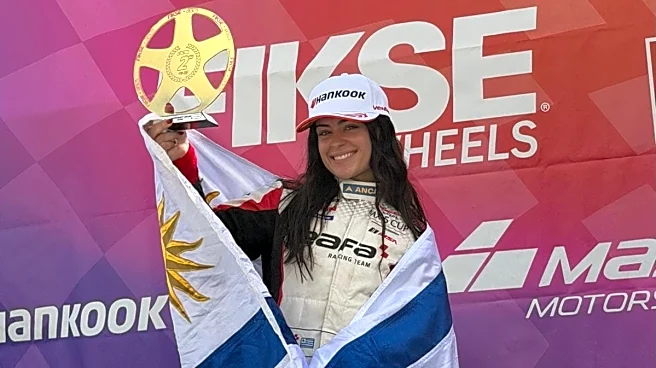





Maite Cáceres grew up surrounded by motorsports. Her father, Fernando, was a rally car driver and her brother, Juan, tested a Formula 1 car for Minardi. She loved the sport like the rest of her family.
"They were my role models growing up, and I wanted to do what they do," she told USA TODAY Sports. "But we had F1 on my TV all day every day that we could."
Fast forward, the 24-year-old Uruguayan driver has broken barriers as a woman in the sport. She has participated in F1 Academy and finished third in the 2024 Formula 4 United States championship. This weekend, she will be calling theF1 Las Vegas Grand Prix for Univision. She is believed to be only the second Latina driver to be a commentator for an F1 race on the Spanish-language channel. Venezuelan
IndyCar driver Milka Duno was part of Univision's F1 broadcast team in 2014.
"That is really nice for girls that maybe I didn't see. I didn't have a chance on TV or anywhere else that I was going with my family that I see girls in motorsport," Cáceres said of her own journey, "and now you can see engineers, mechanics, drivers, crew chief, journalists.
"I think that is truly inspiring for girls that want to achieve their dreams. There is no limitations now."
As a little girl, Cáceres didn't know that driving was a possibility for herself. She remembers around the age of 12 or 13 seeing women drivers and realizing that she could do it too.
"That opened a lot of doors in my head of saying, like, 'Okay, maybe I can do it,' and 'I'm not that crazy of thinking I like cars,'" she said.
Someone who pushed her to chase her dream was two-time F1 champion Fernando Alonso. She became a fan of his in the early 2010s when he was on Ferrari and battled with Sebastian Vettel for the title. She was also inspired by how the Spaniard competed in other motorsport series, winning the 24 Hours of Le Mans twice, and attempting to capture the Triple Crown by competing in the Indy 500.

Cáceres got to meet her idol when she was 16 years old.
"I told him, 'I want to do what you do,'" she recalled. 'My parents don't let me, but I want to become a driver.' And he was so polite to tell me like, 'You need to fight hard for your dream. I still work hard a lot.'"
She was surprised by how relatable his answer was.
"When he told me that, I was like, 'But you are an F1 champion. How do you tell me this?' I thought it was easy, but no, just work hard your way, your path. It is hard."
That conversation motivated her to confront her parents about why she wasn't allowed to drive. For eight or nine years, she was doing everything they asked her to: getting good grades and working hard.
"That moment was when like the bulb of saying, 'Why my brother can do it and I cannot?' So that was the question that changed my life because they said, 'Yeah, she has a point. She's showing passion. She's showing hard work.'"
Maite Cáceres' career as a woman driving in Formula series
Several kids start their driving careers with karting as early as eight years old. Cáceres first got behind the wheel competitively at age 17. But she quickly impressed in Uruguayan Formula 4 and was part of the inaugural season of F1 Academy in 2023. The program, which features a grid of all women drivers, is helmed by Managing Director Susie Wolff, who herself was a driver and wanted to create more opportunities for women in the sport. Several teams are co-signed by an F1 team and the series competes alongside the F1 calendar, racing at tracks like Silverstone, Zandvoort, the Circuit of the Americas and Las Vegas.
The series is, in fact, opening doors for women like never before. In April, last year's F1 Academy champion,Doriane Pin, became the first woman to drive an F1 car for Mercedes.
Cáceres credits F1 Academy for giving her knowledge about what it means to be a driver on and off the track. The next season, she went on to earn five podiums in the 2024 Formula 4 United States championship and an overall third place finish.
"It brought not only exposure and helped me develop me as a driver, but also helped me with brands and also to prepare for my next step, which was huge," she said. "And coming from Latin America, a small country like Uruguay, going into Europe and being my first time into all the racetracks, it was intimidating, also, but really good into learning."


Once she got into racing, it was no longer her parents who didn't want her to drive. She's been pushed off the track, told she belongs in the kitchen and criticized on social media for being a woman.
"There are gonna be people telling you it's not worth it or trying to tear you down," she said. "But as long as it's your dream, you need to work hard for it.
"Even if the boys don't like it, that you're driving or you're winning to them, that it had happened to me, that doesn't mean that you don't belong."
Maite Cáceres brings driver expertise to F1 Las Vegas Grand Prix broadcast
Cáceres will now bring that expertise to dedicated Formula 1 fans and people who are curious about the sport and will tune into the Las Vegas race on Univision.
Rather than the super technical aspects of F1, "I'm more excited to bring to the audience, to people, families that maybe they don't know a lot about motorsport and they wanna get involved to actually explain a little bit from a driver's perspective, what is going on into Las Vegas Grand Prix?"


Besides the glitz and glam of the city that partially attracted Liberty Media to establish the race back in 2023,the colder weather at a November night race in the desert creates a unique environment for the drivers.
"It's gonna be really exciting to see how they can manage with the tire temperature during the race, the time changes for the driver in terms of like training and mentality they're gonna have," Cáceres explained.
The drivers championship is already wrapped up with 20-year-old Kimi Antonelli becoming the youngest champion ever. He did so when he finished third at the Mexico City Grand Prix. The constructors championship is also already clinched. Mercedes claimed its ninth championship at the São Paulo Grand Prix in Brazil.
But Cáceres assured there's plenty of storylines to watch, including how the cars with new regulations will perform, and the fact that the rest of the standings are still to be decided. The final team results determine where each outfit will have their spot on pit lane, which has competitive advantages.
Cáceres also pointed out that Sergio "Checo" Pérez will be trying to get Cadillac's first point. Despite a down year, the Mexican driver has already made history in his career. He was the first Mexican driver to win the esteemed Monaco Grand Prixand first to finish on the podium at his home race, the Mexico Grand Prix.
"He's on another role this year, developing a new team, a new car," she said. "So that is actually also exciting for the Latin community."

Watching Pérez this weekend further emphasizes the importance of representation, especially in European-centric F1. This is something Cáceres cares about as a woman and representing Uruguay.
"It's really an honor to represent my country internationally," she said. "... It's important that we can show that there are some drivers into F1 because maybe there's a little boy or a little girl seeing that, 'I want to do that,' and since they see someone from their country or someone that speaks Spanish, they can relate to it and say, 'Okay, if they they did it, maybe I can have a chance too.'"
How to watch the F1 Las Vegas Grand Prix
- Time: Pre-race coverage starts at 10 p.m. ET, Race starts at 10:55 p.m. ET
- Date: Saturday, Nov. 21
- English: Apple TV
- Spanish: Univision
This article originally appeared on USA TODAY: Meet Maite CáceresWoman driver offering insight for F1 Las Vegas Grand Prix