


Maybe we've got these kids all wrong.
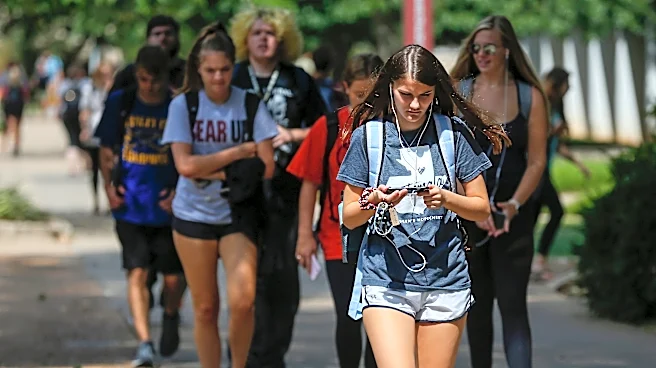
America has been in a steady religious decline, with each generation of adults less faithful than the one before it. Generation Z, it was thought, would continue that pattern, with one study labeling the age group “the least religious generation yet.”
A new Harris Poll survey suggests that may not be the case: The results show younger people are not only more religious than previously believed but more so than any of their elders. Gen Z adults – those aged 18 to 29 – aren’t just embracing religion at higher rates, the survey found, but spiritual practices in general, including meditation, astrology and energy work such as reiki and tai chi.
“This idea that generations would be more secular in the future – this
generation is really flipping the script on that,” said Libby Rodney, chief strategy officer for the Harris Poll, a national marketing and analytics firm.
The firm had studied practices such as astrology and manifestation in the U.S. and figured Gen Z would express high interest in spirituality, Rodney said.
“What was shocking was that 33% identified as religious, nearly double the amount of Boomers and the highest of any generation,” she said.
The online survey of 2,136 U.S. adults included members of Gen Z, Millennials, Gen X and Baby Boomers.
While no one generation can claim to be brimming with spiritual fervor, fully a third of Gen Z respondents identified as religious, compared with just 19% of Millennials, 22% of Generation X and 18% of Boomers. The survey also found that while people are more likely to pray on their own as they get older, Gen Z was the likeliest of all age groups to attend religious services or read scripture.

Those findings didn’t surprise Angie Bosio, a youth ministry director at St. Stephen Catholic Community in suburban Nashville, Tennessee, who while unconnected to the survey said today’s youth strike her as “extremely curious, very positive and already very faith-filled by the time I see them in high school.”
“They are more religious than their predecessors,” said Bosio, who just marked her 25th year in youth ministry. “In my experience, they’re the most religious cohort I’ve seen.”
Bosio believes that in addition to the support of their Millennial parents, social media is playing a large role in this generation’s upswing; today’s youth have online access to faith leaders who help further their interest in scripture and answering life’s big questions.
“They’re coming in with confidence and a little bit of knowledge,” she said. “We can talk at length about that, like, what does this mean to you.”

While Millennials (32%) and Gen X (31%) survey respondents were more apt to describe themselves as spiritual rather than religious, nearly nine in 10 Gen Z members (88%) reported regularly practicing at least one religious or spiritual activity, the highest share of any generation.
'A generational awakening'
The past few decades have seen the country gradually pull away from organized religion: Fewer than two thirds of Americans are Christian, down from 90% in the early 1990s, according to the Pew Research Center.
At the same time, the portion of those describing themselves as agnostic, atheist, or “nothing in particular” – the so-called “nones” – rose to nearly three in 10. But while some studies showed the portion of "nones" significantly higher among Gen Z, other studies indicated young people were increasingly pursuing spiritual fulfillment beyond traditional institutions or faith systems.
Rodney, of the Harris Poll, said the survey demonstrated how young people are coping with growing economic and societal challenges while shaping a future defined by their own values and beliefs. The results, she said, show young people are eager for human interaction.
About six in 10 Gen Z and Millennial survey respondents reported belonging to more real-world, in-person communities – such as clubs, faith communities and hobby or volunteer groups – than they used to, compared with 42% of Gen X respondents and just 32% of Boomers.

Anxious and lonely in a post-pandemic society unsettled by the threat of artificial intelligence and climate change, she said, young people recognize the pitfalls and limitations of digital media and feel disillusioned with the promises of the American Dream. They’ve encountered a shrinking job market and a shortage of entry-level homes and are among the first to be let go when jobs are cut.
“It’s a generational awakening,” Rodney said. “If everything around them feels like it’s not working and disjointed, they’re looking at what kind of life they’re going to build.”
The findings indicate both religion and spirituality will figure into their plans, she said, describing their practices as a sort of “stacking” in which many aren’t just praying or reading scripture but incorporating energy work, astrology and meditation into their lives as well.
The survey found more than half of Gen Z respondents had pursued a spiritual practice or quest for meaning in the past year, while about six in 10 had launched a side hustle, restructured work obligations to fit the life they want or embarked on a new project or hobby. Nearly seven in 10 had learned a new skill or sought new training or education.
“It’s not just about being traditionally religious,” Rodney said. “This generation is facing all these crises where every day things are getting worse. They’re basically gathering all the possible tools and coping mechanisms to figure out how they move forward from here.”

In terms of feeding their religious interests, she agreed social media is playing a major role, pointing to efforts like Pizza to Pews, a viral Sunday activity in which youths congregate at local pizzerias before attending Mass; or the Holy Girl Walk in New York City, in which young Catholic women pray the rosary while strolling through Central Park.
“They’re searching for connection and commonality, and it’s a direct result of feeling lonely post-pandemic,” Rodney said.
Young people, she added, have also found identity and community in global figures like Guilherme Peixoto, a Portuguese Catholic priest and DJ known as Padre Guilherme who blends religion and electronic dance in his sets and performed at World Youth Day in 2023.
This youngest American generation, she noted, is more multicultural and diverse than any previous generation; more than half are people of color and likelier to identify as other than heterosexual. In that sense, she said, their interest in both religious and spiritual practices isn’t so surprising.
“They’re coming from different backgrounds and experiences,” Rodney said. For a generation containing a range of identities, “the idea of being inclusive of spirituality and religion is more organic.”

That’s been the case for Jordan Booker, a 2023 University of Houston graduate who founded Smoove Blendz, a pop-up “wellness + community” experience described as “the calmest party in Houston,” featuring meditation, yoga and matcha.
“Come reset, recharge, and enjoy the moment with us,” a recent event announcement read.
Earlier this month, Booker, who grew up Christian, attended “Motion Night,” a faith-based event at Houston’s Grace Church for adults aged 30 and under that included an afterparty with food trucks.
“It was amazing to see so many people worshipping the Lord and praising him,” Booker said. Such youth-focused events, he said, “make being religious and going to church cool.”
This article originally appeared on USA TODAY: Study: Gen Z is more religious than older groups, defying expectations