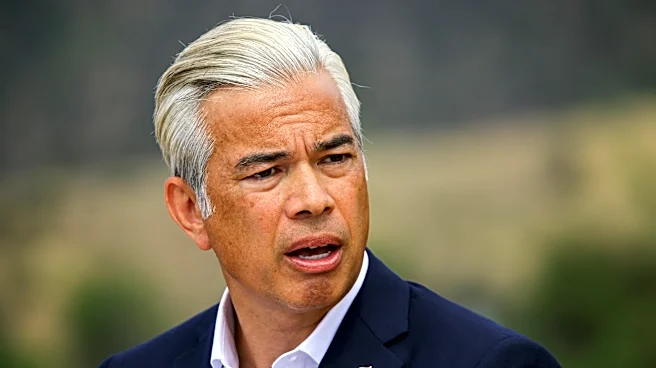



California's Attorney General abruptly canceled a Monday meeting with representatives from Paramount Skydance, which would have brought the two groups together to start discussing a potential settlement of the state's antitrust lawsuit challenging the Paramount-Warner Bros. merger.
The attorney general, Rob Bonta, confirmed in a statement on Aug. 24 that his office had "pulled down this meeting," specifically accusing Paramount of leaking and misrepresenting parts of the settlement, and noted that Paramount's leadership had demonstrated "a lack of good faith."
“As soon as Paramount stops playing games and engages sincerely, my office is happy to meet again,” Bonta said in his statement.
Bonta's accusations likely refer to a Wall Street Journal
article published over the weekend that included confidential details of the potential settlement discussions.

A spokesperson for Paramount told NBC News that the company also shared Bonta's concerns regarding "misreporting that has surrounded this deal.”
“As we have assured the Attorney General’s office, Paramount has not been the source of the leaks of any of our confidential discussions with the AG’s office,” the Paramount spokesperson told NBC News.
How the legal battle over the Paramount-Warner Bros. merger escalated
Bonta's decision to cancel talks with Paramount representatives is the latest twist in the controversial merger between Paramount and Warner Bros. Discovery, after the companies announced on Feb. 27, 2026, that the pair had reached a $110.9 billion agreement.
Prior to Monday's canceled meeting, Bonta had maintained a firm position that the state would pursue an antitrust lawsuit against the merger. Earlier in the month, Bonta even criticized Paramount's leadership,claiming they are attempting to "blackmail the state into letting an illegal deal" to fast-track the state's lawsuit.

Specifically, David Ellison, the CEO of Paramount Skydance, is threatening to move the company out of California starting in October unless the state's attorney general agrees to resolve the merger via a settlement.
"In a span of weeks, Paramount agreed to halt the merger until a court decision or until June 2027, asked for a November trial, and is now back with another attempt to blackmail the state into letting an illegal deal through," Bonta said on X.
"Paramount has lost the plot as it continues to lose in court."
Would a Paramount-Warner Bros merger lead to fewer movies?
On July 13, California and several other states announced they would sue to block the proposed merger between Warner Bros. Discovery and Paramount Skydance, saying it would lead to higher prices, lower quality, and less content for film and television — among other alleged harms.
The lawsuit argued that the merger would create a “media behemoth” and also “likely to substantially harm competition.” Between the two movie studios, Warner Bros. and Paramount, create programming for movie theaters, audiences, and cable television distributors, and employ thousands throughout the entertainment industry. The attorneys general argue that the industry would be harmed if the merger were to go through as planned.
The states point to previous media consolidation as a warning sign. After Disney acquired 21st Century Fox in 2019, the once-prolific 20th Century Fox film label was dramatically scaled back. Fox released an average of 16 films annually in the decade before the merger, but the studio is scheduled to release just six titles in 2026 and three in 2027. Antitrust critics contend the Paramount-Warner Bros. deal could similarly reduce the number of films and television projects produced, shrinking opportunities for workers, creators and consumers.
Paramount CEO David Ellison has pushed back on concerns that consolidation would result in fewer films. Since announcing the deal, Ellison has pledged that the combined company would increase movie production, arguing that the merger would provide the scale and financial resources needed to make more theatrical releases and invest in a broader slate of films.
Critics, however, note that similar promises were made during Disney's acquisition of 21st Century Fox.
Paramount threatens to move studio out of California
About a week after the lawsuit was filed in the U.S. District Court for the Northern District of California, Paramount informed the court that it would not proceed with the lawsuit until June 1, 2026, unless the judge issued a ruling before then, according to court documents.
However, on Aug. 5, Ellison met with his 12-member senior executive team to discuss plans to potentially move the company to another state starting Oct. 1, if talks between Bonta and the company did not budge, according to Puck News.
Paramount Pictures is one of the oldest film studios based in California, founded in Los Angeles in 1912 and maintaining a presence in the state for over 100 years.
Although Bonta initially slammed the idea of reaching a settlement agreement with Paramount, Xavier Becerra, the Democratic gubernatorial nominee and former Attorney General for California, urged the attorney general to settle the lawsuit during POLITICO's The California Agenda: Sacramento Summit.
Becerra shared that antitrust lawsuits are "very difficult" to win and urged his predecessor to consider a settlement and pursue a deal that would benefit California's entertainment industry and families.
"At the end of the day, is it good for the entertainment community in California? Does it benefit California families to have another merger occur?" Becerra said during the summit on Aug. 11.
"I hope it settles before court. It is easier to stand in a conference room to settle than it is to stand in a courtroom."
Noe Padilla is a Northern California Reporter for USA Today. Contact him at npadilla@usatodayco.com, follow him on X @1NoePadilla or on Bluesky @noepadilla.bsky.social. Sign up for the TODAY Californian newsletter or follow us on Facebook at TODAY Californian.
This article originally appeared on USA TODAY: California cancels potential settlement talks with Paramount