








As we age, no one looks forward to getting weaker, feeling less steady or discovering that carrying groceries takes more effort than it used to.
To help stave off those changes, some people turn to supplements or expensive treatments. But one of the most useful investments in maintaining strength and independence is surprisingly simple: regularly asking your muscles to work a little harder.
After all, "strength training improves physical function and independence as well," says Dr. Emily Miller, a sports medicine physician and associate clinical professor at the University of California, Los Angeles.
And the best part, she adds, is that these and other benefits don’t require becoming a bodybuilder or spending hours at the gym. Here’s why strength
training matters, how walking also fits in and five ways to build strength safely and consistently.
What happens to your muscles as you age?
Age-related muscle loss occurs due to several changes, explains Miller, including a reduced ability to build and maintain muscle proteins and changes in the nerves that activate muscle fibers. Increased levels of inactivity and nutritional changes can also contribute. Over time, such factors can lead to sarcopenia, a muscle disorder characterized by low strength and reduced muscle quantity or quality that increases the risk of falls and disability.
This underlying muscle loss usually begins in one’s 40s but "accelerates with age," says Dr. Jordan D. Metzl, a sports medicine physician at Hospital for Special Surgery in New York. By "age 60," he adds, "we start to lose about 10% of our muscle mass per decade."
Resistance training can counter those changes by challenging muscles with weights, bands or your own body weight – exercises that can "slow age-related decreases in muscle mass, strength and power," says Miller. She adds that more than 100 randomized controlled trials "show this can also improve mobility, gait speed, abilities to move from sitting to standing and many activities of daily living."
Strength training benefits can also extend to joint function and comfort, as "stronger muscles help protect aching joints like arthritic knees," says Metzl. He adds that building muscle also supports blood sugar regulation by helping muscles take up glucose from the bloodstream and improving their responsiveness to insulin.
Miller says these types of exercises can support bone health, too, because placing stress on bones helps maintain their strength. "And we are learning more about the anti-inflammatory properties of muscle, which carry over into disease prevention across the lifespan," adds Metzl.
Is walking or strength training better for healthy aging?
While strength training directly challenges muscles to maintain or build strength, walking complements that work by supporting cardiovascular health, mood and endurance.
Because of this, both have a place in a healthy aging routine. That's why the Centers for Disease Control and Prevention recommends at least 150 minutes of moderate-intensity aerobic activity or 75 minutes of vigorous activity each week, and muscle-strengthening activities on at least two days.
As for a daily step goal, 10,000 steps is often held up as the target, "but this is not a magical number," says Metzl.
Indeed, a 2025 meta-analysis found that taking 7,000 steps daily was associated with a 25% lower risk of cardiovascular disease and a 47% lower risk of dying from any cause compared to those individuals who walked only 2,000 steps a day.
The most important lesson is that "the biggest gains are seen when people move from being sedentary to more active," Miller says. That might mean beginning with short walks, trying resistance bands or gradually building a gym routine, but "movement is impactful on health no matter how it's done," says Metzl.
What are the best strength-training tips for your 40s, 50s and 60s?
Building strength as you age starts with choosing a routine you can sustain, which may be helped by considering the implementation of these five tips:
- Have someone to exercise alongside. Specifically, "find a buddy or someone to take a class with or to work out with," advises Miller. She explains that “accountability helps" and that having someone who is expecting you to show up can make it easier to keep exercising when motivation dips. They can also spot you and support you to make sure you’re working out safely.
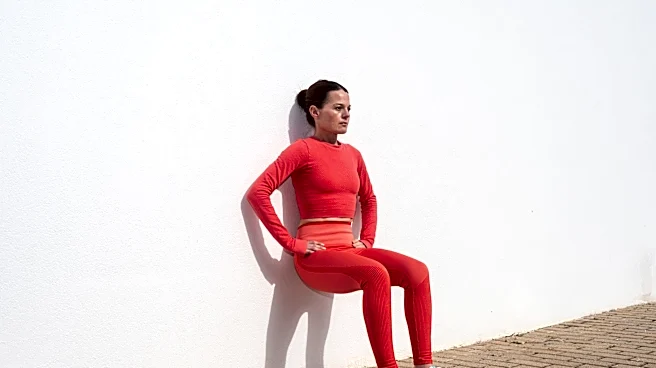
- Make strength training a regular part of your week. Miller echoes the CDC’s recommendation of "practicing resistance training at least twice a week." When doing so, she suggests working all major muscle groups, ideally on nonconsecutive days. She recommends initially aiming for eight to 12 controlled repetitions per exercise, then resting between sets before repeating as appropriate for your goals and abilities. Exercises such as push-ups, pull-ups, squats, lunges, crunches, planks and glute bridges can help. It's OK to choose versions that match your current strength and mobility, Metzl says.
- Learn proper form and technique. As you master each movement, "start low and go slow," Miller advises. An introductory class or a qualified trainer can help you learn proper form, she says, especially when using unfamiliar equipment. Good technique helps you target the intended muscles, gives you better control over each movement and reduces your risk of injury.
- Increase resistance and repetitions gradually. As exercises become easier, Miller suggests adding repetitions, increasing resistance or introducing another set. That might mean beginning with one set per exercise and working toward two or three as your strength and tolerance improve.
- Recover, and listen to your body. Miller emphasizes allowing recovery between demanding workouts for the same muscle groups and adjusting when you need more time. A practical starting point is a full rest day between those sessions, roughly 48 hours from one workout to the next. While some muscle soreness can follow an unfamiliar workout, Metzl distinguishes that from "significant discomfort which changes the way you move." Pain that alters your movement, he says, warrants stopping the exercise and getting assessed.
Consistent movement can help at every stage of life, so starting later still counts. "I start patients on strength training programs at any age, including patients I see in their 80s," says Metzl. "Remember, if you're not actively building muscle, you're actively losing it."
This article originally appeared on USA TODAY: The 5 best strength-training tips to do in your 40s, 50s and 60s