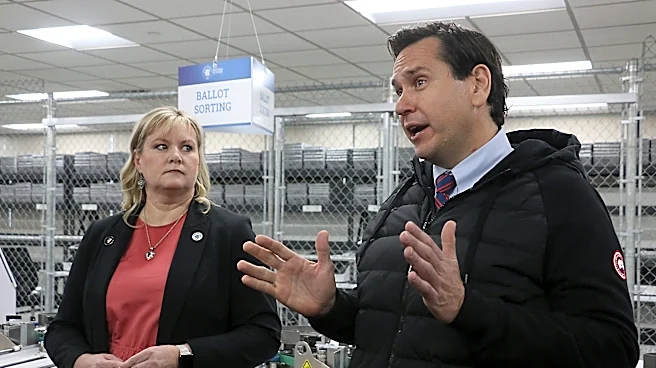

Multiple states said they will join together and file a new challenge to mail-in ballot restrictions being implemented by the Trump administration.
The suit is expected to be filed as soon as Aug. 26.
"The
fight's not over," Nevada Secretary of State Cisco Aguilar told USA TODAY.
Aguilar, who also leads the Democratic Association of Secretaries of State, spoke about the issue one day after the U.S. Supreme Court removed a block on the Postal Service writing rules to put the plan into place. A second separate hold preventing the Postal Service from moving forward is already in place nationwide.
In the meantime, news of the court's decision has created new uncertainties for voters that state and local election officials must grapple with weeks before Election Day.
Despite any perception, the ruling has "no bearing currently on electoral processes for mail-in voting for individuals for the 2026 election," Maryland State Administrator of Elections Jared DeMarinis said. "It's important that ... we tell voters mail-in voting is legal, the processes have not been altered or changed, and it is a safe, convenient, verified method of voting. That is the truth. That remains the reality of the situation here."
The Supreme Court's decision said a lower court moved too soon when it partly paused President Donald Trump’s executive order cracking down on mail-in ballots. It also said that states couldn't challenge rules that have not yet impacted them. States had challenged the executive order, saying the Constitution gives them authority over election administration, not the executive branch.
The Postal Service finalized those rules Aug. 21, despite the lower court's order.
"The Supreme Court said, 'Hey, your original challenge was a little too early because you really didn't know what the implications were going to be. So now that you do know, go and fight in courts over the actual existence of the rule,'" Aguilar said.
The rules, which will be formally published Aug. 26, detail how the Postal Service would implement an executive order Trump signed in March that seeks to give the agency a say over when and how ballots are mailed and which ballots are returned to local election officials.
The high court didn't rule whether the restrictions on mailed ballots in the executive order were legal or could be used in this year’s midterms.

“The Supreme Court ruling was a major win for the security of American elections. Radical Democrats continue to oppose commonsense measures that protect the security of mail-in ballots and ensure only Americans are electing American leaders. The Trump Administration will continue to lawfully enact the agenda President Trump was elected on – which includes the safety and security of our elections," White House spokeswoman Lauren Bis told USA TODAY.
The fight over what rules govern absentee ballots could be crucial for the 2026 midterms, which will determine which party controls Congress. Democrats need to flip a handful of seats in the House and Senate to gain control.
Colorado Secretary of State Jena Griswold stressed that voters should know the Supreme Court's move was procedural, not final.
"We are going to continue to fight this as the executive order is implemented. We believe we are on the right side of the law, the Constitution and history," Griswold told USA TODAY. "The Constitution is clear. The states run elections, not Donald Trump. Trump is trying to decide which voters can receive a mail ballot."
Voting by mail has decreased since its peak during the COVID-19 pandemic. But nearly 30% of voters still cast an absentee ballot in the 2024 election.
Democrats are more likely than Republicans to vote by mail, according to the MIT Election Data & Science Lab.
"The point is to undermine public faith in our elections by raising the specter of "chaos and distrust" that will get people to stay home on Election Day, said Sean Morales-Doyle, director of the Brennan Center's Voting Rights and Elections Program. The Brennan Center is part of the legal team in a separate lawsuit that still blocks the Postal Service from moving forward.
The Postal Service did not respond to a request for comment.
States worried about confusion
Multiple secretaries of state told USA TODAY they fear the Supreme Court's order just over 70 days before the election will sow chaos and confusion among voters about whether the Postal Service will get to decide which absentee ballots to deliver.
Maine election officials are moving forward as if nothing will change, Maine Secretary of State Shenna Bellows said.
"What the Supreme Court did, as egregious as the decision is, changes nothing for election officials who are already making plans for November to ensure that every eligible American has the ability to cast their ballot and know that their vote will be counted fairly," she told USA TODAY. "We are not going to change any processes or procedures at the president or the Supreme Court's whims. We will not make any changes unless we are legally required to do so."
Griswold, Colorado's secretary of state, said she is concerned people will catch only bits of what is happening and be confused.
"I do think that this back and forth in lawsuits and a court decision so close to the election is troublesome for various reasons," she said. "Having this uncertainty is hard. We are way too close to the election. I do think it can be confusing for American voters."
There isn't much time left for the cases to be resolved or for the new Postal Service rule to practically be put in place, the state officials said.
Under federal law, ballots must be sent by mail to military and overseas voters the week of Sept. 14 to ensure they can be returned on time. Twenty states also send mail-in ballots to voters 45 days or more before an election, according to the National Conference of State Legislatures. For example, North Carolina begins sending ballots out the first week of September.
The Postal Service's new rule requires state and local election officials to submit voters’ names and addresses to USPS through a new portal, and only voters whose information is submitted will be allowed to receive mail-in ballots, which will be sent in envelopes with special federal barcodes.
Also under the rule, the Postal Service would not collect or record party affiliation and would not inspect ballot contents. Postal workers would not be authorized to open sealed mail.
Aguilar said even if the lawsuits fail he doesn't think the Postal Service could enforce the rule in the midterm election.
"I don't think there is one ounce of opportunity that the post office can put this database together in less than 70 days," he said. "No federal government agency can do anything in a meaningful, efficient way. And to ask them to build a massive database that requires a lot of technology and a lot of thought in a short period of time will drive them to complete failure."
Use ballot boxes
To address voter confusion, some election officials are urging voters to use ballot drop boxes rather than the mail to ensure their ballots are counted.
"If you're going to use the Postal Service, drop it off a week before Election Day. If you're gonna hold it closer to Election Day, drop the mail ballot off at a polling location in a drop box," Aguilar said.
But more than two dozen states don't allow ballot drop boxes or have restrictions on them. In many of those states, voters who don't want to put ballots in the mail can opt to drop off absentee ballots in person at local election offices.
Eleven states either explicitly prohibit drop boxes in statute or list approved methods of ballot return that do not include drop boxes, according to the National Conference of State Legislatures. They are Arkansas, Indiana, Louisiana, Mississippi, Missouri, North Carolina, Oklahoma, South Carolina, Tennessee, Texas and West Virginia.
Another six states – Idaho, Kansas, North Dakota, Pennsylvania, Wisconsin and Wyoming – are not explicit about drop boxes in statute and have some jurisdictions that use them.
Alabama, Alaska, Montana and New Hampshire do not have an applicable statute and do not use drop boxes, according to the NCSL.
The other 29 states and the District of Columbia explicitly permit drop boxes by law.
Contributing: Maureen Groppe
This article originally appeared on USA TODAY: New legal battle looms over Trump mail ballot rules