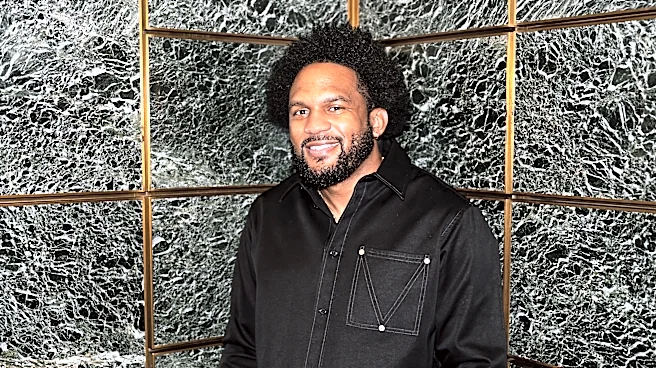



On the Friday, August 7, 2026, episode of The Excerpt podcast: Before the crowdfunding giant Kickstarter hired a 33-year-old CEO in the fall of 2022, revenue had been falling…. as much as 20 percent earlier that year. Since then, the company – where folks fund projects by creatives – has bounced back in a big way. Kickstarter CEO Everette Taylor joins The Excerpt to share what motivates him.
Hit play on the player below to hear the podcast and follow along with the transcript beneath it.
This transcript was automatically generated, and then edited for clarity in its current form. There may be some differences between the audio and the text.
Podcasts: True crime, in-depth interviews and more USA TODAY podcasts right here
Jay Stahl:
Before the crowdfunding
giant Kickstarter hired a 33-year-old CEO in the fall of 2022, revenue had been falling as much as 20% earlier that year. Since then, the company where folks fund projects by creatives has bounced back in a big way. Last year was Kickstarter's best year on record. So how did a young, Black corporate executive do it?
Hello and welcome to USA TODAY's The Excerpt. I'm Senior Reporter Jay Stahl. Today is Friday, August 7th, 2026. I'm now joined by Kickstarter CEO, Everette Taylor. It's so good to have you here, Everette.
Everette Taylor:
It's great to be here. Nice to meet you, Jay. How are you?
Jay Stahl:
Nice to meet you too. I'm great. You grew up in Southside Richmond, Virginia. What was that like?
Everette Taylor:
Southside Richmond, Virginia, a lot of trouble, but good things as well. I mean, for me, culture and creativity has always been a big part of my life. So I was into music, I was into art, I was into all different types of things, science, history, et cetera, et cetera. I kind of had my own little world, but obviously outside of that in Southside of Richmond, it was tough. It was a poor socioeconomic area. It was gangs, drugs, prostitution. You saw the whole gauntlet there. But at the end of the day, I had an incredible mom. She worked really, really hard. I was always involved in sports and creative activities and things like that. So it kept me out of trouble mostly, but I think I got to see a wide spectrum of the human experience being in the city. And then also it taught me what not to do, and it showed me that I wanted to get out of there and expand beyond Richmond, the city.
Jay Stahl:
So you were homeless during your childhood in Richmond before you turned 18. Why and how did that change you?
Everette Taylor:
Why and how did that change me? I think that at the core, I'll never forget that experience. And no matter how successful I become, no matter what I experience, I still remember what it's like to be in that position. And I never want to put myself in a position where I feel like I can't take care of myself and the people that I love most. And that has been something that has been a motivating factor throughout my career, especially early in my career. And I think another big piece of that is just the emotional intelligence and empathy that came along with that experience.
And when I think about product experiences, building businesses, et cetera, et cetera, I think of the whole spectrum of humanity from the people that have everything to the people that have nothing. And that experience has always been a balancing factor throughout my entire life. And it also motivates me and inspires me to do really purpose-driven work, to help change lives. And that's why I feel like there's a lot of alignment with me at Kickstarter because we get the opportunity to change millions of lives.
Jay Stahl:
Your path to Kickstarter was through branding and marketing, which is atypical. How do you think that shaped your strategy as CEO?
Everette Taylor:
I think with Kickstarter being in a space where the brand was in a bit of a decline, crowdfunding itself was in a bit of a decline. I think my ability to really think about how to shape brands, how to engage people, find target audiences, how to rejuvenate brands and rejuvenate culture was a plus. And those are the things that I thought about when coming into Kickstarter. I wasn't looking at it from a purely financial operational lens. I was thinking about it from a creative lens. I consider myself a creative first before a businessman. And I think having that kind of creative lens instead of just thinking purely analytically, I think helped me a lot coming into the CEO role at Kickstarter.
Jay Stahl:
Can you talk about how the rise of the creator economy, especially after COVID, helped contribute to your rebound, and how you revived Kickstarter?
Everette Taylor:
Yeah, Jay. Kickstarter was started in 2009. How many people did you hear calling themselves a creator in 2009? Probably not a lot, right? You fast-forward to 2026, that's completely different. So many people every day are looking at themselves as creators, especially Gen Z. A lot of them aren't looking to work traditional 9-to-5's or become doctors and lawyers. They want to be creators. People want independence. People want the ability to have ownership, to be able to set the course of their own lives, and build and own their own audiences. And I think Kickstarter, it was before its time, and now it's at the right, exact moment during this explosion.
And I think seeing so many people wanting to launch new things, be independent, be a creator, I think Kickstarter had a lot of alignment with that. And we're seeing a surge in business due to the explosion of the creator economy, as well with a lot of other things that are happening that is causing our growth.
But on the flip side, I would say things that are happening in our economy also have boosted the creator economy. People are losing jobs. There's been mass layoffs. The economy is a little mixed right now. And so I think people are now almost kind of being forced into entrepreneurship and creatorship at this time and point. And so I think it's a beautiful thing that people are being independent and want to launch their own thing. And I think Kickstarter is the perfect platform to do so.
Jay Stahl:
It's interesting because on that note, you recently announced that Kickstarter has pledged $1 million to its new culture fund.
Everette Taylor:
Yes.
Jay Stahl:
It's an initiative that aims to support projects from creatives across the fashion, music, art, and film industries. What helps inspire you in this new venture at Kickstarter?
Everette Taylor:
Yeah. I think first and foremost, although Kickstarter is a global tech company and we're a for-profit, we are also a public benefit company. And as a public benefit corporation, it's really important for us to maximize impact in the good of the world over maximizing profits. And for me, when I look around the world and I see what's happening, artists are getting impacted greatly. These are the fashion designers, these are the visual artists, these are the filmmakers, these are the musicians. The infrastructure is crumbling around them. And the ethos of Kickstarter is about creativity, it's about artistry, it's about helping out creative people.
And I think this is the step in the right direction as we just launched our new campaign called The Power of Belief. If we expect others to believe in people, then we need to believe in people ourselves. And so that's why I was inspired to launch this fund. And this is just the first one. It's going to be a multi-year, multi-million dollar fund. The first million dollars will be dedicated to fashion, art, film, and music. But we're going to continue to expand this and grow this, and I'm really excited about it.
Jay Stahl:
You mentioned being a young Black CEO. I wanted to ask you about that. You're only 37. What are your thoughts on being that type of representative for the Black community, for young people, for people that are millennials?
Everette Taylor:
Only 37. They're calling me unc nowadays, Jay. I definitely understand and I'm grateful for the position that I'm in. But also I know that I deserve to be here because I've put in the work, and I've had the results at every stop of my career. I mean, that's something that I'm extremely proud of. And I want to be an example to other young Black boys and girls or underrepresented groups that, if you work hard, if you're intentional about your life, intentional about your career, that you can do the same and still be authentic.
I can wear an Afro style. I can wear cornrows and braids. I can be fashionable. I can wear streetwear and still be a CEO. I can still be authentically Black as a CEO. That's something that's really important to me as long as you're putting in the work. And to be an example of that, I think is extremely important because people don't have that. I don't know anyone else particularly like me running a company of the scale of Kickstarter that's as young as me and looks like me. And I want to provide pathways for more people that look like me, that come from unorthodox backgrounds to be able to do the same because Black people are magic, man. And diversity is important, and I don't care what anyone says. That's something that I feel very, very strongly about. So to be a representative of that is really important to me.
Jay Stahl:
As you transitioned to CEO of Kickstarter, Kickstarter transitioned to a fully remote, 32-hour, four-day work week. Can you tell me about the thinking behind that?
Everette Taylor:
I came into Kickstarter in late September of 2022. I mean, COVID was still around, obviously it's still around, but they had already went remote for the most part. We still had this huge office in Brooklyn, but a lot of our employees had moved to other parts of the country. We had started hiring globally, so we had employees all around the world. And it felt like I would be going backwards a bit to force people back into going back into the office. I care very much about people's lives outside of work, and I didn't want to destroy families or put people in really hard positions to have to move back to New York or move back to Brooklyn.
I know a lot of people just look at businesses as profit and maximizing for shareholder value, which you have to do. But to me, I always want to see the human side of things. That goes the same for the four-day work week, which I was not a fan of coming in. I'm still, eh on the four-day work week, to be honest. But when I came in, they had just ended a trial of the four-day work week. And what I will say is, to all the CEOs of business people that are listening to this, once you trial a four-day workweek, you basically got a four-day workweek. It's very, very hard to put the genie back in a bottle or the toothpaste back in a tube, as they say.
And although I do not believe that you can be as productive consistently in a four-day workweek over a five-day work week, I also understood that there are things that are more important than completely maximizing every bit and ounce out of people. And I think that's something that has benefited us in this new world, in this new economy. I think we've given people a piece of their lives back to be more creative and spend more time with their family. And I think that brings them back to be more engaged, or at least we hope so. And we're experimenting every single day still with it. We still are trying to optimize and maximize the best that we can. But for me, the choice to keep the 32-hour work week and to keep us remote was about my passion and empathy for our employees' lives, not necessarily for business performance.
Jay Stahl:
Do you ever worry that you might be attracting the wrong talent because of that choice?
Everette Taylor:
Absolutely. And we have, and we do. When I interview someone, I want to know why they want to work at Kickstarter, and how does that fit in their journey for what they want in their lives. And I think when you have a remote environment, a four-day work week, especially during a time now where people are trying to scam and work multiple jobs and do this and do that, or they don't want to work that hard, I think it does attract people who are not A players.
And at Kickstarter, there's no room for people that aren't A players. I want people to give their all during the time that they're here, and I want them to give their all to live in their best lives outside of work. But no, you're coming here to work, and we definitely have unfortunately attracted some of the wrong people who are not here for Kickstarter's mission truly, or to do the work, but more for work-life balance. And I want people who are here for the mission.
Jay Stahl:
Kickstarter's mission is about bringing ideas to life. Did you imagine on the Southside of Richmond that your life would look like this?
Everette Taylor:
I thought it was going to look better. Jay, I'm a dreamer, man. And I want to be the best. I get up every single day wanting to be the best at what I do, and also wanting the best life for myself and the people that I love. And I'm not there yet. When you're young and you picture yourself at 35, 36, 37, you have these huge, big aspirations for yourself. And I don't think I've matched the dreams that the inner child in me or the child back in Southside of Richmond wanted for himself yet. But best believe I'll get there, and I'm confident that I'll get there.
But no, I didn't see this either. I didn't know I was going to be a CEO. I didn't know what I was going to do. And I didn't have the exposure to truly even fathom being able to do what I can do now. But I'm still hungry, man. I said this on Threads recently, I'm addicted to changing lives. I'm addicted to impact, and so there's just so much more I want to do.
Jay Stahl:
I think you're going to get there. I think we all are. Thank you so much for being here today with me, Everette. Follow The Excerpt so tomorrow's story is ready when you are. I'm USA TODAY Senior Reporter Jay Stahl. Dana Taylor will be back Monday with another episode of USA TODAY's The Excerpt.
This article originally appeared on USA TODAY: Rags to riches Kickstarter CEO starts inspired artist fund | The Excerpt