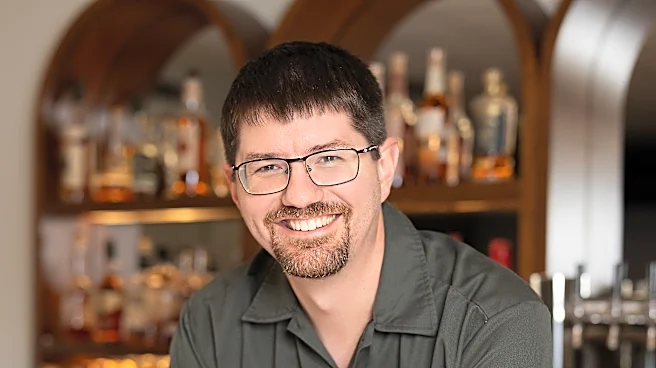



WASHINGTON − John Ream home-brews the vanilla stout his wife prefers. He’s crafted his own wine and mead. But a nearly 160-year-old federal ban on home distilling is keeping the Ohio engineer from experimenting with spirits.
“I really want to dive in and play with some rye mash for distilling into whiskey,” he said. “There’s the challenge to it. There’s also the satisfaction of having something that you made for yourself.”
Ream has asked the Supreme Court to let him distill his own liquor, and there’s a good chance the justices will take up the issue.
While the federal appeals court based in Ohio that heard Reams’ challenge to the ban ruled against him, an appeals court in Louisiana that considered a similar lawsuit said the ban is unconstitutional.
As a result, the law can’t be uniformly enforced across the country unless the Supreme Court intervenes.
The conservative groups trying to end the ban say getting rid of it could spark the same kind of innovation and revitalization for hard liquor that legalization of homebrewing in the 1970s did for beer.
But they’re also hoping the Supreme Court will use the case to broadly limit the reach of the federal government’s power into homes and private conduct.
“It’s ultimately to protect individual liberty,” said Andrew Grossman, a senior legal fellow at The Buckeye Institute, which is representing the challengers. “Home distilling is just an example of that.”

Alison LaCroix, a constitutional law professor at the University of Chicago Law School, said the lawsuits could end up stretching far beyond home distilling to affect many activities that Congress has been able to regulate for decades.
“It seems in some ways like it is a narrow issue,” she said, “but it has this tremendously important potential sweep.”
The history that led to the ban
The sweep is also historical.
Opponents of the ban point to the fact that prominent founding fathers, including George Washington, had successful distilleries on their homesteads. The 2,250-square-foot whiskey distillery at Mout Vernon was one of the largest in early America.
To help pay for the Revolutionary War, Congress taxed distilled spirits – the first nationwide internal revenue tax – beginning a long fight over the unpopular measure that included the Whiskey Rebellion of 1794.

In defending the ban against the latest challenge, the Justice Department points out that the tax was regularly evaded. That eventually led to laws in 1866 and 1868 prohibiting home stills, which were difficult for government inspectors to find. Before the ban, at least seven-eighths of all spirits made in the country were not being taxed, according to the government.
Today, the tax generates billions of dollars in annual revenue. Home distillers can be fined $10,000 for every batch and imprisoned for up to five years.
Congress legalized home brewing in 1978
Occasional efforts in recent years to change the law failed to gain traction.
By contrast, Congress repealed federal restrictions and taxes on brewing beer for personal use in 1978.
At the time, Americans sipped one dominant style of beer, a light lager, sold by big breweries such as Coors and Anheuser-Busch. But after home brewers were able to show the appeal of hoppy IPAs, malty stouts and citrusy wheat ales, that eventually led to a boom in small breweries.
Ream, who until recently owned a brewpub in Newark, Ohio, developed a passion for the product after his wife gave him a home-brewing kit in 2009.
“I just fell in love with it,” Ream said. He entered contests, won some medals, and found he enjoyed diving into both the science and the art of brewing.
Rick Morris, who started the Hobby Distillers Association in 2013 to try to change the law, said making distilled spirits feels like the natural next step to many hobbyists.
“I think the same group of enthusiasts that make beer and make wine, it’s those same things that drive people to want to be able to go to that next level and distill,” said Morris, the owner of a company that makes stills for commercial distilleries. He’s also one of the plaintiffs involved in the so-far successful challenge to the home distilling ban that started in Texas.
A certified bourbon steward who has mastered the art of tasting spirits, Morris said he now wants to try making his own.
“There are so many different characteristics that we’ve come across through all the whiskeys that we’ve tried, all the bourbons that we’ve tried,” he said. “You pick a little bit out of this one, a little bit out of that one.”

Lower courts divided over the issue
But in April, two appeals courts issued contradictory rulings about the legality of the ban on home distilling.
The Cincinnati-based 6th U.S. Circuit Court of Appeals upheld the law under the clause of the Constitution that allows Congress to pass laws that are “necessary and proper” to carry out its assigned duties.
The ban, the court said, was needed to collect taxes when it was passed, “and we have no reason to conclude otherwise now.”
When it comes to “liquor and taxes alike,” the court said, “human nature remains decidedly unchanged.”

Grossman, the attorney representing Ream and Morris in the two cases, agrees that there was massive tax evasion when the ban was passed. But he said that wasn’t due to home stills. Large commercial distillers would bribe tax collectors because the taxes were so high, he said. And the ban on home distilling, he argues, was actually “an early flash of the temperance movement.”
“It was more moralistically directed than anything to do with preventing tax evasion,” he said.
Even if the ban was necessary to collect taxes, Grossman added, that still raises the question of whether it’s proper.
“It’s a very unusual thing for the federal government to claim regulatory authority to reach into people’s homes and regulate them there,” he said.
'Remote work may be deemed a crime'
That argument found a receptive audience with the Louisiana-based 5th U.S. Circuit Court of Appeals.
That court said the ban isn’t “necessary and proper” for tax collection because it actually reduces revenue by prohibiting the conduct the government wants to tax.
And if home distilling can be banned, the court also said, nothing would stop Congress from prohibiting any home-based business through its taxing power.
“Remote work may be deemed a crime,” the court said.
In response, the Justice Department said that in raising hypotheticals about other types of activities, the 5th Circuit ignored the tax evasion history specific to distilled spirits.
“Congress attempted to collect the tax on distilled spirits for years without success,” the government told the Supreme Court in a filing. “Only when such efforts failed did Congress regulate the location of distilling as a means to collect that tax.”
Court asked to revisit 2005 ruling about marijuana
Both the government and The Buckeye Institute want the Supreme Court to take up the issue, but they disagree on the scope of what the justices should consider.
The Buckeye Institute – along with a number of other conservative groups that have filed supportive briefs – want the justices to also revisit a 2005 decision that affirmed a broad interpretation of Congress’s power to regulate interstate commerce.
In that case, the court said the federal government could seize marijuana plants grown for personal use that were legal under state law.

LaCroix, the University of Chicago Law professor, said there are probably justices on the current 6-3 conservative court who want to overturn that decision.
“For many conservatives, there’s a sense that limiting the powers of the federal government − especially of Congress − are central to what they think the Constitution requires,” she said.
But the tricky bit is doing so without eviscerating Congress’ regulatory powers across a lot of different dimensions, including criminal law, that the justices may also think important.
“They don’t want to undercut the entire edifice of alcohol regulation, federal taxation,” she said.
The court will consider whether to take up the issue after it starts its next term in October.
This article originally appeared on USA TODAY: Free spirit: Will the Supreme Court let this man distill his own whiskey?