

If you've been fantasizing about winter after waves of hot weather this summer, you might have turned to a popular source of weather predictions to see when the cold and snow is coming: a farmer's almanac.
Whether you consulted a prediction online or in an iconic yellow-covered tome, have you gained valuable insight into future weather patterns, or have you been duped?
The almanacs' exact prediction methods are kept top secret, but they say they include a mix of climatology and meteorology – and what experts say are some less scientific principles. The Old Farmer's Almanac uses solar activity and sunspots, and the Farmers' Almanac says it uses "sunspot activity, tidal action of the Moon, the position of the planets, and more."
forecast calls for 'signs of fall,' milder temperatures
J. Marshall Shepherd, a University of Georgia atmospheric scientist, is among the experts who have long discounted the almanacs as legitimate sources of weather information.
He told USA TODAY that "scientific-based weather forecasting and short-term seasonal prediction has advanced significantly. Our models, observational systems and knowledge base has made short-term prediction, hurricane tracking, and El Niño forecasts quite reliable."
"Yet people still default to groundhogs, almanacs and folklore," he said.
But even the most scientific weather predictions aren't perfect; most can relate to hearing about a forthcoming torrential storm that only panned out to a brief trickle, or expecting blue skies but getting a sudden downpour. And quantifying the accuracy of seasonal forecasts is a tricky business.
Adding to the confusion: Almanacs do more than publish controversial climate predictions.
What is an almanac anyway?
An almanac is a reference book that gives information about a number of different subjects, which can include weather predictions, sunrise and sunset times, important dates and much more. Two of the most popular almanacs still in existence are Old Farmer's Almanac, which has been around since 1792, and the Farmers' Almanac, founded in 1818 and which is shutting down after the 2026 edition. For generations, both have offered long-term weather predictions that they boast are highly accurate, but which weather experts tend to scoff at.
Heidi Stonehill, executive editor of the Old Farmer's Almanac, told USA TODAY that her publication's meteorologists and those from other organizations work toward the same goal: "Both long-range weather predictions and shorter-term forecasts provide guidance on likely trends in an effort to help individuals and communities stay safe, keep productive, and enjoy life."
"Weather affects all our lives, in both small and large ways. Therefore, people like to know what’s ahead – how to be best prepared for inclement weather, to find out if they can look forward to a bright sunny day during their trip or special event, or if their plants need a bit of extra loving care during a hot, cold, or dry spell," Stonehill said.
USA TODAY also reached out to Farmers' Almanac for comment and information on its methods.
How do farmer's almanacs predict the weather?
Farmer's Almanac and Old Farmer's Almanac are two different publications, which both say they use secret formulas developed by their founders more than two centuries ago. Neither divulges the specifics of its formula, but both offer some limited insight.
Here is what they say:
Old Farmer's Almanac: "Some individuals doubt that the amount of energy emitted by the Sun has any impact on the atmosphere, weather, and climate. However, we belong to the group that believes otherwise. We base our beliefs on the fields of solar science, which studies sunspots, climatology, which examines weather patterns, and meteorology, which focuses on the atmosphere. ... While the forecasts are based on the same principles, we use the latest state-of-the-art satellite data, all the latest technology, and equipment."
Farmers' Almanac: "Over the years, various methods have been used to make the Farmers’ Almanac predictions, including studying sunspot cycles, solar activity, tidal forces, and even the reversal of winds in the stratosphere over the equator. ... This formula incorporates many of the various techniques mentioned here, as well as sunspot activity, tidal action of the Moon, the position of the planets, and more."

Farmers' Almanac says it makes its forecasts two years in advance and doesn't go back to change them after an edition is printed.
Routine weather forecasts are “only really accurate out to about two weeks,” Peter Goble, assistant state climatologist at the Colorado Climate Center at Colorado State University, said.
To make the longer-term seasonal outlooks, forecasters use advanced computer models that combine huge volumes of data and help the meteorologists assess what the probability will be of temperatures outside the norm. They look at the relationships between the slower-moving components of the climate and how they tend to affect weather, Goble told USA TODAY.
A May 2023 post on the National Oceanic and Atmospheric Administration's climate.gov said forecasters will never be able to say a month in advance that there’s a 100% chance of a wetter-than-average May. “The climate is not that predictable," stated the post's author, Rebecca Lindsey.
Corey Davis, assistant state climatologist at the North Carolina State Climate Office, told USA TODAY he was encouraged that compared to almanac forecasts from 10 to 15 years ago, today's outlooks seem somewhat more rooted in science. Looking at the outlooks for the winter season 2026-27, Davis said he was pleased to see discussion about El Niño, expected to majorly shape winter weather patterns this year, as a factor in Farmers' Almanac and Old Farmer's Almanac discussions.

The secrecy is concerning to Goble.
"An individual forecaster making decisions based on methods that are not published, it just doesn't strike me as good, transparent science," he said.
How accurate are almanac forecasts?
Both prominent almanacs boast a success rate of about 80%, but experts raise their eyebrows at that figure.
"Although neither we nor any other forecasters have as yet gained sufficient insight into the mysteries of the universe to predict the weather with total accuracy, we correctly predict the weather about 80% of the time," the Old Farmer's Almanac says on its website.
Stonehill of Old Farmer's Almanac told USA TODAY that the publication compares actual temperature and precipitation records for a city in a forecast region with the direction that was forecast (whether it was above or below normal). The percentage of regions correctly forecast (above or below normal) is used for accuracy rate for temperature and precipitation, which are averaged for an overall rate.
"For example, for the U.S. long-range 2025/26 winter weather forecast, the accuracy rate was 83.3% for temperature (15 out of 18 regions correct) and 94.4% for precipitation (17 out of 18 regions correct), for a total accuracy rate of 88.9%," Stonehill said.
Here's how Farmers' Almanac describes its success: "Though weather forecasting, and long-range forecasting, in particular, remains an inexact science, many longtime Almanac followers maintain that our forecasts are 80% to 85% accurate."
When people hear that the almanacs are 80% accurate, they assume that means they are 80% right in trying to predict when cold and wet periods will happen, but "it's more trying to predict the overall tendency of the weather," Davis said.
Goble compared Farmers' Almanac predictions for winters from 2019-20 season through 2023-24 to the National Weather Service’s Climate Prediction Center seasonal outlooks.
"I took every testable claim that I could from the Farmers' Almanac and compared that claim with what the Climate Prediction Center said for that region. And unsurprisingly, the Climate Prediction Center did significantly better overall. Both had their misses because seasonal forecasting is hard and there's a lot we still don't understand," he said.
Shepherd criticized the Almanacs' very broad predictions. For example, he said calls for a "cold and snowy winter" in New England or Minnesota is statistically normal and isn't a true scientific breakthrough.
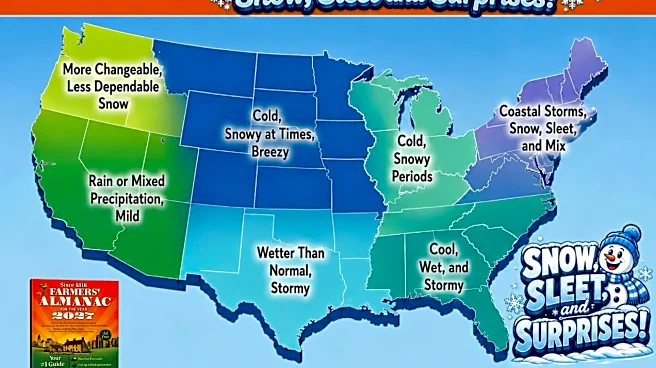
Goble agreed: "For instance, this year's (Farmers' Almanac) winter outlook for my region, kind of the north-central region of the country, says cold, snowy at times, breezy. Take from that what you will. I’m in Colorado but if you live in say, South Dakota, which is also part of this whole region that they’ve drawn blue and given this forecast, you could make an argument that a much warmer than normal winter is still 'cold, snowy at times and breezy.' So, hiding behind that kind of vague language can make it difficult to test their claims."
Another meteorologist, Matt Lanza, said on Twitter a few years ago when the Almanac was coming out that it was "your annual reminder that using the Farmers' Almanac for a seasonal meteorological outlook is about as good as going to a psychic."
Almanacs rooted in history, useful resources
For generations, people have turned to almanacs for weather predictions because they are written in a way that is often more appealing to the general public than the forecasts produced by other sources, Davis and Goble said. They do the "storytelling" part of forecasting well, Davis said.
"Without fail, the Farmers' Almanac provides, especially in the northern half of the country, this really kind of oftentimes dramatic language for how the winter will feel, like 'bone-chilling cold' or 'teeth-chattering cold,'" Goble said. "I think that language, even though it doesn't make for good science, kind of grabs people."
Davis said he knows people whose grandparents keep hard copies of the almanacs on their shelves as conversation pieces.
"Everyone talks about the weather, and especially if you can talk about what may happen ahead, you know, it feels like magic," Davis said.
Almanacs also have other uses.

Information such as moon phases, sunset and sunrise times, future eclipses and when high or low tides will happen are known with a high degree of scientific certainty and can generally be trusted in almanacs, Davis said.
The very first almanacs, which were born out of Europe, were used by farmers and gardeners to help guide their crop growing, and by sailors wanting to know the moon's positions for navigation, Davis said.
Long-range weather predictions became popular as almanacs were introduced in the United States, he said. Founding father Benjamin Franklin published one of the earliest almanacs found in Colonial America, Poor Richard’s Almanack, for about 25 years, starting in 1732. A 1733 edition of Poor Richard's included astrological signs, the planets' motions for the year, months with weather predictions, predictions of eclipses for the year and the dates of important events such as courts, Quaker meetings and fairs.
"His predictions weren’t always accurate, but Franklin had a witty response to his critics: 'No one … will allow that we always hit the day of the month,' he said. 'We only ask an allowance of a few days and if there still be a mistake, set it down to the printer,'" Davis said about Franklin's weather predictions, in a 2012 blog about almanacs.
This article originally appeared on USA TODAY: Winter forecast controversy. Can you trust an almanac?