





In the early months of 1938, Nazis and Hitler Youth group members forced Jewish residents of Vienna into the streets to scrub the sidewalks clean with their bare hands. John C. Wiley, the U.S. chargé d'affaires in Vienna, wrote of this public humiliation ritual (known as Reibpartien) and recalled a conversation he had with a Jewish journalist at the time.
The journalist, Wiley wrote, was "in such a state of nerves that he was planning to 'escape to Germany.'"
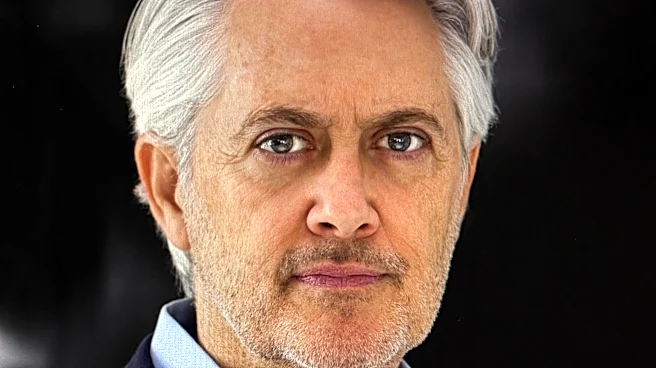
This realization of reality for the Jewish population living in Vienna during the 1930s and 40s is part of an engrossing story told in historian Douglas Smith's "The City Without Jews: Life and Death in Nazi Vienna" (out now from Farrar, Straus and Giroux). Smith, an award-winning historian based
in Seattle, pieces together a narrative of Jewish life under Nazi rule and uncovers how Austria -- mainly Vienna, where much of the country's Jewish population lived -- served as an early model for the cataclysmic destruction enacted by the Nazis throughout the second world war.
Smith follows the life of one woman, Mignon Langnas, who lived openly as a Jew during the Holocaust. Her letters and diary entries, from which Smith constructs her story, paint a portrait of someone seeing their world vanish in real time.
"The City Without Jews" is Smith's first book on Austrian history. He's the author of numerous books of Russian history -- including "The Russian Job," "Rasputin" -- and a translator, most recently of Konstantin Paustovsky's "The Story of a Life." Smith spent many years living and working in the Soviet Union, as both a Russian guide for the U.S. State Department and an analyst for Radio Free Europe. He's the recipient of a Guggenheim Fellowship, a Fulbright scholarship and his 2013 book, "Former People," won the Pushkin House Russian Book Prize.
Smith spoke with USA Today about the journey of writing "The City Without Jews" and what it meant to carve a personal story out of a global catastrophe. This conversation has been edited for length and clarity.
You start the book with the story of Hugo Bettauer’s ‘The City Without Jews,’ a satirical 1922 novel in which all Jewish residents are forcible removed from Vienna, and from which your book takes its name. Why begin your work of history with a novel?
When I read about Bettauer in a general history of Austria in the 20th century, I was surprised that I had never heard of him and I'd never heard of his book after living in Vienna for two years. I read the novel and thought, this has to be the way to start the book. There's the idea, I think it was Marx, that history repeats first as, you know, tragedy and then as farce. And here was the inversion, farce, followed by tragedy. And this idea that Bettauer describes in this farcical satire sees itself realized a little over a decade later to such tragic results. And as far as I can tell, he was the first Jew killed by a Nazi in 1925. This is well before Hitler comes to power in Germany. So I thought this was such a startling and shocking way to begin the book, to really grab the reader and set up this whole premise that if we just get rid of the Jews, all of our problems will go away, which was what Austrians were thinking in 1938 when the Anschluss happened and they became part of the Third Reich.
I was also intrigued because Bettauer’s office was just a couple blocks around the corner from where I lived as a college student in Vienna. So I felt this little bit of a personal connection too. And as for the title: titles can't be copyrighted. And since his novel came out over a century ago, I felt it was okay to use it. And the title is just so provocative and eye-catching, I felt there was nothing I could do to better it.
Did you read the book in translation?
I read it in German, but it is available in translation. It came out in the States at the time and was hugely successful. And the New York Times reviewed it and said it was ridiculous and it's impossible to imagine any political party coming to power on a slogan of throw out the Jews and totally dismissed it as nonsense. Well, clearly the reviewer missed the boat on that.
At the heart of your book is a woman named Mignon Langnas. How did you come upon her story?
It was summer of 2020 -- couldn't travel anywhere, couldn't go anywhere. I've been trained mostly as a Russian historian and written a number of books on Russian history. And I was getting fed up with Putin's Russia and I wanted to do something different. I had lived in Vienna for two years, one year as a student in college, and then one year as an English language instructor in a school in Vienna. So I just started like ordering books online about about Austrian history and I just was reading that summer and I came upon a book by an Austrian author named Kurt Bauer in German. The book's called "Die Dunklen Jahre," ("The Dark Years") and it was a general history of sort of daily life in Austria under the Nazis. And in a couple of places he quoted from the diaries of Mignon Langnas. And I was kind of like, oh, that's kind of interesting. I saw that there was a book published by a small sort of academic publisher in Austria called "Mignon" that had her diaries and some of her letters. So I ordered that and through it was unlike anything I've ever heard.
Learning the degree to which Vienna was at the forefront of the antisemitic policies of the Third Reich, that they were this ‘accelerant,’ if you will, I didn’t know that. I had no idea, and her story just grabbed me. I quickly formulated the larger story of what happened to Jewish Vienna, 1938 to 1945. But I focused on the life of Mignon and her family, because if you just describe these massive, epic, horrible events without really grounding it in a few key individuals it becomes amorphous. It's hard to follow. It's hard to really feel what this history was like.
I did some sleuthing. I saw that the ("Mignon") book was edited by George Langnas, and I'm thinking that's Mignon's son. I didn't know if he was alive or dead, but I got an address for him and I wrote a letter introducing myself, telling him who I was and what I was interested in doing. And a few weeks later, my cell phone rang with an unrecognized number, and I happened to answer it, and it was George Lagnas. We started this conversation about his mother and what I wanted to do, and went through sort of a courtship where I had to prove to him that I was the right person to tell this story. And then when I was able to travel, I went out and spent like a week with him and his wife, and he showed me this massive family archive that he had put together over many decades.
What stuck out to you about Mignon? I'm curious what it was like reading about her and what drew you in.
She was a very intelligent woman. She was a well-read woman, a deeply feeling woman. A woman with such utter commitment to family, to her parents, to her husband, and to her children. And what came through is just the incredible strength of character that she showed to survive those years. It was a combination of her character, her will to live mixed with just pure luck. So much of those who survived those years, even those who fought tooth and nail to survive and sought every avenue to escape or get away, most of the times it came down to luck. Did you get a visa? Did your passport come through? I liked the idea of telling the story a Jewish woman, who managed to live openly as a Jew through all these years.
There's an enormous memoir literature from survivors of the Holocaust, which is valuable and important. But [Mignon] is someone who's writing at the moment. These are diaries. This is not after the fact. This is someone who's writing day after day, literally wondering: will I be alive to write again tomorrow? There's an immediacy and a directness, a fear that comes through with diaries that you don't get with a memoir account.
 Farrar, Straus and Giroux." id="91985548007">
Mignon didn't start writing in her diary until 1939, and her entries don't appear until 165 pages into your book. How did you construct the historical moment leading up to this primary document?
I'm very methodical, I'm slow and I'm someone who tries to be as thorough as possible. When I work on these books it's a five-plus year commitment, full time. What I try to do is literally read everything I can on the subject. I went to Vienna several times. And I must have worked in 5 or 6 archives there. Israel's Yad Vashem archive -- I was able to get that online. In the United Kingdom I went to the Wiener Holocaust Library. And then in the U.S., I went to a number of archives. One of the best for me was the archive of the United States Holocaust Museum. I take notes. I'm very old-fashioned. I take notes on everything. I used to do all that longhand. Now I actually type the notes with like using Word doc. And it's a sifting process that's very slow, but as I sift through the notes, read them over and over and over, I really start to form pictures and ideas and connections in my head.
What was it about the Mignon family archive that differed from other sources on Mignon and Vienna during the Holocuast?
What George had, as I remember it, was a good deal of family letters that added context and helped me better understand a lot of things that were going on. For example, one of [Mignon's] sisters, Nellie, married Ernst Eckstein. And Nellie's mother-in-law tried to get away from Vienna. And she was one of those who was shipped off to the East to Poland and probably died a horrible, violent death. We don't know exactly what happened to her. But she wrote a lot of letters to her sons Ernst and Karl. And none of those letters are in the original Mignon book. But she writes about Mignon in them and she writes about what she's going through. And I quote a lot from her letters and her sources. There was also a lot of ephemera, a lot of this kind of stuff that was useful in just getting, again, a greater sense of context and elements of Mignon's life and the things she was dealing with.
Has George read the book?
Yes. George and his sister, Manuela, are both still alive. George lives now in New York with his wife, and Manuela has been living in Florida for a long time. They both have received copies of the book. I think they were very pleased and it gives them real pleasure and satisfaction to know that this story has now been told and people can read about it. There's pictures of them in the book and everything.
You describe Vienna in the book as a “laboratory for the Holocaust.” You also write that “Vienna birthed Hitler’s dream, and Europe’s nightmare.” What does this mean?
That was something that I didn't know before starting this book. Vienna really was a flashpoint for igniting incredibly violent acts against the Jews. Hitler comes to power in Germany in 1933. It's not followed immediately by mass pogroms. In Vienna and in Austria - but especially Vienna because most Jews lived in Vienna and Austria - in March of 1938, Austria became part of the Third Reich and overnight the city went literally satanic. The people who left memoirs or reporters and journalists who were there say it was like the gates of hell had been opened. The level of violence that was inflicted on Jews, literally like the striking of a match, was shocking.
One thing that kind of paradoxically that did was it made clear to many of the Jews in Vienna that they had to get out. They had to escape. What went with this explosion of anti-Semitic violence was also what was known as Aryanization, sometimes called wild Aryanization, where people were basically just stealing everything from the Jews. Whether it was their businesses, their apartments, their furnishings, their bank accounts, their automobiles -- just mass theft on a grand scale. This was something that had not happened in Germany.
it was also in Vienna that Adolf Eichmann, one of the most notorious of figures in the Holocaust, set up an institution for forced immigration for Jews, the Central Agency for Jewish Immigration. They were going to force all the Jews out of the country. And then after World War II starts, and Germany invades Poland, you have Eichmann and others in Vienna thinking that forced immigration is not going to be so easy because a lot of countries wouldn't accept Jews. And they were going to force the Jews of Vienna to get on trains and ship them east. And they sold them this idea with all sorts of lies. This idea of putting Jews on trains and shipping them to Poland was basically born in Vienna. So those are just some of the examples of the ways that Vienna pushed the anti-Semitic violence that would eventually end up leading to the gas chambers.
One of the most fascinating threads in the book is the role and activities of the Israelitische Kultusgemeinde (“Israelite Religious Community”/IKG) throughout the book. Founded in the 1850s, the organization shows up throughout the entire book. Tell me about the IKG – how they started, what they did – and how they came to be put in, as you write, an “impossible position” under Nazi rule.
The IKG, the Israelitische Kultuskeminde in German, is basically the official Jewish body that had been around since the 19th century. It faced the Jewish community in Vienna, and helped to organize it and record births and deaths and marriages and that sort of thing. But then it also faced the state because -- we're talking about when it was still the Austro-Hungarian Empire -- they basically wanted Jewish life regulated and they wanted facts and figures and numbers as part of the whole bureaucratic process of running the empire. Because for a long time, Jews had no civil rights or anything like that. And it was only really in the second half of the 19th century that they gained civil rights.
When the Nazis seize power, they close down the IKG and they close all Jewish organizations. They shut all of them down. They throw the leaders of the IKG into prison. And then Eichmann pulls the leaders out and calls them to a meeting and says the IKG now works for him. So the IKG is first tasked with trying to help organize mass emigration. So people work through the IKG to try to get the paperwork in order so that they can leave. The population of Jewish Vienna is a little bit under 200,000. And what's amazing is the IKG is actually pretty successful - they help somewhere around 125,000 people emigrate. When the war starts, immigration becomes more and more difficult. So that's when the IKG really becomes, instead of a tool for immigration, sadly a tool for mass extermination. And they have to organize deportations of Jews to the East instead of trying to help Jews get out. And it's a really tragic situation. And the man who's the leader of the IKG, a man named Josef Löwenherz, is a very conflicted character put in the most extremely difficult of situations. It's one of the most gut-wrenching aspects, I think, and morally complicated elements of this story.
What parallels do you see between the book and our current moment?
When you go to Austria now, you go by synagogues and Austrian institutions and there's always a police presence out front. It gives you pause to realize that the hatred that animated all of this history in the middle of the 20th century -- these things don't really go away. They ebb and flow, they go underground for a while like an underground stream and then they're going to bubble up somewhere else. We're seeing all this nativism in this country, ethnonationalism in this country, anti-Semitic acts in this country, and among other forms of racism and Islamophobia, and I just...It sickens me to see these ideas resurfacing and gaining followers and currency. And again, it's not unique to Austria. It's a broader phenomenon.
The City Without Jews: Life and Death in Nazi Vienna. Farrar, Straus and Giroux, $37 (hardcover), 560 pp. Sept. 29, 2026. 9780374606558.
Upcoming events:
- Douglas Smith will be at Elliott Bay Book Co. (1521 10th Ave., Seattle, WA, 98122) on Thursday, Oct. 1, 2026 at 7 p.m. to discuss "The City Without Jews." RSVP at www.elliottbaybook.com.
Zachary Fletcher is a trending news reporter with USA TODAY Network's Washington state team. Keep up with him on X (@zdfletch), BlueSky (@zfletcher.bsky.social) or reach him at zfletcher@usatodayco.com.
This article originally appeared on USA TODAY: Seattle historian's new book tells a personal tale of Jewish life during Nazi occupation