






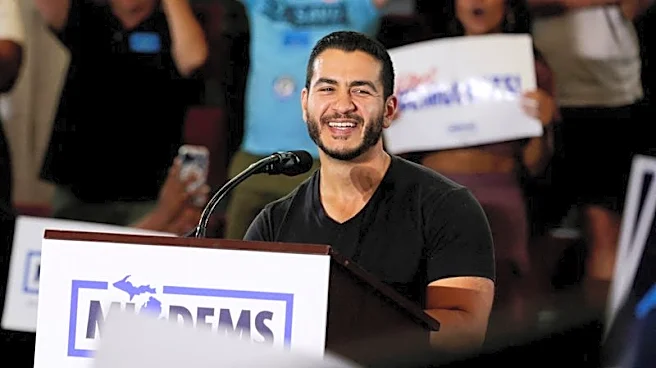
Democratic U.S. senate candidates Abdul El-Sayed in Michigan and Troy Jackson in Maine have a slight edge over their Republican opponents, but the major races for control of Congress are still in play, according to a new poll from CNN and SSRS.
The new polls found no clear leader, as advantages were within the polls' margins of error. In Michigan, 47% of likely voters preferred El-Sayed to the Republican candidate, former U.S. Rep. Mike Rogers, who 44% of respondents favored. In Maine, 48% of likely voters said they'll cast a vote for Jackson, while 45% said their pick is incumbent Republican Sen. Susan Collins.
The midterm elections in November are less than two months away as both parties make a final push to control Congress. Maine and Michigan's
senate races are among only a handful of competitive races where voters will ultimately decide which political party controls Congress and sets the legislative agenda for the final two years of President Donald Trump's second term.
Voters in both states were dissatisfied with Trump and cited economic concerns as a top deciding factor in their voting decisions, according to polls conducted from Aug. 31 to Sept. 6 and released Sept. 9.
Michigan voters have the economy and Trump on mind
Despite El-Sayed's three-percentage-point lead over Rogers, 26% of likely voters said they were still persuadable. That group is made up of 6% who haven't picked a candidate and 20% who picked but "might change mind."

On the Michigan poll, the cost of living was the most important decision for 47% of voters in casting their ballots, followed by 24% who said their decision was influenced by "The state of U.S. democracy." In response to the White House's tariffs on Canada, 64% of likely voters said they were a "bad thing," while 44% of respondents said their financial situation is currently worse than it was two years ago.
Sixty-five percent of Michiganders polled disapproved of Trump, while 34% approved of the president. Forty-two percent of likely voters said their vote will send a message that they oppose Trump, while 17% said their vote supports the president and 40% said their vote does not send any messages about him.
Half of likely voters said El-Sayed, who is seen as a member of the Democratic Party's progressive flank, is "too liberal," while 44% found him "about right."
Maine voters 'for' and 'against' Collins
Jackson's three-percentage-point lead over Collins was less about him and more about her, according to the polls. Of those who said they'd vote for Jackson, 71% said their vote is a "vote against Collins" who has served the state for over 29 years, and only 29% said it was a vote "for" Jackson. Of those who favored Collins, 74% said it is a vote "for" her, not against Jackson.
Still, 18% of likely voters said they're persuadable, which consists of 14% of likely voters who might change their minds and 4% who haven't picked a candidate yet.

The driving factor in deciding how to vote in Maine were similar to those in Michigan, with 45% of Maine likely voters saying the economy and cost of living were their decider, while 27% cited the state of U.S. democracy. Maine respondents were split over their personal financial situation compared to two years ago, with 42% of likely voters saying they were worse off, 16% in a better place and 41% about the same.
A similar story also came with the president's popularity, as 67% of voters disapproved of him and only 31% approved of Trump. Forty-six percent of likely voters said their vote sends a message that they oppose Trump, while 17% said it shows their support for him and 37% said they're not sending a message about the president with their vote.
On Trump's tariffs, 7 in 10 likely voters said they are a bad thing for Maine.
This article originally appeared on USA TODAY: Democrats hold razor-thin lead in Michigan, Maine Senate races: Poll