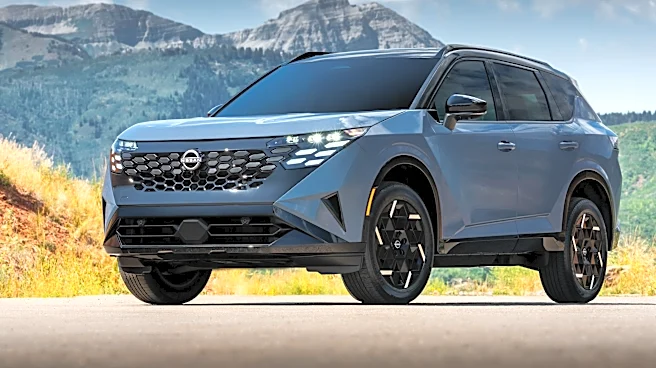







Nissan is adding a hybrid version to its most popular U.S car, the Nissan Rogue, as car shoppers continue flocking to fuel efficient vehicles with gas prices remaining stubbornly high at over $4 per gallon.
The Japanese company said, in a Sept. 21 news release, "the all-new 2027 Nissan Rogue Hybrid brings Nissan's globally proven hybrid e‑POWER technology to the U.S. for the first time, delivering smoother acceleration, quieter operation and more confident control."
"The all-new Rogue Hybrid is exactly what customers have been asking for: the functionality, technology and packaging of a Rogue, now paired with an advanced hybrid powertrain that enhances efficiency while delivering a dynamic driving experience," Ponz Pandikuthira, senior vice president
and chief product and planning officer for Nissan Americas, said in a statement.
The announcement comes as several of Nissan's competitors have gone all in on hybrids and their customers appear to be receiving them well.
In the first half of 2026, 22% of shoppers said they would consider a hybrid vehicle, which was up from 20% in 2025, according to Kelley Blue Book. By comparison, only 10% of car shoppers said they would consider buying a fully electric model during the first half of 2026, according to the group.
"While durability and safety remain the most influential purchase considerations across all shoppers, affordability and fuel economy have become increasingly important over the past five years," Kelley Blue Book said.
With that in mind, the USA TODAY Cars team took a look at why Nissan is adding a hybrid option to the Rogue now, which is the company's most important vehicle, and why Nissan's competitors are also flooding showrooms with hybrids now.
Why is Nissan making a hybrid Rogue now?
Nissan said it decided now was the right time to make a hybrid of its most popular car because it was listening to its customers.
"By listening closely to customers and designing around their needs, we've created a hybrid SUV that delivers an agile and spirited driving experience while adding the benefits of a hybrid powertrain," Pandikuthira, the company's chief product and planning officer, said. "The instantaneous torque delivery, with a quiet and efficient powertrain, will redefine what hybrid means in this segment."
Nissan said the 2027 Rogue hybrid will start at $35,490 and it will be available in three different all-wheel-drive trims. The company said it has a 1.5-liter turbo hybrid engine and it will have 148 horsepower and 171 pounds per foot of torque.
The Rogue has been Nissan's top-selling U.S. car since 2016, when it first surpassed the Nissan Altima for that title.
Here's how the Rogue has sold in the U.S. since then:
- 2025: 217,896
- 2024: 245,724
- 2023: 271,458
- 2022: 186,480
- 2021: 285,602
- 2020: 227,935
- 2019: 350,447
- 2018: 412,110
- 2017: 403,465
- 2016: 329,904
Why are carmakers turning more than ever to hybrids?
Carmakers are selling more hybrids than ever because, as several of them cut back on their EV production at the start of President Trump's administration, the hybrids they were already making became more attractive to consumers as the salience of fuel efficiency increased for car shoppers.
In 2025, there were 13,929,600 non-plug-in hybrid vehicles and 1,765,700 plug-in hybrid vehicles registered on U.S. roads, according to the U.S. Department of Energy's Alternative Fuel Data Center. By comparison, the agency said there were 5,689,100 fully electric cars and over 240 million gas cars registered in the nation last year.
At the start of the second Trump administration, the White House and Republicans in Congress moved to eliminate the popular $7,500 EV tax credit offered by the federal government since the tail end of former President George W. Bush's administration. Trump also moved to cut funding for electric vehicle chargers approved by former President Joe Biden.
Carmakers reacted to the shifting headwinds in Washington by cutting back on many of their plans to introduce new electric models. But automakers that have been marketing hybrids for years, like Honda, Toyota, Hyundai and Kia, have reaped the benefits as gas prices surged.
Why are shoppers gravitating to hybrid cars?
Record-high gas prices have driven shoppers to consider hybrids a lot more.
The average price of gas on Thursday, Sept. 24, was $4.45, according to AAA. That's up from an average of $4.43 one week ago on Sept. 17, and an average of $3.16 on Sept. 24, 2025.
Despite those increases, polls show there is still hesitancy among some drivers about going fully electric. Car buyers have been telling pollsters for years that they have major concerns about the battery range of electric cars. The concern has bubbled up so often that it has been dubbed "range anxiety."
According to a poll released in January 2026 by the EVs for All America group, an advocacy group that works with car manufacturers to push U.S. and state lawmakers to adopt EV-friendly policies, 20% of 600 respondents to a poll intended to survey potential EV buyers in 2025 said their top concern about plug-in models is the charger networks being unreliable.
That's where hybrids come in. Most regular hybrids have batteries that get their power from regenerative braking, according to Edmunds, which is an automotive industry research group that also tests and reviews cars. That means drivers don't have to worry about hooking up to a charger at all. Hybrid cars operate on battery usually for shorter, low-speed portions of the trip and switch to gas when necessary for longer, higher-speed trips. Some hybrid cars can get over 500 miles per gallon on a single tank.
Plug-in hybrid electric vehicles, or PHEVs as they are sometimes referred to, usually have a significantly larger battery pack that allows the car to be operated on electric power for stretches of time that can last about 40 to 50 miles, according to Edmunds. Plug-in hybrids have been seen as a compromise option for people who want to experience electric driving, but are not ready to commit to driving a fully electric car.
Keith Laing is an automotive reporter on the National Trending Desk at USA TODAY. Contact Keith at klaing@usatodayco.com.
This article originally appeared on USA TODAY: Nissan's most popular car is going hybrid. It speaks to a larger trend