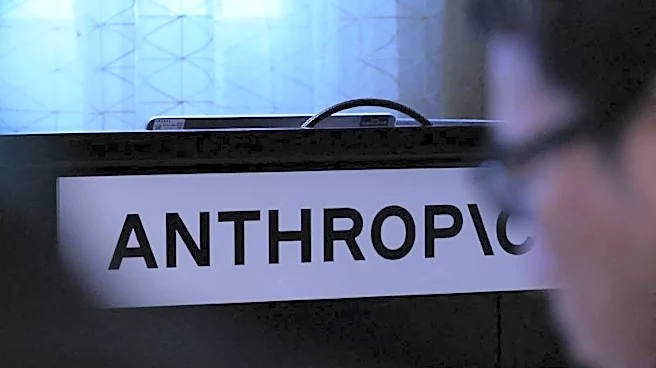






Anthropic, the San Francisco-based artificial intelligence start-up and creator of the popular Claude AI models, announced on Monday, Oct. 26, that it filed its proposed initial public offering, which is expected to be one of the largest stock offerings to debut.
Investors predict the company could be valued at nearly $1.5 trillion or up to $2 trillion, with a potential debut on Wall Street next month. As a leading AI company, investors believe its IPO could surpass Elon Musk's June listing of SpaceX, which raised about $86 billion and was valued at about $2 trillion.
Although its final valuation is not yet set, the filings do not reveal Anthropic's expected starting stock value. The document noted that the AI company will trade under the ticker
symbol "ANT."
In its filings with the Securities and Exchange Commission, Anthropic's leaders lay out their vision for the future, noting that their AI models will "revolutionize" dozens of fields of "human endeavor," including the economy, sciences, medicine, and more.
"We believe the diffusion of AI through the global economy represents one of the largest opportunities in history to improve how humans live and work, and it is just beginning," reads Anthropic's Form S-1 registration statement.
"In our view, the world has only begun to use the capabilities of today's frontier models, and the gap between what Claude can do and how broadly it is used represents one of our largest growth opportunities, alongside continued advances at the frontier."

The filings also revealed that the five-year-old company, founded by former members of OpenAI, has seen rapid revenue growth, reaching nearly $5 billion between 2023 and 2025. The company also highglighted that within the first six months of 2026, it had earned $16.3 billion in revenue, which "represents "a year-over-year growth rate of 1,300%."
However, Anthropic also noted that investors should not expect that level of growth in future revenue as it believes much of the growth reflects "early-stage adoption dynamics, the nascency of the AI market, and rapid initial customer expansion."
"We expect our revenue growth rate to decline over time. In addition, because the AI industry is very nascent, we have struggled to accurately forecast our revenue in the past and may struggle to do so in the future," reads the filing.
Additionally, the filings reveal that although Anthropic has made billions in revenue, the company has not made a profit due to investment, financial, and resource costs. Even as the company saw record revenue in the first six months of 2026, it reported a net loss of $80.7 billion over the same period.
"While we have experienced significant revenue growth in recent periods, our business is highly capital intensive, and our ability to remain at the frontier of AI capabilities and secure sufficient compute depends in meaningful part on our ability to generate and sustain substantial revenue and improve our operating efficiencies," the filings read.
"Further, our revenue growth may not be sustainable, and our rate of growth may decrease. We expect our costs will increase over time and our losses will continue as we expect to invest significant resources towards growing our business and operating as a public company."
Anthropic notes potential obstacles to contiuned growth
Anthropic also notes in its filings that it has several contractual obligations for multi-year investments with other major tech companies valued at a few hundred billion, which may hinder the company's ability to turn a profit in the foreseeable future.
Notably, Anthropic says that earlier this year it entered into agreements with Google for cloud infrastructure and a massive equity investment, committing to spend at least $114.5 billion between April 2026 and July 2033 for its services. The company also entered into a similar agreement with Amazon, to spend at least $110.0 billion between May 2026 and April 2036.
The company also noted that investors should expect its dividend yield to be zero, "as we have never declared or paid any dividends and have no current plans to do so."
Anthropic also noted that future growth potential may slow as lawmakers advocate for and support new artificial intelligence regulations, which may limit the company's product development or flexibility.
In some cases, states have already begun showcasing intent to oversee artificial intelligence systems, as in September 2026, Gov. Gavin Newsom signed asweeping executive orderto advance the possibility of creating an emergency AI “kill switch."
This announcement also comes as public sentiment toward artificial intelligence is low, with many pointing to a thread by Jacob Coxon, a former Anthropic employee, who warned of the potential human-level threatAI poses.
"They are racing straight to self-improving superintelligence and gambling with our lives," he said. "The people building AI earnestly believe that it could kill us all by the end of the decade. This is not a marketing stunt … No other human activity poses this level of danger."
To address these concerns, Anthropic CEO Dario Amodei called on AI companies to moderate the pace at which they advance model capabilities and outlined a three-step framework to slow development and create more time to manage its risks.
The company's filing also highlights public concerns in its risk factors section, which includes almost 100 pages and the possibility that the company’s technology could be “catastrophic” for humanity.
Anthropic’s risk factors section runs from page 26 to page 119, totaling 93 pages of potentialdangers. For comparison, SpaceX’s risk factors spanned 37 pages, Microsoft's risk factors spanned 40 pages, and Coinbase’s spanned 60.
USA TODAY reporter Greta Reich contributed to this article.
Noe Padilla is a Northern California Reporter for USA Today. Contact him at npadilla@usatodayco.com, follow him on X @1NoePadilla or on Bluesky @noepadilla.bsky.social. Sign up for the TODAY Californian newsletter or follow us on Facebook at TODAY Californian.
This article originally appeared on USA TODAY: Anthropic's IPO gives investors new insight into the company