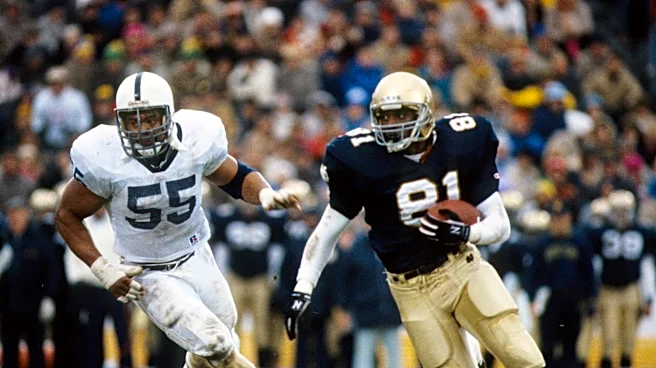






BOSTON – He was a Heisman Trophy winner who became a Pro Football Hall of Famer. Only 10 players have accomplished that feat.
On one hand, the story of Tim Brown is one in which you could say he was a product of his environment and figuring out which sport he liked best.
Everything he learned from a sports perspective before age 12, he says, he learned at the local recreational center in South Dallas. Every day during the summer, he could play something different.
“I wish I had played golf. I can't believe they didn't play golf,” Brown says.
On the other hand, he’ll tell you, though he put in the work to try and be the best he could be at football, he was the recipient of good fortune, even luck.
“When you look at the numbers, the possibility of
a high school player making it to the NFL, the numbers are so miniscule that you really can't go tell a kid, ‘Hey man, you got a shot in high school to make it to the NFL,’ ” Brown tells USA TODAY Sports. “You can say it, but you can't really mean it because you've got to be lucky.”
We were sitting in the green room at the Project Play Summit at a Back Bay district hotel in May. Brown, 60, was reflecting on what it took for him – one of the most accomplished players in football history – to get noticed. He didn’t realize he had a shot at the NFL himself until his junior year at Notre Dame.
It almost didn’t happen.
Brown was about to go out on stage and talk about leadership and success, and about how they came to him unexpectedly out of something he loved, but not something his mother always loved.
“She was a woman of deep faith, still is a woman of deep faith, and thought football was a devil's workshop,” he said to the moderator of his live session, Binta Niambi Brown. “Really did and wanted no part of me playing sports. And I still don’t know what my dad did, but whatever he did, it allowed me to keep playing football.”
Brown, who would go on to play 16 years as a wide receiver with the Raiders (and one with the Bucs), finally made it into organized sports by junior high school and, under the cover of another activity, began his rise.

Putting our kids into athletics is much more complicated in today’s youth sports world where everything seems professionalized. They need balance in their lives more than ever.
Brown, who became a father of athletes himself, spoke with USA TODAY Sports, and on stage, about how we can find it and how sports can bring us surprising results, on and off the field.
'I was just a guy': Play sports to make yourself well-rounded. Whatever comes next in your career is a bonus.
“There's no future in football for you. You go up there and get that education and get on back home.”
Those were the words of his parents, says Brown, one of their six children, when he went off to Notre Dame.
“Dad was too busy,” Brown says of his father, Eugene, a construction worker. “Mom (Josephine) didn't care. When I say she didn’t care, she didn't want me to play sports, period.”
Brown played junior varsity football his freshman year at Woodrow Wilson High in Dallas, but was a part of the marching band that attended the varsity games. He broke out as a sophomore on varsity. His mom still thought he was in the band.
“What did you do?!” Brown recalled his mother saying when family friends told her he was in the newspaper.
The first time he touched a football playing for Notre Dame, Brown fumbled the opening kickoff. He sort of agreed with his mom and dad at that point. But their statement, and the ups and downs of sports, also gave him perspective.
“So my next two years, I was just a guy,” he says. "I was playing. I was on time to graduate. I was happy. I thought this was big-time college football.”
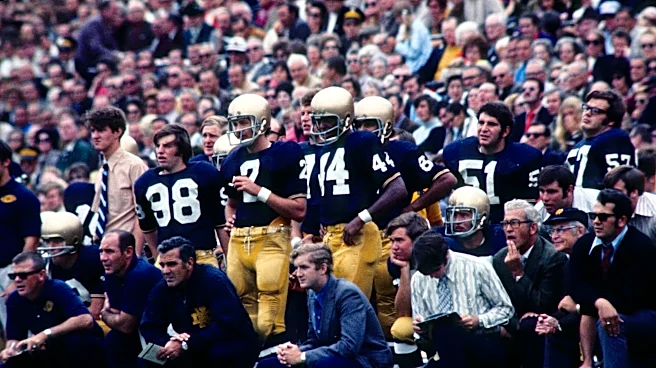
His team was going nowhere from a national perspective. The Fighting Irish went 7-5 his freshman season and 5-6 as a sophomore in 1984 and 1985, respectively, under Gerry Faust.
“Even kids who are talented, you can get to the wrong situation in college,” Brown says. “So I just tell kids to enjoy it. Just work hard and enjoy it. … Even if you're lucky enough to play 17 years, you’re still 38, 39 years old. You’ve got a long life. So get that education.”
What happened next, setting in motion a whirlwind that would change his life, speaks to the following two life lessons now ingrained in him.
A key to success at anything is finding people who believe in what you're doing
Lou Holtz replaced Faust as head coach to start the 1986 season. The team went 5-6 again, but, at the same time, everything seemed to change.
Holtz had a unique ability, Brown recalls, for finding something in each person in the locker room that would motivate them.
“I've had a lot of coaches, but a lot of them didn't have that skill,” Brown says. “They didn't have the ability to talk to a person about football through their heart. Always want to yell. But to be able to get a man's heart – you get a man’s heart, you’ve got a man.”
After two days of watching Brown, Holtz pulled him aside and asked why he wasn’t being featured.
Was it drugs? Was it women? Was it grades? You tell me what it was, son.
Brown said it was none of the above and about how much his parents valued education over football. Holtz responded: “Son, you can have both.”
Nobody had ever opened up Brown’s world like that before. The legendary head coach would go on to tell him he thought Brown could win the Heisman Trophy.

“I turned around,” Brown says. “I literally thought somebody else had walked in the room. But every day for the next two or three weeks, he would bring me in and show me what I was doing.
“Obviously, I was doing something on the field already, that he saw something in me. I have been confident, but I didn't have that belief. And I think there's a difference between having confidence and having belief. And once I got the belief, literally, everything went through the roof after that.”
Notre Dame pulled out a 38-37 win at nationally ranked USC to close the season. After the game, Jim Murray of the Los Angeles Times, a legend like Holtz in his profession, came into the locker room.
“Timmy Brown,” he said, “You'll be my front-runner for the Heisman.”
“Even if I don’t win,” Brown recalls, “do you think somebody may want me to come play in the NFL? That was a first sign.”
The moral of the story, though, can be more simple: Don’t hesitate to encourage a young athlete. It goes a lot further than telling them what they can’t do.
'Conceive, believe and achieve': Ultimate success comes from inside you
Sometimes it takes meeting one person, or one chance occurrence, to help us reach our goals, even fulfill our dreams. But Brown says it ultimately takes belief, and execution on our own.
“Conceive, believe and achieve” became an autobiographical mantra for him. He wanted his children, who are now adults, to live it, too.
“I pushed them,” Brown says, “(but) not to the point where we were sitting there arguing about the wins and losses.”
About five years ago, his daughter, Timon, suggested he should have done more pushing.
His reply: “I don't want to hear that.”
“I told them back then, ‘You'll regret this,’ ” he says. “I can't be the one to brow-beat this into you because you’ll end up hating me if I drag you out to track practice. Track, that’s not volleyball or basketball. This is outdoor, gritty. You gotta be locked in for that. So I let them live their own lives and run their own course.”
His younger daughter, Tamar, was talented at track, too. His son, Timmy Jr., played football and ran track in high school but was 5-foot-9, three inches shorter than dad’s listed playing height. He also had a problem with his hip that required surgery.

Timmy Jr. now works in Notre Dame’s recruiting department, where he sees kids feeding off the leadership of head football coach Marcus Freeman. Tim Sr. thinks some are looking for guidance in a chaotic world of NIL, social media and the transfer portal.
“They see in him somebody who can lead them to the next level,” Tim Sr. says. “And whether that's football or life, they'll take either one. They'll take both.”
The Aspen Institute, which uses its Project Play initiative to build healthy sports communities, has launched, along with Heisman, a Captains Leadership Academy for high school athletes. Its goal: empower the next generation of sports and civic leaders to "address real-world challenges — from access to youth sports to mental health and community well-being."
“This is not a personal position,” Brown, who succeeded Howie Long as Raiders captain in 1994, told USA TODAY Sports. “You have to be able to put your (goals) aside for the importance of the team. That's what a lot of people can’t do. A lot of people want ... ‘You make me happy, the team will be happy.’ Well, that’s not the case in most situations. It’s all about the team.”
A number of Heisman Trophy winners, including Brown and Charlie Ward, have expressed interest in participating in the mentorship program.
But Brown sees the new opportunity as something they will need to seize for themselves.
“The students are not gonna look at it as being real if somebody from the outside is coming in to do it,” he says. “I think if you can do that, if you can get it going from that standpoint, where you have the students who are leading this charge, I think you have something that is real inside that school, maybe even inside the neighborhood, which is really what we should try to accomplish.”
It’s a way we can approach sports parenting, too, no matter how much we have achieved ourselves. Brown admits he was “jumping on the fence and all in” for his kids’ athletics. Then he laughed.
“You have to be that way,” he says, “but, at the same time, if he’s not gonna take the trash out, he’s not gonna take the trash out. So, ‘I love what you did (but) take that trash out.’ That’s what it’s all about.”
Steve Borelli, aka Coach Steve, has been an editor and writer with USA TODAY since 1999. He played baseball in high school, rowed in college and spent 10 years coaching his two sons’ baseball and basketball teams. He and his wife, Colleen, are now sports parents to a college and high school baseball player. For his past columns, click here
This article originally appeared on USA TODAY: Former Notre Dame, Raiders legend Tim Brown shares story of his unlikely rise