






Is the tide turning on support fordata centers?
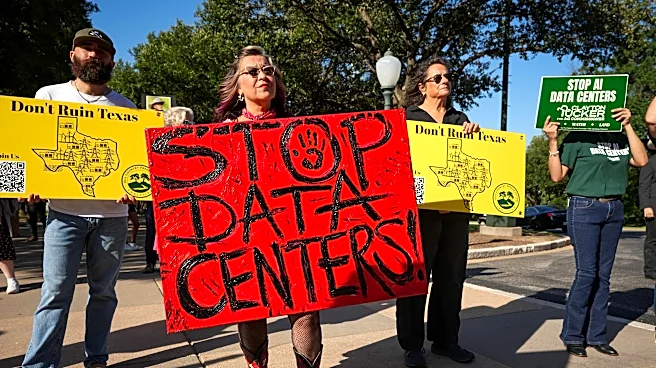
In a poll published Sept. 1 from YouGov and the Economist, nearly two-thirds of Americans (63%) would not support a new data center in their community. About half of Americans believe that data centers are bad for the country, and while more Democrats have negative feelings about data centers than Republicans, overall the parties are largely aligned.
Of those who self-identify as "AI users," only 26% believe data center construction is good for America. The number is even smaller, 9%, for those who say they do not use AI.
But that hasn't slowed down technology companies from starting new projects, and President Trump has publicly and adamantly supported growing the data center market in the United
States.
Georgia is among the states largely supporting data center development, and a new report has found that the greater Atlanta metro area is now the epicenter of new data center projects in America.
Here's what to know.
Atlanta top market for data center construction
The Atlanta metro area has officially surpassed Northern Virginia as the top market for total data center construction in the first half of 2026, according to an August report from CBRE, a real estate investment firm.
"Atlanta's under-construction capacity surged by 52.3% year-over-year to 2,882 (megawatts)," the report said. "Georgia remains one of the nation's most attractive markets for AI, hyperscale cloud and enterprise data center development, even amid ongoing entitlement and power delivery challenges. The state continues to offer a highly competitive business environment relative to many primary data center markets, supported by favorable tax incentives, available construction labor, a mature supply chain and lower operating costs."
According to CBRE, the number of locations under construction has increased every year overall, with a spike in 2024 and a major jump in the first half of 2026, measured in megawatts.
The city of Atlanta alone now accounts for 2% of the total primary market inventory, and multiple companies are eyeing the metro for expansion.
Already Google, Microsoft and Meta operate data centers in central Georgia, with OpenAI planning an expansion outside Savannah.
In August, the Atlanta City Council approved a Data Center Task Force to "examine national and global best practices in the development, siting, and regulation of data centers, which includes impacts on electric grid capacity, water supply, noise, the City's ad valorem tax digest, and ratepayer costs," the city council said. The decision came after the Public Service Commission approved an additional 9,885 megawatt capacity plan for Georgia Power, and the company agreed to temporary rate freezes as well as a plan of what to do if data centers close.
Georgia families fight Big Tech
Georgia officials may be allowing data centers to move forward across the state, but local families are taking their opposition to court.
In a lawsuit filed in Gwinnett County last week, four Georgia families accused both Meta as well as county development officials of failing to accommodate the people that live near theMeta Stanton Springs Data Center which began construction in 2018.
The families allege the data center has caused property damage, "contaminated water" and created "unreasonable living conditions" for those closest to the center, according to the lawsuit reviewed by USA TODAY.
"We believe that everyone deserves clean water and the peaceful enjoyment of their property," Christopher Bowers, an attorney representing the families, told USA TODAY in a statement. "When good faith efforts to simply sit down and attempt to resolve these harms are met with silence or wholesale denials, the court system emerges as the only means available to seek a remedy for these landowners."
The property, owned by the Joint Development Authority of Jasper County, Morgan County, Newton County and Walton County, stands to generate billions of dollars in tax revenue over the course of it's operation, money that would be split between the counties where the property crosses borders.
The families allege not only that Meta has not taken the proper precautions to protect nearby homeowners, but that the JDA has prioritized the anticipated profits to the counties (which will be used to pay off long-held debts, according to the lawsuit) over the health and safety of their community.
Meta told the Atlanta Journal-Constitution in a statement that a study conducted by the company shows groundwater flows away from the plaintiff's properties and that water used for construction came from the local utility and not the source of the families' well water.
"While we are committed to being a good community partner, we will still defend ourselves from baseless lawsuits," Meta told the outlet.
A spokesperson for JDA told the AJC their authority was aware of the lawsuit and "will thoroughly review the matter and response as appropriate," as of last week.
Where do top candidates stand on data centers?
The direction of data center development in Georgia could largely be determined by which candidates win major races this November as part of the midterm election cycle.
Democrat incumbent Senator Jon Ossoff, running for reelection, previously launched an investigation into consumer pricing in Georgia as it relates to data centers, including in an open letter to the Federal Energy Regulatory Commission questioning how increased costs from data center development would be managed.
His opponent, Republican Rep. Mike Collins, said in a recent campaign stop that data center development should "be a local decision."
"Do we need data centers? We sure do; we're in a race for AI against China. But if it's going to hurt local infrastructure, then those people don't deserve for that to happen."
Former mayor of Atlanta Keisha Lance Bottoms is running for governor, and she recently told reporters she supported a "pause" on data center development.
"I want us to gather all the information, factual information, and then make a determination on how we move forward," she said. "I can tell you when I'm moving around the state, a lot of people are concerned about the environmental impact. They're also concerned about the rising cost of utility bills."
Her opponent, healthcare CEO Rick Jackson recently wrote an opinion article for the Atlanta Journal-Constitution titled "Georgians must have voice on whether data centers come to their communities."
He has also echoed Collins in other comments he has made to reporters.
"First of all, every community needs to have control of whether they have a data center or not, full stop," Jackson said. "No property taxes for the data centers, or don't have one. It's totally up to them. As a business person, I just want to give them that option so that they know both sides of the street."
Irene Wright is the Atlanta Connect reporter with USA Today’s Deep South Connect team. Find her on X @IreneEWright or email her at ismith@usatodayco.com.
This article originally appeared on USA TODAY: Where are new data centers being built? Atlanta metro takes top spot