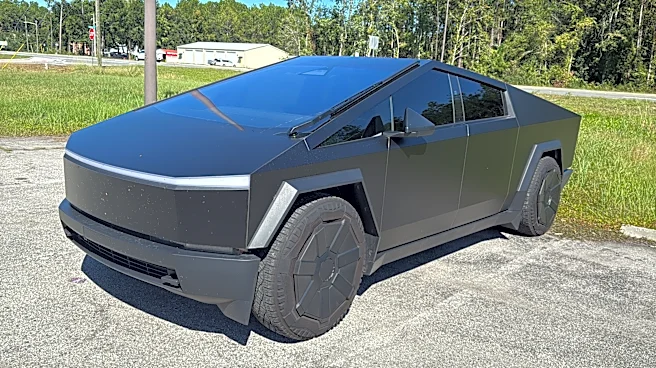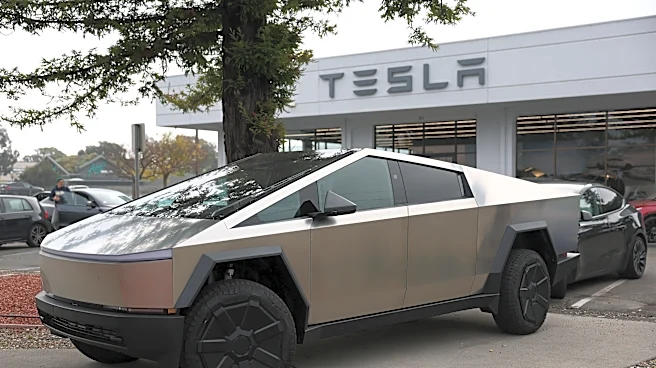







Perhaps no car became more of a symbol of the political battle over EVs than the Tesla Cybertruck.
First introduced for the 2024 model year with a clunky design, the Cybertruck entered the market as Tesla's CEO Elon Musk was becoming a political lightning rod.
Musk campaigned with President Donald Trump in 2024, and later became the face of the administration's effort to shrink the federal workforce. Musk's political moves enraged many of Tesla's most ardent supporters, and Cybertruck sales suffered.
Tesla sold 11,586 Cybertrucks in the first three months of 2026 before Musk's Nov. 9 announcement that the vehicle is being eliminated, compared to 16,097 in the first three months of last year, according to Cox Automotive.
EV supporters have cited
recent polling that shows partisan resistance to plug-in models is softening, even as overall market demand for them has weakened.
New polling from the Zero Emission Transportation Association, which lobbies for EV-friendly policies in Washington, and Generation180 shows willingness to consider EVs may be more closely tied to age than partisan affiliation, which was the assumption in the early days of the second Trump administration
ZETA's poll showed 75% of Americans under 35 say they are likely to purchase or lease an EV within five years, compared to just 23% of adults over 65 who said they would consider buying a plug-in model soon. By comparison, ZETA said 57% of Democrats and 45% of Republicans would buy one.
The group said the 52% spread on the age comparison dwarfs the 12% spread on the partisanship question, showing that age is now a better predictor of openness to EV adoption than politics.
“What this data shows us is that EVs are the cars of today and of the future,” Corey Cantor, research director at ZETA, said in a statement. “Even if they don’t own one now, many people see themselves driving EVs within the next five years.”
The USA TODAY Cars team took a look at how the Cybertruck became a symbol of the political fight over EVs, why Tesla decided that now is the time to pull the plug on it, and whether politics is receding as a factor in EV adoption.
How did the Tesla Cybertruck become a political lightning rod?
The Cybertruck launched during the height of the 2024 presidential campaign, when Musk vocally supported Trump, and the cars became a symbol for some shoppers' alignment with Musk's and Trump's politics.
At the start of the second Trump administration, Musk became the face of Trump's Department of Government Efficiency, which was tasked with drastically reducing the size of the federal workforce. Musk became closely associated with job cuts that enraged many of Tesla's biggest supporters.
According to a November 2025 Yale University study, Tesla sold 1 million to 1.26 million fewer vehicles between October 2022 and April 2025 than it otherwise would have without what the study's authors dubbed the "Musk partisan effect." The study found Musk's public political stances also helped to increase the sales of other automakers' electric and hybrid vehicles by 17% to 22%, as drivers who were opposed to the CEO's politics fled to other EV manufacturers.
According to a poll released in January 2026 by EVs for All America, an advocacy group that works with car manufacturers to push U.S. and state lawmakers to adopt EV-friendly policies, 44% of people who said they are seriously considering buying an EV had a mostly unfavorable opinion of Musk.
Stephanie Valdez Streaty, Cox Automotive’s director of Industry Insights, said in a statement that "the decision to discontinue the Cybertruck highlights how difficult it can be to translate strong initial attention and enthusiasm around a new vehicle into sustainable mainstream demand."
Why do EV supporters hope the political war over plug-in cars is fading?
Hardening political opinions about electric cars have been seen as a roadblock to higher adoption of plug-in models nationwide.
The states that have the biggest EV penetrations are ones that generally vote for Democratic candidates in presidential and statewide elections. According to the Alliance for Automotive Innovation, which lobbies for most major automakers, California, Washington, Nevada, Oregon and Colorado had the most EV registrations in the first half of 2026, which is the most recent data the group has released. All of those states, except Nevada, voted Democratic in the 2024 presidential election.
But EV supporters see signs of progress on the political front in 2026.
"We asked this trick question for years ... which is agree or disagree with this statement: 'EVs are for people who see the world differently than I do.' Very cultural, red, blue kind of thing," Mike Murphy, CEO of the American EV Jobs Alliance, said in an appearance on the "Directly Current" podcast.
"Three years ago, 59% of Republicans agreed with that statement," Murphy continued. "Just ruling them out on dogma. Those are for the other side, so to speak. Now it's tied. ... So we've had about an 18-point falling of the political dogma stuff, which is a very good sign."
Carmakers sold 725,888 EVs in the first nine months of 2026, which was down from over 1 million sold in the same period last year. But Trump signed legislation last summer that ended the federal government's popular $7,500 tax credit for EVs in September 2025. California has stepped in to offer $3,500 EV rebates, but those credits only go to in-state shoppers.
Stuart Gardner, Executive Director of Generation180, said in a statement that his group's data shows that EVs are now mirroring the ways other forms of technology are usually adopted.
“This is how new technology often moves into the mainstream: Younger consumers lead the way,” Gardner said.
Keith Laing is an automotive reporter on the National Trending Desk at USA TODAY. Contact Keith at klaing@usatodayco.com.
This article originally appeared on USA TODAY: Does Tesla's Cybertruck cancellation mark the end of EV political war?