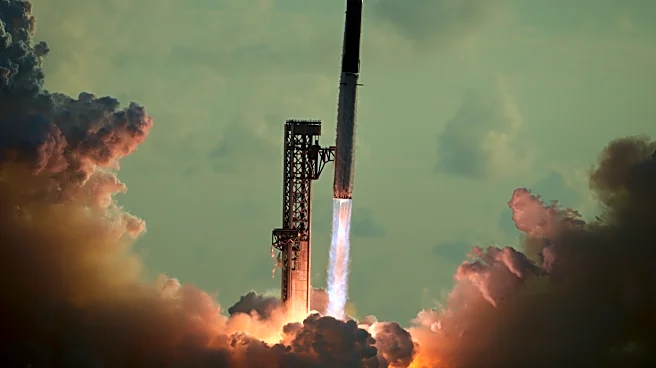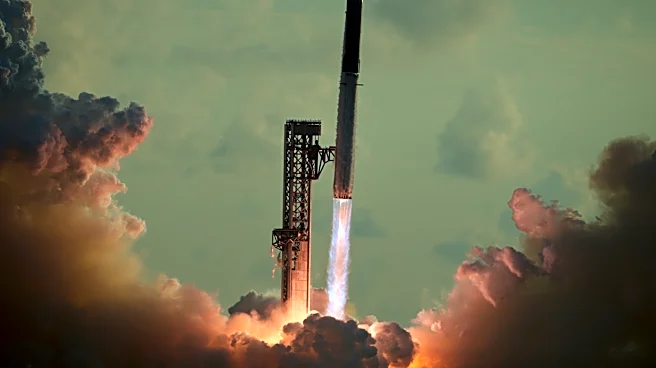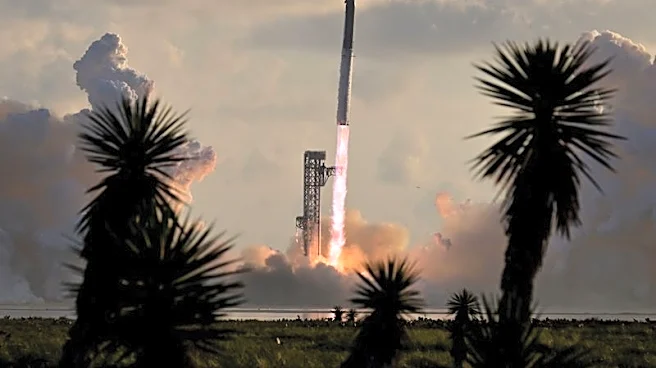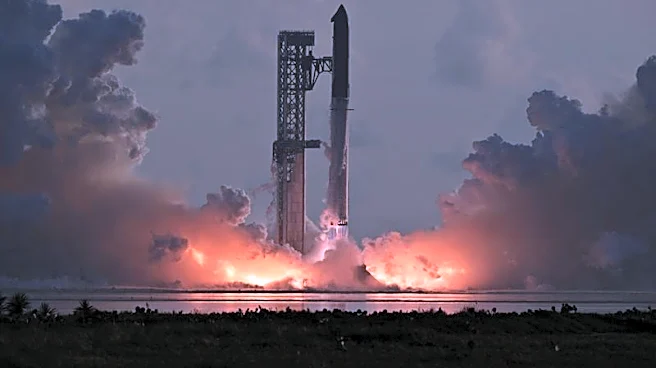








Following more than three years of flight tests, SpaceX's gargantuan Starship rocket has reached orbit for the first time.
The major milestone comes as tech mogul Elon Musk's commercial spaceflight company races to have the world's largest rocket ready for routine service potentially before 2026 comes to an end. Standing more than 400 feet tall when fully stacked, Starship is not only historically large and powerful, but is also crucial to both SpaceX and NASA's ambitions.
For SpaceX, Starship has been tasked with expanding the company's internet satellite network while potentially taking the first humans to Mars. And for NASA, Starship is among the vehicles due to transport its astronauts to the lunar surface in the years ahead.
Musk has said
he envisions Starship rockets eventually launching multiple times a day from spaceports across the U.S.
That may still be a distant objective, but Starship's most recent launch from South Texas, which SpaceX refers to as flight 14, marked an optimistic step in the right direction.
The orbital milestone comes after all 13 of Starship's previous test flights since 2023 were limited to suborbital space. The flight test also saw Starship carry operational Starlink satellites to orbit, marking the first revenue-generating mission for a spacecraft still under development.
Elon Musk celebrates as Starship reaches orbit in SpaceX's 14th flight test
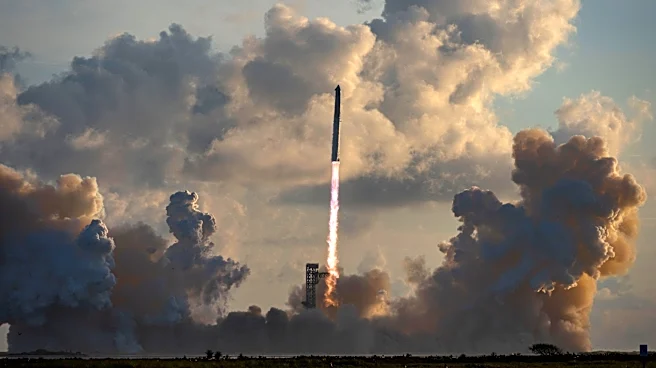
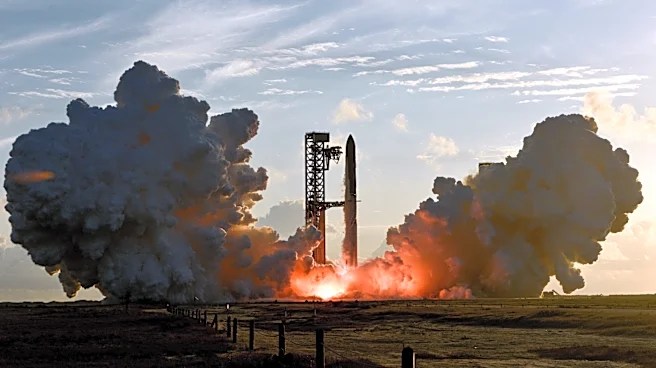
SpaceX's massive Starship rocket most recently launched at 8:48 a.m. ET Monday, Sept. 28, from the company's Starbase headquarters in Texas near the U.S.-Mexico border.
After providing the initial burst of thrust at liftoff, the 236-foot lower stage Super Heavy booster separated from the upper section of the rocket for a water landing in the Gulf of Mexico, renamed in the United States under executive order as the Gulf of America.
The 171-foot upper-stage, designated as Ship 41, then went on to reach orbit in a critical milestone following more than three years of testing.
The flight test was scheduled to last 10 hours, but was reduced to three after one of Starship's three main engines shut down prematurely during the ascent, SpaceX wrote in a mission recap.
The spacecraft was able to deorbit through Earth's atmosphere for a splashdown in a pre-designated landing zone in the Pacific Ocean. Landing in a nose-up position, the vehicle – which SpaceX had no plans of recovering – was engulfed in flames as it tipped onto its side, igniting in a large fireball.
Liftoff of Starship's first orbital flight pic.twitter.com/vG6QWlpwnY
— SpaceX (@SpaceX) September 28, 2026
Musk, who founded SpaceX in 2002 and serves as its chief executive, celebrated the milestone in a post on X, his social media platform.
Starlink satellites deployed to space
During the mission, Starship also deployed 26 next-generation Starlink satellites one by one at an altitude of about 161 miles high.
"All 26 Starlink V3 operational satellites deployed and operating nominally," Musk wrote on X.
The deployment also marked a major first. SpaceX had delivered test satellites in previous missions before, including a batch that was briefly operational in Starship's previous test flight in July that intentionally burned up in the atmosphere.
These satellites, though, are expected to raise their orbits and begin serving customers in a few weeks, SpaceX said.
See photos of flight 14
NASA's Jared Isaacman praises Starship launch
Because Starship is so crucial to NASA's plans to return astronauts to the moon, Administrator Jared Isaacman appeared to be following the test flight closely.
Isaacman also congratulated SpaceX on the orbital milestone in a post on X.
Congrats @SpaceX! Gorgeous launch, getting Ship to orbit and managing every step in a safe, responsible, and especially inspirational way. @NASA, along with the rest of the interested public, is excited to help where we can and for Starship missions to become routine! https://t.co/6DSKmMUT4T
— NASA Administrator Jared Isaacman (@NASAAdmin) September 28, 2026
"Gorgeous launch, getting Ship to orbit and managing every step in a safe, responsible, and especially inspirational way," Isaacman wrote on X. "NASA, along with the rest of the interested public, is excited to help where we can and for Starship missions to become routine!"
SpaceX develops world's largest rocket for moon, Mars
SpaceX is developing the rocket to be a fully reusable transportation system, meaning both the rocket and vehicle can return to the ground for additional missions.
Musk's vision has long been for Starship to be an interplanetary vehicle that takes humans to Mars, where they can establish a self-sustaining colony. While the world's richest man has indicated that SpaceX will focus on building a lunar city first, the company has already announced a human-led expedition to Mars' orbit – though it has not set a target date.
SpaceX is also under contract with NASA to develop a lunar lander configuration of its Starship, known as the Human Landing System, to ferry astronauts to the moon under the U.S. space agency's Artemis program.
But now that Starship has reached orbit, SpaceX still needs to demonstrate two more crucial capabilities:
- refueling mid-flight in a complex process that requires two Starships equipped with docking adapters to meet in orbit to transfer propellant;
- having an upper-stage capable of returning to the launch site, similar to how SpaceX has already demonstrated the ability for the Super Heavy booster to return and be caught by giant mechanical arms known as "chopsticks" on the launch pad.
Contributing: Reuters
Eric Lagatta is the Space Connect reporter for the USA TODAY Network. Reach him at elagatta@usatodayco.com
This article originally appeared on USA TODAY: Starship reached orbit for 1st time. What's next for SpaceX's rocket?