



Here’s what you should expect in the first 24 hours after a major earthquake in Los Angeles County.
The services you rely on daily will be “significantly degraded,” Kevin McGowan, director of the Los Angeles County Office of Emergency Management.
Getting gas could be a problem, for example, because most gas stations have underground storage tanks with pumps that require electricity—and electricity will be disrupted, he said.
Our ability to communicate by making phone calls will be impacted. The sheer demand for law enforcement could exceed their capacity. And there will be a lot of fires, officials said.
Meanwhile, county officials will determine which areas have been impacted most to deploy resources, as well as restore key infrastructure like
electricity, McGowan said.
Los Angeles County officials held a presentation about earthquake readiness at the end of September after Supervisor Kathryn Barger called for it in a motion in July. The county is a sprawling region home to an estimated 9.6 million, according to the U.S. Census Bureau. In 1994, the Northridge earthquake left dozens of people dead and billions of dollars in damage.
Too many faults in SoCal to worry about just one
A major earthquake is a threat in itself. But renowned seismologist Lucy Jones spotlighted another challenge that’ll arise — a staggering number of fires as modeled in the ShakeOut Earthquake Scenario. Published in 2008, it captured the impacts of a major earthquake on the San Andreas Fault. The fire following that earthquake “doubled the losses.”
“When we modeled it, it came up with this number of 200 million square feet to be burned if it was a calm, cool day when the earthquake happened because there would be 1,600 ignitions,” Jones said.
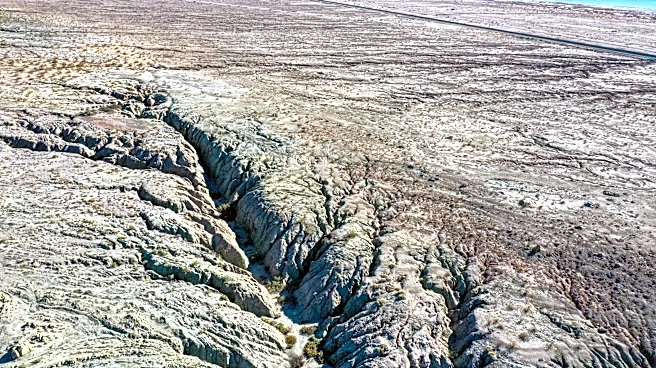
The San Andreas Fault, while likely the most recognizable, isn’t the only fault in Southern California. We have too many faults to worry about just one, Jones said. The San Andreas Fault is the “fastest moving fault,” yet none of our damaging earthquakes have been on it in the last 150 years.
Snapshot of what challenges await after an earthquake
In a disaster scenario, water and gas lines could be severed — the latter of which causing fires — adding to firefighters’ challenge, said Nick Duvally, deputy fire chief with Los Angeles County Fire Department
“One of the major effects will be fire,” said Mark Pestrella, director of Los Angeles County Public Works, echoing Jones. “And we’ll have many fires to address after an earthquake.”
In a catastrophic earthquake, the mutual aid from partners that the Los Angeles County Sheriff’s Department might otherwise rely on for immediate assistance could be delayed, considering how widespread the impacts could be, Sheriff Robert Luna said. The county sheriff department’s planning emphasizes self-sufficiency as a result, he said.
It’s a sentiment echoed by Duvally, who said that regional, state, federal, and international aid may be “comprised” in getting to their destination. The county fire department will be “counting on” county public works to help them access the communities most in need.
Immediately after a major earthquake, affected sheriff’s stations can activate their emergency operations center to establish priorities and assess the situation, Luna said. Deputies will also identify major hazards and damage and assist with evacuations in their area.
Luna identified one problem in the immediate response to a catastrophic earthquake: demand for law enforcement could exceed available personnel and resources. However, the department has policies to mobilize personnel and has built its planning around prioritizing available personnel and resources to sustain essential operations.
Airports can move people and supplies if roads and other forms of transportation are disrupted, said Pestrella, the public works director. He said specialized teams are prepared to inspect damaged infrastructure and prioritize repairs based on public health and safety.
“I would put out you’ve got an extraordinary team that’s doing a lot of work,” Jones told the board of supervisors. “What will at some point happen in our biggest earthquake is going to overwhelm all of this.”
Key solution: Neighbors helping neighbors
Jones, the seismologist, said she has worried about Los Angeles being a “freeway culture.” We drive past a million other people to see the person we want to, she said, and we don’t connect with our neighbors.
However, the recovery she’s witnessed in her neighborhood after the Eaton Fire last year has shown her that they’ve “kept together as a community” more than she thought they would.
“That’s where I think the really big solution is going to come is the degree to which we don’t depend just on ourselves or even just on the county, but we figure out how to be partners so that we respond most effectively,” Jones said.
Research regarding Hurricane Katrina — the only disaster of a somewhat comparable scale, Jones explained — showed that the communities who “came back” had a “high degree of social capital,” she said. The Cambridge Dictionary defines social capital as “the value of the relationships between people who work or live together and the knowledge and skills that they have and share.”
“In a widespread disaster when an earthquake occurs, neighbor helping neighbor and community helping community is going to be the most impactful portion of our initial response,” McGowan said.
He said it’s critical that people prepare at both the family and community level. Investing into one’s preparedness can start with something small like having an emergency kit in your car in case the earthquake happens while you’re at work, for example.
While being ready for a disaster is “essential,” being prepared can “feel out of reach for many residents,” said Andrew Veis, director of countywide communications, pointing to the cost of emergency supplies, time constraints, and other competing priorities.
However, three “basic” steps people can take to prepare for a disaster are making a plan on what to do, signing up for alerts to stay informed, and putting together a basic emergency kit, Veis said.
Paris Barraza is a reporter covering Los Angeles and Southern California for the USA TODAY Network. Reach her at pbarraza@usatodayco.com.
This article originally appeared on USA TODAY: This is how LA will respond to the Big One. What they want from you