





Federal agents searched the Washington-area home of Rep. Ilhan Omar on Oct. 12, the latest escalation in the Trump administration’s long-running clash with the country’s first Somali American lawmaker.
Omar, the Democratic congresswoman who represents Minneapolis, has for years been a target of President Donald Trump. Some of his supporters, Republican elected officials among them, have gone further, calling for Omar to be stripped of her citizenship and deported. And top officials in his administration have repeatedly lobbed unsubstantiated accusations of immigration fraud at her, which Omar denies.
The Justice Department said agents from Homeland Security Investigations, the investigative arm of the Department of Homeland Security, executed
a court-authorized search warrant as "part of an ongoing federal criminal investigation." The department did not say what the investigation involves, and Omar has not been charged with a crime.
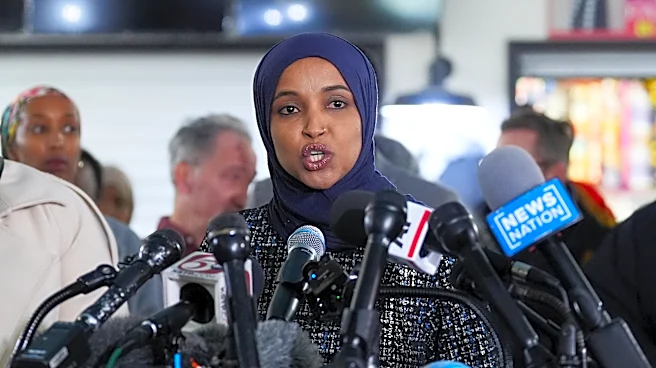
On social media, Omar called the search "an attempt to target political enemies and weaponize federal law enforcement."
The search comes as the administration has supercharged its efforts to strip naturalized Americans of their citizenship. Last year, the Justice Department directed its lawyers to "maximally pursue" denaturalization cases, and it has since set a goal of filing at least 250 by October.
The Trump administration has also zeroed in on Minnesota’s Somali community, particularly after a sprawling fraud scandal involving state social service programs. Omar has not been accused of wrongdoing in that case.
DHS Secretary Markwayne Mullin made clear last month that Omar was on the administration’s radar, telling conservative podcaster Benny Johnson "something’s going to happen."
"If we can prove it, that you shouldn't have been here in the first place, we'll deport you," Mullin said. "And so, we're looking at – it's more than just her case."
Here’s what to know.
What happened at Rep. Ilhan Omar’s home?
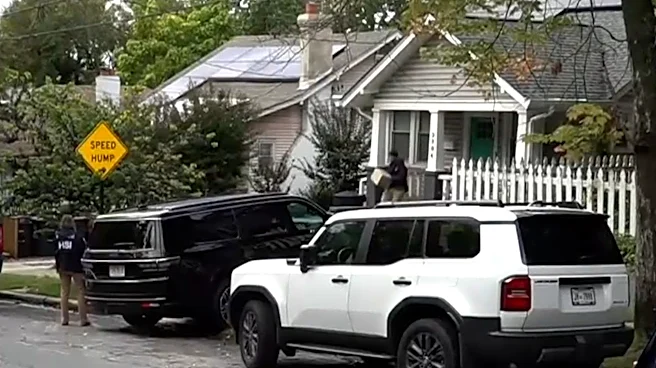
By Oct. 12 morning, a block in Northeast Washington had been taken over. Federal law enforcement vehicles lined the street outside a house associated with Omar, and agents in jackets marked “POLICE HSI” moved in and out every few minutes. Some came out, carrying cardboard boxes.

The Justice Department confirmed only the basics: HSI agents were carrying out a court-approved search warrant as part of a criminal investigation. The agency would not say what agents were looking for or whom the investigation targets. DHS referred questions to the Justice Department.
Omar has not been charged with a crime, and a search warrant is not an accusation of one.
Who is Rep. Ilhan Omar?
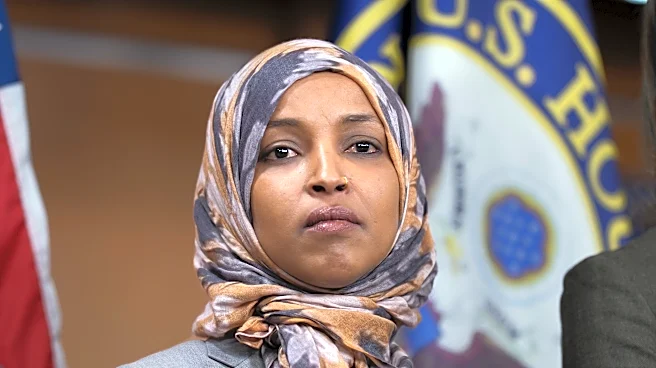
Omar’s story begins in Mogadishu, where she was born in 1982, the youngest of seven children. When she was 8, civil war tore through Somalia and her family fled, spending four years in a refugee camp in Dadaab, Kenya, before resettling in the United States. They eventually landed in Minneapolis’ Cedar-Riverside neighborhood, the heart of the country’s largest Somali community. She became a U.S. citizen in 2000, at 17.
She rose quickly in Minnesota politics. In 2016, she ousted a 44-year incumbent in a Democratic primary and won a seat in the state House. Two years later, she was elected to Congress, becoming the first Somali American to serve there and, along with Rep. Rashida Tlaib of Michigan, one of its first two Muslim women. As a member of the progressive group of lawmakers known as the "Squad," she has become one of the most recognizable and polarizing Democrats in Washington.
Her marriage history has drawn scrutiny since her time as a state lawmaker. Minnesota court and marriage records show she married Ahmed Elmi in February 2009 and divorced him in December 2017. In 2016, while still legally married to Elmi, she told Minnesota Public Radio that the two were separated and that he was living in England, calling the marriage "a difficult part of my personal history that I did not consider relevant in the context of a political campaign."
In 2018, she married Ahmed Hirsi, the father of her three children, with whom she’d earlier had a religious marriage. They divorced in November 2019, and she married Tim Mynett, a political consultant, in March 2020.
It is the Elmi marriage that her critics have seized on, saying without evidence that he is her brother and that she married him to help him gain immigration status. Omar has called it "absurd and offensive."
Why has Rep. Ilhan Omar been a Trump administration target?
For nearly as long as Trump has been in politics, Omar has been one of his favorite foils, a Somali-born refugee, Muslim and progressive whom he has often held up as a symbol of the immigration he wants to curb.
The attacks began in his first term. In 2019, he suggested that she and three other progressive congresswomen of color "go back" to the countries they came from, and weeks later a crowd at one of his rallies chanted "send her back" as he lit into her from the stage.
His second term brought sharper language and, increasingly, the machinery of government. At a cabinet meeting last December, Trump called Somali immigrants "garbage," used the same word for Omar and accused her "friends" of ripping off Minnesota for billions in welfare money. Weeks later, he said the Justice Department was looking into her wealth.
Omar has rarely let the attacks go unanswered. She has called Trump a racist, backed efforts to impeach him and emerged as one of the loudest critics of his immigration operations in Minnesota, pressing DHS with oversight letters and holding hearings on the operation. After the “garbage” remarks, she wrote on social media that his “obsession with me is creepy.”
In January, a man rushed Omar during a Minneapolis town hall and sprayed her with a liquid from a syringe, later identified as apple cider vinegar. The next day, she blamed Trump’s rhetoric, saying her death threats spiked whenever he attacked her and the Somali community.
Then a years-old internet rumor about her marriage made its way to the White House. In March, Vice President JD Vance told Johnson on his podcast that Omar "definitely committed immigration fraud," and said he and Stephen Miller, the White House deputy chief of staff, had been discussing how the government might go after her.
By September, the talk had turned to investigation. Mullin, speaking with Johnson at a Republican National Committee event in Dallas, called the matter "an ongoing investigation" and asserted, without offering evidence, that Omar had married her brother to bring him into the country. He suggested there might be "more to this," pointing to her family’s migration.
Days later, Tom Homan, the White House border czar, said on Fox News that HSI was conducting a criminal investigation involving Omar, but declined to give further details.
"If someone committed an immigration violation, if someone committed marriage fraud or anything like that, regardless if they’re a congressman or not, no one’s above the law. So, I’ll leave it at that," he said.
Why has Trump zeroed in on Minnesota?
Fleeing civil war and the strife that followed, thousands of Somalis made their way to Minnesota beginning in the 1990s. Over the next three decades, they built the largest Somali community in the country. Today, about 80,000 Somali Americans live in the state and most are U.S. citizens.
Under Trump, that community has found itself in the crosshairs.
The administration has repeatedly tied the Somali community to a string of fraud cases involving state-run social service programs. Chief among them Feeding Our Future, a scheme that siphoned roughly $250 million in federal child nutrition funds and has produced dozens of convictions.
Trump has used the cases to paint Minnesota as a hub of fraud and money laundering. Local leaders, including Somali residents who have condemned the fraud, say he is punishing an entire community for the crimes of a few.
The rhetoric soon turned into policy. In November 2025, Trump announced that he was ending deportation protections for Somalis in Minnesota, blaming "Somali gangs" without offering evidence. Within weeks, the administration launched Operation Metro Surge, flooding the Twin Cities with nearly 3,000 federal agents in what DHS called the largest immigration enforcement operation ever. The surge set off mass protests, which only grew after federal officers shot and killed two U.S. citizens, Renee Good and Alex Pretti.
For Omar, the crackdown hit close to home. Last December, she said ICE agents pulled over her son, a U.S. citizen, after he stopped at a Target, and let him go only after he showed his passport. In August, a police officer found an undercover HSI agent parked outside one of her town halls. The agent said she was there for an unrelated drug investigation.
This article originally appeared on USA TODAY: Ilhan Omar’s home was searched. What to know about her immigration story