



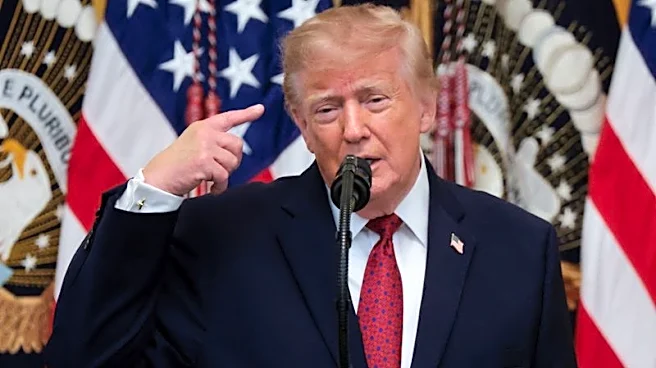
A key group of voters who swung towards President Donald Trump in 2024 are now swinging just as sharply away from him ahead of the 2026 midterm elections: young people.
Nationwide polls of likely and registered voters from Economist/YouGov, Marquette Law School, Reuters/Ipsos, Emerson College and Echelon Insights showed that young voters have moved away from Trump more than other age groups have. The September polling showed Trump's approval among young voters ranged from 19.5% in Emerson's poll to 31% in Echelon Insight's poll, while his approval from the whole population ranged from 32% in the Reuters/Ipsos poll to 39% in Emerson's poll.
That comes only two years
after Trump made gains among young voters, who are usually defined by pollsters as those under 30. Former Vice President Kamala Harris carried the group 54% to 43%, according to exit polls, but Trump improved his youth vote performance compared to previous elections, especially among young men. In 2020, he only won 36% of the youth vote, so 2024 represented a 7 percentage-point improvement.
"There's sort of this reputation about Gen Z that they might not be engaged or care, and we've learned through listening they are a little bit jaded around our political process," said Kalisha Dessources, of the nonpartisan voter turnout organization When We All Vote.
When asked by pollsters whether they approve of Trump's performance and which party they would prefer in a congressional race, young people are more likely than voters 30 years old and up to say that they disapprove of the president and will vote a Democrat to Congress in the midterms.
Young voters more likely to be independent, struggling with cost of living
Young voters are less likely to affiliate themselves with a political party, according to experts, and they are expressing financial frustration at an even higher rate than the electorate as a whole.
"We're in this, like, new political era where younger people are judging their politicians and their politics and kind of how they think, voting through a different lens than previous cohorts," John Della Volpe, who leads a youth voter polling initiative at Harvard University, said.
Dissatisfaction with high inflation during the Biden era contributed to Trump's 2024 success, particularly among young voters, who earn less and have less savings than older Americans. According to the Bureau of Labor statistics,inflation sat at 2.7% in November 2024. As of August 2026, inflation has risen to 3.4%.
Della Volpe has studied young voters since 2000 and called it a "stability and experience era" in which young voters are looking to politicians to help them lead a more stable day-to-day life, often in terms of financial security.
He runs focus groups around the country with young voters and shared the story of one young woman in Michigan telling him in the spring of 2024 that the election was going to be about the economy. She said she was leaning towards Trump because she could "worry about abortion and guns and other important issues" after her own economic situation was settled.
A spokesperson for The Center for Information & Research on Civic Learning and Engagement (CIRCLE) at Tufts University, which tracks engagement and voter trends among young people, told USA TODAY that the current young voter population is composed of "issues-based voters." That group of voters is more independent and are not judging every candidate in the Republican Party by their assessment of the Trump administration.
"The fact that they may be frustrated or disillusioned with the current administration doesn't necessarily mean that they're going to go ahead and vote in the other direction,"said CIRCLE's Alberto Medina.
CIRCLE's tracking of young voters revealed that two-thirds said their political opinions have changed in recent years. Medina said that isn't surprising, given "young people are still kind of figuring things out and looking at their options and making choices based on the issues and what's happening around them."
Dessources said that in When We All Vote's interactions with voters at summer events such as Lollapalooza and the World Cup, the organization also found the group to be more issues-based than partisan. Forty-three percent of Gen Z Americans surveyed at these events said that they identify as independents, and many expressed frustration with the cost of living.
In Echelon Insights' polling, the cost of living was the top concern for all voters but "young voters are more likely to list that as their top issue," according to Avery James, the communications director for the polling organization. James noted, though, that during the 2022 midterms, then-President Joe Biden also had "a significant gap with younger and older voters as he was looking at the handling of the economy."
In the Economist/YouGov September poll, 29% of Americans rated inflation as the most important problem. Among voters aged 18-29, 38% ranked inflation as the most important issue. In contrast, voters 65 and older were more likely to rank presidential leadership (17%) as their top issue, with only 6% of young voters who identified it as their top issue in the Economist/YouGov poll.
Just as young voters were more likely to disapprove of Trump, they're more likely to disapprove of his war in Iran. In the same poll, 63% of the electorate overall disapproved of the war and 31% approved. When it came to young voters, 69% disapproved and only 25% approved.
Young men told Della Volpe in his focus groups that "they were promised by Donald Trump... a lower cost of living and fewer wars."
Young men backed Trump rather than GOP
Exit polls from a consortium of news organizations in 2024 showed 49% of the young men voted for Trump, compared with 48% voting for Harris. CIRCLE at Tufts reports a much larger split, saying in their exit polling that 56% of young men voted for Trump and 42% voted for Harris.
The online "bro" podcast culture with MAGA media personalities like Joe Rogan and the Nelk Boys helped boost Trump with that demographic.
But a "bro vote" for Trump in 2024 didn't necessarily mean that young men were signing up to stick with the Republicans. A Sept. 15-18 poll by Cygnal of registered young male voters showed the Democratic congressional candidates in the midterms lead Republicans by almost 10 points.
"Young men, in particular, played a key role in returning Donald Trump to the White House," said Della Volpe, of Harvard. "Almost two years later, the lesson from that experience in that election was that a vote for Donald Trump did not mean that younger people or younger men were signing up to be Republicans for life."

Young voters are less likely to vote
One caveat that may soften the blow for Republicans: Young people are relatively unlikely to vote.
The data review by USA TODAY revealed that more than half of young voters reported being likely or enthusiastic to vote, but their response on those questions fell from 5 to 17 points below the polls' total percentage.
According to Marquette Law School in September, only 56% of young voters were "absolutely certain” or "very likely" to vote, compared with 73% of the whole electorate. Emerson's poll found that 66.4% of young voters were "very excited to vote," but that also fell below the whole population, where 71% of voters said they were very excited.
Young voter turnout is historically lower than older populations. Della Volpe said that as Gen Zers − who were born between 1997 and 2012− reached voting age in the 2018 and 2022 midterms, strides in participation were made, with the rate of young people voting reaching a record-high 36% in the 2018 midterms, as opposed to a historically typical rate of just 15% to 20%. However, Della Volpe said there is "still a gap" compared to all eligible voters participating at rates between 52% and 54% in 2018 and 2022.
"It would be a lot to expect that young people are going to catch up to older voters in one election cycle," Medina noted. He said when CIRCLE surveyed young voters in February, 55% said they would vote in November. But since survey respondents tend to overestimate their odds of voting, "that doesn't necessarily mean that youth turnout is going to be 55%, which would be beyond historic for a midterm."
This article originally appeared on USA TODAY: Young voters swung to Trump in 2024. Now they are leaning Democratic