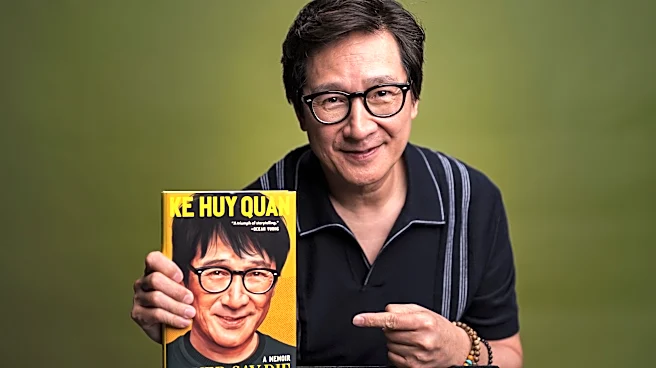







NEW YORK – It’s fitting that Ke Huy Quan’s name is printed on his memoir in sunshine yellow.
When the “Goonies” and “Everything Everywhere All At Once” actor strolls into the USA TODAY studio, he is as joyful as he appears in a now-viral video reuniting with Harrison Ford or his signature wide-grinned selfies.
It’s a joy that is in many ways defiant. Just four years after fleeing Vietnam, living in a refugee camp and finally being reunited with his family in the US, Quan became a child actor in “Indiana and the Temple of Doom” and “The Goonies.” But as he grew up, acting jobs dwindled. He didn’t land a role for almost two decades. In 2022, he returned to the screen in “Everything Everywhere All At Once.” Then 51, his Oscar win for best supporting
actor was hailed as a triumphant comeback and the emotional acceptance speech he gave exclaiming "this is the American Dream" is considered one of the most inspiring in Academy Award's history.
Now, he’s telling the whole story in “Never Say Die” (out Sept. 15 from Grand Central Publishing).
This interview has been edited for clarity and length.

Question: You write in the acknowledgments that you were initially hesitant to go back in time. Why was that?
Quan: Especially in the very beginning, the journey was quite traumatic and I didn't know if I wanted to share that part of the story or to revisit some of those memories. But there was one thing that I wanted to do if I was going to write a book: I needed to be truthful and I needed to tell the whole story.
I learned a lot about myself. It was definitely a self-discovery journey. And at the same time, it was a therapy session that I never had.
The book begins when you’re attempting to flee Vietnam with your dad. You were jailed multiple times as a 7-year-old before making it to a refugee camp in Hong Kong and finally reuniting with your mom and siblings in the US. It’s a powerful opening. What was it like revisiting those memories?
This book ended up being the unabridged version of my Oscar speech. In the very beginning, I didn't know how I wanted to start, but I ended up choosing the moment when I was just 7 years old when my dad woke me up in the middle of the night and I didn't know what was going on. He carried me over his shoulder. We got in a waiting car and we went out to the beach, and that was our first attempt ever to escape Vietnam. We didn't make it. I spent three weeks in jail that first time. Then just a few months later, we tried again, failed again, ended up spending three months in jail.
I wrote this book for my dad, because most of my adult life, my dad was never there because he had suffered a debilitating stroke. And so my memory of him has always been post-stroke.
My first memories of him, he was alive and healthy and vivacious. So that was the part that I really love. And it was as if he came alive as I was writing this book and I got to walk alongside him once more.
I experienced so much trauma at an early age and then right after a lot of success, and then had it all taken away from me. So the whiplash between these extremes had taught me, had ingrained in me a sense of impermanence. Life is fleeting. Something bad happening today could be good tomorrow or something good today could turn terrible tomorrow.
If you could go back in time and talk to that 8-year-old, what would you tell him?
I don't think I’d want to do that. When I was younger, there was a lot of struggling. It was hard. And ironically, even though I come from a big family, I spent a lot of time in solitude, especially in my late teens and early twenties. I didn't have the wisdom or the resource to try to figure out why I was feeling the way I did. And when we tried to flee Vietnam, I was so young, I didn't know anything. My parents kept a lot of that away from me. They were trying to protect me. But now having written this book and having the benefit of hindsight, everything that has happened has shaped who I am today, and I wouldn't change a thing.
It reminds me of the quote from "Everything Everywhere All At Once" ...
Every rejection, every disappointment has led you (here) to this moment. Don't let anything distract you from it.

A couple of years later, your life did change very rapidly with “Indiana Jones.” It was special to read about your relationship with Harrison Ford. What is your relationship like since reuniting?
It's been great. I'm really happy that I got to reunite with him.
How he carried himself, how he treated other people, how he approached everything with a sense of humility and gratitude, that has made a big impact in my life.
(During one stunt) on the set of Indiana Jones … I was so scared and I cried, and here was Harrison crouching down to my eye level and comforting me and not telling me not to cry, not to toughen up. It's OK. It's OK to be nervous. It's OK to be scared. That's all part of life. It was amazing.
My dad wasn't there, not because he didn't want to be, but because he couldn't. He was no longer healthy. He no longer had control over his body the way he wanted. So when I needed him, he wasn't quite there. So who did I turn to? I turned to (Steven) Spielberg, I turned to Ford. To see how they carry themselves, how they treated people.
You’re also close with Jeff Cohen from “The Goonies,” and you two had similar paths of falling out of acting. Was it hard to watch your other “Goonies” costars continue to book roles while you weren’t?
It was. Because when we did "Goonies," actually, I came off of “Indiana Jones and the Temple of Doom.” So I had this big movie that I just did, a lot of them were just starting out. And not soon after, I saw how well their careers were going, especially Sean (Astin) and Corey (Feldman). They were doing one movie after another. Incredible movies. And also well-deserved because they were incredible actors. And also not only them, but other child actors, too. Everywhere I looked, everyone was working except me. I felt like the world was moving, was spinning and I was the only one that was standing still. That's how I felt. Now, I didn't know it at the time, Jeff Cohen, a.k.a. Chunk from “The Goonies,” was going through the same thing.
I thought I was doing it alone. I was the only one. And it was really hard and I didn't know who to turn to.
In those times when you were really struggling, what kept you going and pushed you to pursue those dreams?
I would be lying to you if I tell you that I never thought about giving up. I did. And many, many, many times. But then I would go to the movie theater on the weekends and I would watch a great movie or a great performance, and I would be so inspired. Walking out of that theater, I’d go, "Yes, I'm going to hold onto this dream I have. An opportunity is going to come along and it's going to turn things around." And of course it never did, and that dream would slowly fade away, but then I would go back to the movie theater.
You've seen such a dramatic change in your career after “Everything Everywhere.” A lot of this book is a love letter to your wife, who worked as a translator on set and kept telling you your time would come.
Strangely enough, over the years, every time I get an opportunity, whether it's a movie or a television show, I would say, "Oh, this is the turning point that I'm looking for. This job will give me the success that I'm looking for.”
Now looking back, it was meeting my wife. That was the turning point that I was looking for. She really believed in me and because her believing in me was so strong, and she was right about a lot of things, I didn't want to disappoint her. I didn't want to be the only one that she was wrong about. And I think it was because of that, that gave me the strength and the courage to keep on going.
The title is an iconic “Goonies” quote. What does that mean to you today?
What it means to me is that, yes, the journey will be difficult. Things aren't going to be easy all the time, but as long as you keep moving, as long as you don't say die, you never know what's right around the corner. Things that are not so great today doesn't mean that tomorrow is not going to be better. As long as you hang on to that dream of yours and work hard enough, and hopefully you'll find meaning in your journey that someday things will turn around.
Clare Mulroy is USA TODAY’s Books Reporter, covering buzzy releases, chatting with authors and diving into the culture of reading. Find heron Instagram, subscribe to our weeklyBooks newsletter or tell her what you’re reading at cmulroy@usatoday.com.
This article originally appeared on USA TODAY: Ke Huy Quan reveals Harrison Ford's 'big impact' on his life but credits wife for comeback