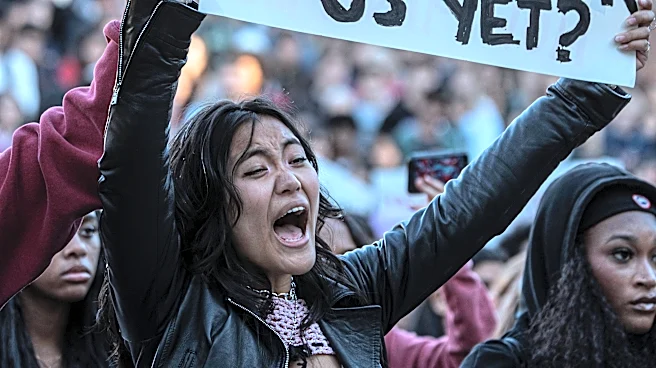








Fewer than four in 10 college students believe freedom of speech is secure in the United States today, according to a new study from the Knight Foundation.
It's a decade-low level that marks a significant decline since 2016, when nearly three-fourths of college students said the same.
The finding was published in one of two First Amendment studies the Knight Foundation published on Oct. 13. One surveyed young adults between the ages of 18 and 29, while the other surveyed high school students.
Two in three high school students agreed that the climate on their campus "prevents some people from saying things they believe because others may find it offensive," according to the study.
The high school survey, which is the ninth of its kind since 2004,
also found a record-low percentage of students (53%) who agreed that "people should be allowed to say whatever they want in public, even if it is offensive to others." More than two-thirds said the same in 2004.
Both studies touched on topics including self-censorship, artificial intelligence and the extent to which respondents believe the First Amendment goes too far in the rights it guarantees – or not far enough.
While more than half of the high school students (57%) said the First Amendment doesn't go far enough in its protections, more than a quarter (28%) said it goes too far, the study reported.
A similar share of young adults (54%) said the First Amendment doesn't go far enough. Just under a quarter of all respondents said it goes too far, a belief that the study said was higher among Black and Hispanic young adults, as well as those from households earning less than $50,000 per year.
Ambivalent views on AI
The studies also outlined respondents' concerns about AI, as well as its usefulness in their daily lives.
Nearly half of high school students reported feeling more comfortable expressing their true thoughts to AI than to others around them, according to the study, which said that figure is even higher among low-income households.
"Notably, students from lower-income households are also less likely to report feeling comfortable speaking freely in the classroom, suggesting that AI may serve as an alternative outlet for expression for some students," the report said.
It described high school students' views on AI as "conflicting." The study found that 62% believed AI chatbots "should not restrict or refuse to discuss any topic, even offensive ones." At the same time, 69% said AI tools have a "responsibility to limit harmful or dangerous content."
More than a third of young adults (39%) said it was important, at least to some extent, to grant the same First Amendment protections to AI-generated content as human-generated content, according to the study. More than half said it was either "not that important" or "not at all important" to allow AI to "generate all types of content, even if it may be offensive or biased."
The Knight Foundation in August published data finding that just over half of Americans feel very or mostly free to express their political views. As with the Oct. 13 reports, the study found "wide variability" between demographic groups.
Among Hispanic Americans, for example, that number lowered to 41%, while 38% of Black respondents said they felt free to express their political views.
Other demographic groups, which the Knight Foundation described as being "in crisis," also hovered around 40% – including current students, LBGTQ+ Americans and adults between the ages of 18 and 24.
BrieAnna Frank's role covering First Amendment issues at USA TODAY is made possible by a collaboration among Freedom Forum, Journalism Funding Partners and the USA TODAY Network. Freedom Forum does not provide editorial input. Reach BrieAnna at bjfrank@usatoday.com and @brieannafrank on X and Bluesky.
This article originally appeared on USA TODAY: Fewer than four in 10 college students think free speech is secure