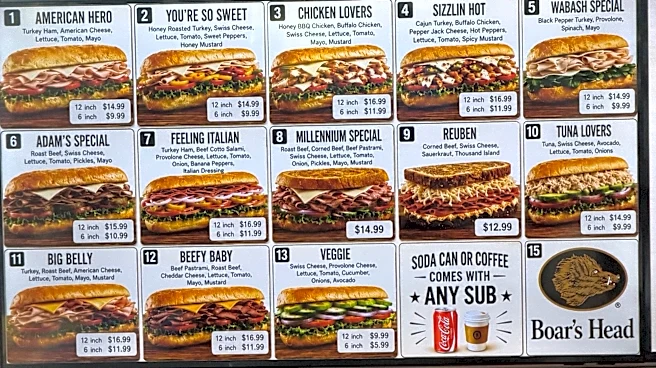






When Chris Murphy went into his local deli in late August, all the menu items had been replaced by uncanny, AI-generated images. The sandwiches depicted on the screen above the countertop displayed food with strange, repeated textures that looked hyperrealistic, yet somehow aggressively fake at the same time. It was the kind of "AI slop" that made Murphy’s stomach turn and appetite suppress.
The Chicago deli, which is located just across the street from Murphy’s office, only switched to the increasingly prolific AI-generated menu about a month ago. On their Yelp review page, there’s still photos of their old menu, which features generic food photography and text describing the contents of each sandwich. Had the original menu remained intact,
Murphy said he would have placed an order.
But the food was "just so viscerally disgusting," he told USA TODAY. He showed his coworkers, who recoiled and begged him to take the images away. "They almost vomited," he said.

It’s part of a growing trend where AI-generated designs are increasingly replacing traditional advertisements. AI-generated flyers have been popping up more frequently in public places, plastering generic signage around cities and establishments, often to the dismay of passersby. These menus filled with AI-generated food images are being coined "AI food slop," and Murphy isn’t the only one expressing his disgust.
Despite a seemingly innate aversion to these images, the internet is captivated. In a post with nearly 2 million views, an X user posted a picture of a sign outside a restaurant she passes on the way to work. "This is genuinely one of the worst ai shop horror food menus I’ve ever seen," she wrote. And while the replies overall express horror or disgust ("I feel like I have bugs crawling in my throat when I look at this," one said), it also sparked an influx of posts from other users sharing photos of AI slop menus in the wild.
This is genuinely one of the worst ai shop horror food menus I’ve ever seen and I have to pass it almost every day on the way to work pic.twitter.com/dM7myJt6si
— Julia 🤝 (@REMARKSIST) August 27, 2026
Experts say there's a reason why we can't look away.
When images look almost real, but clearly fake, our brains get stuck between "approach and avoidance" as they try to make sense of it, according to psychologist Stephanie Sarkis. "People can have an urge to look away or anxiety, but at the same time, your brain may also be trying to look at it more," Sarkis explained. For some onlookers, the images can bring more severe reactions, especially for those suffering from a condition called trypophobia, an extreme fear of repeated holes, patterns or textures.
Why we can’t look away from distressing 'AI food slop'
While relatively rare, trypophobia can be severely debilitating. The condition is commonly thought to be a fear of small, repeated holes, but can include any sort of repeated textures or patterns, thus extending to this new "AI food slop."
According to Sarkis, these visceral reactions are meant to help humans avoid dangers like contamination, disease, decay or parasites. "Our brain goes, 'We need to look at that and make sure it’s not bad.' The problem is that if you look at it again, it doesn’t stop the reaction, it can actually intensify it," Sarkis said.
While those suffering from trypophobia may feel greater levels of distress, these "unnatural" AI-generated images can be off-putting to anyone, Sarkis clarified.
"It’s making recognizable food look biologically bizarre. It’s stuff that makes us go ick," she said.
For immediate relief, the best approach is to distract yourself. Sarkis recommends grounding exercises like looking at three things you can hear, see and touch. If the stress starts to impede daily functioning, talk to a mental health professional who can provide additional support.
As these ads become more prolific and consequently unavoidable, more people are speaking out in the hopes that restaurants will stop turning to AI altogether − which falls in line with Americans' increasingly negative views on AI and Big Tech. According to an August 2026 Pew Research Center survey, a majority of adults under 30 (55%) now say they’re more concerned than excited about AI, and a YouGov Poll in July found that 7 in 10 adults believe technology companies have too much power.
'It's a slippery slope'
Emily Hawkes, a professional food photographer based in New York, has a group chat with other digital creatives in the food industry, where they share and roll their eyes at AI slop ads.
From their trained eye, the images look laughably fake. But Hawkes said they can’t believe that restaurant owners or brands think these images will be appetizing to customers. While AI-generated ads have become more normalized − you can even find them on popular streaming platforms like Hulu − she's optimistic that food will take longer to adjust to.
"There are things about the way that food looks in the world, that even people who don’t spend all their time looking at it and thinking about it like I do, there’s an innateness that you can feel in your bones," Hawkes explains. "There's something wrong, and you might not be able to put your finger on it, but you know it when you see it."
The crux of her job as a food photographer is to "present the food as realistically, but also deliciously as possible," she said. In reality, customers want to see images of food that are truthful to what they will be served. She added that even before AI, people already criticized overly generic photos of food.
"When people see something that makes them actually hungry and actually has appetite appeal, it’s because they’re seeing something real. They’re seeing something that they can imagine themselves eating," she said. "I struggle to see a world where AI could ever really capture that."
If food photography is cost-prohibitive to a business, there are other avenues to explore rather than turning to generative AI. Hawkes suggests reaching out to student photographers and offering a free meal in exchange for content, or turning to YouTube tutorials for a DIY approach.
For customers like Murphy, anything is better than that appalling Reuben at his local deli. He worries that it's a slippery slope, too. First, AI infiltrates the food photography and menus, but what happens if restaurants turn to ChatGPT recipes and then, as Murphy speculates, "suddenly we're eating straight up horror slop?" It boils down to the lack of trust these "AI food slop" images instill in the quality of food the establishment may offer.
"A thoughtful photo of your food with your iPhone is going to be better than whatever AI is going to generate because it's your food," Hawkes said. "It's not whatever the AI thinks a sandwich looks like."
This article originally appeared on USA TODAY: Why 'AI food slop' is making people so uncomfortable and upset