








Renting across Florida's largest markets became less competitive overall, except in one, according to a report by RentCafe.
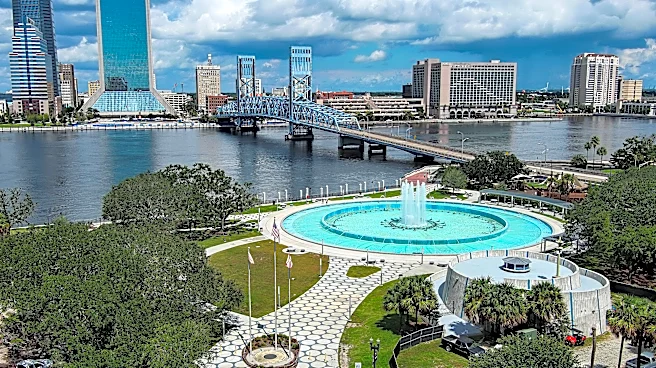
Jacksonville was among the top trending markets during 2026's peak rental season, according to RentCafe's October report on rental competitiveness, which analyzes Yardi data. Jacksonville's "competitiveness score" went up to 76.5 in 2026 from 72.8 in 2025. The national score was 73.9, according to an email by Esther Urmosi, a communication specialist with RentCafe.
The company reviewed apartment data across 139 rental markets in the country, ranking them based on averages in April, May and June. The full methodology is available on RentCafe's website.
The rental competitiveness index takes into account five factors: "How many
renters competed for each vacancy, how many renters renewed their leases and how much new construction reached the market." In more competitive markets, for instance, a higher number of renters may be competing for each listing.
Chicago took Miami's place as the most "competitive rental market in the country" with a rental competitiveness score of 91.8 to Miami's 89.8. In Miami, 96% of apartments are occupied, with about 16 renters competing "for each opening." Seventy percent of renters also renew their leases rather than moving.
Orlando, meanwhile, "cooled the most of any large market," dropping 6.3 points "and sliding from 12th to 34th." On average, nine renters compete for every vacancy, and apartments "take 42 days to lease," which is six days longer than last summer, according to Urmosi. The city's competitiveness score "fell from 80.6 to 74.3."
Rental homes out of reach for 'millions'
Rental homes are out of reach for "millions" of low-wage workers — in Florida alone, you'd have to work 91 hours per week to afford a one-bedroom at minimum wage.
That's according to the 2026 Out of Reach report, published by The National Low Income Housing Coalition, a self-described nonprofit advocacy organization based in Washington, DC.
The report lists "housing wages" by state and metro area, which it defines as estimates of the income required to afford a rental home at HUD’s Fair Market Rent without spending 30% of one's wages on housing. Nationally, the housing wage for 2026 was $34.73 per hour for a "modest" two-bedroom rental, and $29.19 for a one-bedroom rental. The average hourly wage for renters was $24.84.
How South Florida rent prices compare
Florida ranked as the 10th most expensive state overall, with an hourly housing wage of $37.93 required to afford a two-bedroom apartment, for which the fair market rent was listed as $1,973.
That means, to "afford this level of rent and utilities" without spending more than 30% of their income on housing, a renter in Florida must earn $6,575 per month, or $78,905 per year.
Within the state, Monroe County, home of the Florida Keys, was first on the list of most expensive areas, requiring a housing wage of $48.15 to afford a two bedroom at fair market rent. Monroe County also ranked as the second most expensive nonmetropolitan county or county equivalent nationally, beat only by Nantucket town in Massachusetts.
The Miami-Miami Beach-Kendall area followed closely, with a housing wage of $46.85 required to afford a two-bedroom. The Fort Lauderdale area required an hourly wage of $44.87, and the West Palm Beach-Boca Raton area required a wage of $43.35.
Meanwhile, the state's minimum wage just became $15, while the average renter's wage is $24.27, according to the report.
How much apartment space you could get for $1,500 in Miami
A budget of $1,500 per month got you fewer than 500 square feet in Miami, according to a report by RentCafe.
RentCafe's analysis of 200 cities was based on data from Yardi, a company that provides real estate intelligence, and was current as of March 2026. According to RentCafe, the national average rent for an apartment was $1,740 per month, while the average apartment was about 835 sq. ft.
In about half of the 200 cities that the company analyzed, $1,500 per month could cover a one or two bedroom apartment. Anyone with the same budget would struggle to afford a studio in 26 cities, however, "most of which [were] in California," with several located in Florida, as well.
Studio apartments generally range from 500 to 600 sq. ft. in size, according to Apartments.com. In Miami, $1,500 per month could get a renter an apartment of about 498 sq. ft.
In other South Florida cities, including Fort Lauderdale and Hialeah, $1,500 got renters apartments of fewer than 600 sq. ft.
RentCafe's most competitive markets in 'peak rental season,' 2026
1. Chicago, IL
2. Miami, FL
3. Silicon Valley, CA
4. Manhattan, NY (tie)
4. Suburban Chicago, IL (tie)
6. Grand Rapids, MI
7. Milwaukee, WI
8. Suburban Twin Cities, MN-WI
9. Suburban Philadelphia, PA
10. Twin Cities, MN
Sarah Perkel is a South Florida Connect Reporter for the USA TODAY Network's Florida Connect team. You can get all of Florida’s best content directly in your inbox each weekday day by signing up for the free newsletter, Florida TODAY.
This article originally appeared on USA TODAY: Renting in Florida's large markets got less competitive, except for one