




It's a story as old as time. And a story that needs to be told again.
John Steinbeck's 1952 epic "East of Eden" is a story about family, betrayal, sin, good, evil, love, legacy and America. It's a Bible story retold in gray 19th-century New England, on the sunny early 20th century farmland of California and in the minds of its deeply flawed, deeply human characters, so much more complicated than Cain and Abel ever were.
In 1955, legendary Hollywood director Elia Kazan directed an adaptation of the book with film star James Dean. In 2026, his granddaughter Zoe Kazan, an actress, writer and producer in her own standing, has brought the story to television, starring newly minted Hollywood star Florence Pugh. It's a Hollywood story of family, legacy
and America.

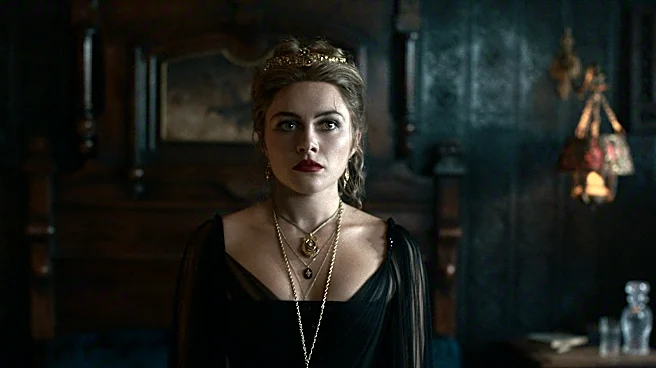
Zoe Kazan's "East of Eden" (now streaming on Netflix, ★★★★ out of four) is a blistering adaptation of Steinbeck's work, a dark and dreary epic for the ages that challenges its viewers ideals, morals and presumptions, in an age when TV is designed to make us all too comfortable and lazy. Aided in that she can encompass far more in seven episodes than her grandfather could achieve in a two hour feature film, Zoe Kazan zooms in on the story's looming antagonist, mother, prostitute and murderer Cathy Ames, brought to life in a career-best performance by Pugh, also a producer on the project.
Elia Kazan's focus was Cathy's sons, Cal and Aron, for its most central storytelling in an era where men's stories, particularly those of wartime violence, epic love and self-reflection, were the main pillar of Hollywood. It is a fitting evolution that Zoe Kazan's version gives Cathy the spotlight, not manipulating the story or changing it, but turning the camera's lens ever so slightly to a woman who can be written off as a one note villain in the annals of pop culture history. Pugh's Cathy is many things, but she is not one-note.
The film adaptation of Steinbeck's novel focused on its second part, set in Salinas, California, ahead of World War I, in which adolescent twin brothers reckon with their father's love (or lack thereof) and the discovery of their mother's life as the madame of a brothel.
The Netflix series gets there eventually, but is able to spin the entirety of Steinbeck's saga, starting all the way back in the late 19th century as a different pair of brothers, Charles (Mike Faist) and Adam (Christopher Abbott) grow up in Connecticut under an exacting and abusive father in the shadow of the Civil War. Nearby a young Cathy Ames (played by Vaughan Riley as a teen) grows up under the shadow of patriarchal dominance and control. She is stalked, abused and controlled, eventually connected to the suicide of her obsessed schoolteacher and harmed by her father. Cathy's road to darkness, and independence starts when she kills her parents in a house fire and leaves for a life of sex work. After she spends a year as the kept woman of a wealthy man who beats her nearly to death, she ends up bleeding and clinging to life on the doorstep of Adam and Charles' farmhouse.

Adam and Cathy wed, even as Charles proclaims her to be a she-devil, and the newlyweds head west to California seeking fertile land and a new life, though Cathy is already beginning to resent Adam's control over her life. She gives birth to twin boys, abandons them and Adam, and starts life again in a brothel. Cal (Joseph Zada) and Aron (Joe Anders) then enter the narrative, along with the family's Chinese-American servant Lee (Hoon Lee) and Irish immigrant Samuel Hamilton (Ciarán Hinds).
The series is dense, complex and stuffed with characters and famous faces (Martha Plimpton shows up as a brothel madame). Its large cast never feels cumbersome or extraneous, each character crafted with care and dignity by Kazan's meticulous scripts. There are moments for everyone even as the central narrative never wavers. A short exchange between Lee and Hamilton about the virtues acting like caricatures of their respective immigrant minorities for safety and prosperity is fleeting, but deeply affecting.
Faist, who wears pain and skepticism on his face more easily than he smiles, is a standout in the series' early episodes. Abbott, a ringer for Kit Harington in the early days of "Game of Thrones," adds a softness to Adam that offers a counterpoint to the character in the film.
But the star of the series is Pugh by a lightyear, and she shines brilliantly in every scene. Powerful, expressive and restrained when needed, the actress becomes Cathy easily and completely, from her most vulnerable and quiet moments to the woman's loudest and most colorful rages. She is impossible to look away from, even as the story winds through some dark and deeply depressing sagas in Cathy's life.

There is not usually a reason to remake a classic. What can modern actors do that James Dean could not? Yet, Zoe Kazan makes her take on "Eden" achingly relevant and vital.
Even as Cathy and the other women in the story endure unspeakable violence and the worst indignities of a deeply misogynistic culture a hundred years ago,Pugh is leading the charge of celebrities speaking out against the "Cornell 7," seven college men accused of brutally gang-raping a young woman in 2024, a case that has drawn national fury and reminded the rest of us all too acutely that a hundred years is barely any time for our society to really change.
We have not yet gotten anywhere close to the garden of Eden.
This article originally appeared on USA TODAY: 'East of Eden' Netflix remake seemed questionable. Florence Pugh makes it a must-see