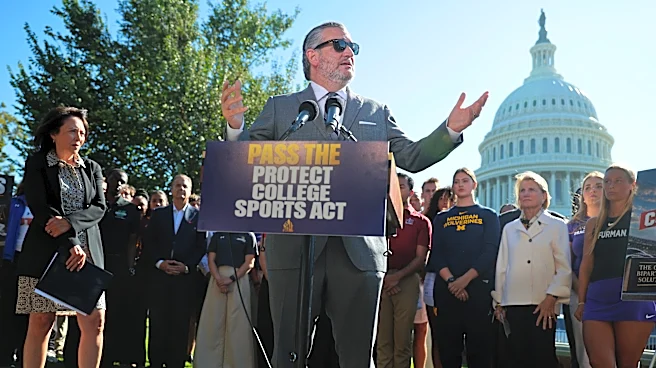

Flanked by current student-athletes and prominent college basketball coaches John Calipari, Mark Few and Kelvin Sampson, Sens. Maria Cantwell (D-Wash.) and Ted Cruz (R-Texas) stood just steps from the
U.S. Capitol on Monday and urged lawmakers to pass the Protect College Sports Act.
The bill is expected to receive a Senate floor vote no later than next week and could come up as soon as Tuesday, Cruz said.
Cantwell and Cruz are co-sponsors of the legislation, which was the focus of an hour-long event featuring remarks from student-athletes, coaches and several senators who have backed the bill.
“We are, I believe, on the cusp of passing historic legislation, bipartisan legislation to protect and preserve college sports,” said Cruz, who first teamed with Cantwell more than three years ago to initiate work on the PCSA.
“No other country on Earth has anything remotely like college sports. College athletics have been an avenue for opportunity for millions of young men and women, many of whom otherwise would have no opportunity to get a college education.”

Cantwell, noting that her office plans to release a report Tuesday outlining escalating costs across college athletics, framed the bill as a necessary step toward reining in what she called the "Wild West" of college sports.
“This is about reigning in the bad practices that are happening in college sports today, the runaway costs that are sending people to (their respective) state legislature asking for a bailout,” said Cantwell, who multiple times cited a “300% increase in recruiting costs." "(Asking) taxpayers to pay for (college) sports. Asking people to take endowment funds that should go to things like research or A.I.
“The statistics show that the majority of college athletics departments right now can’t make ends meet.”
Craig Bohl and Craig Robinson, leaders of the two major coaching associations backing the legislation, joined athletes and coaches Monday in support of the PCSA.
Representing more than 16,000 coaches combined, Bohl, executive director of the American Football Coaches Association, and Robinson, executive director of the National Association of Basketball Coaches, reaffirmed their organizations' support for the bill.
The legislation currently has eight co-sponsors, evenly split between Democrats and Republicans. But it also drew vocal opposition Monday from Sen. Chris Murphy (D-Conn.).
Earlier in the day, Murphy's office hosted a virtual news conference to criticize the proposal, which has received backing from the NFL, NBA, MLB, NHL and WNBA.
“What this bill does at its core is to protect a system of exploitation,” Murphy said. “This bill seeks to give an unprecedented antitrust exemption to an industry that is violating the law every single day. … Instead of fixing the problem, the college sports industry has come to Congress and is asking Congress to make their illegal behavior all of a sudden magically legal through an antitrust exemption.”
The proposed bill has broad support from current student-athletes across the college landscape, and more than a dozen were on hand in Washington, D.C., during Monday’s gathering.
“My story is one of many, 85% of (NCAA) athletes are in non-revenue and Olympic sports,” said Sophia Stylianos, a rower from the University of Michigan who said her grandmother used her rowing skills to deliver bread during World War II. “This is why I’m proud to be on an Olympian-producing team. We deserve the chance to represent America on an Olympic world stage.
“I therefore urge Congress to pass the bipartisan Protect College Sports Act.”
There was college football representation from Howard University, which last Saturday, Sept. 12, played at defending national champion Indiana.
“(The Protect College Sports Act) provides security and a fair opportunity, it protects the right to earn from Name, Image and Likeness,” said Kedrick Green, a Howard defensive back. “It provides safeguards and protects scholarships with more consistent rules.
“For an HBCU player like myself at Howard, stability matters. At the end of the day, this is about protecting college athletes who make (college athletics) possible, so I hope Congress passes this act.”
Opponents of the bill point to its treatment of student-athletes as a major sticking point. The legislation's proposed antitrust exemption would prevent college athletes from unionizing or collectively bargaining with schools, conferences and the NCAA, rights that players in professional sports enjoy. That provision has become a focal point of the United College Athletes Association's opposition.
In July, the UCAA announced more than 100 women's college basketball players had signed union authorization cards. The organization argues athletes should have a seat at the table as college sports continue to reshape their economic and governance models.
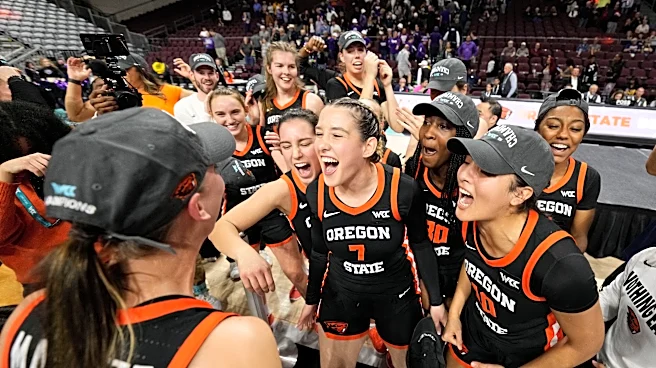
The UCAA is backing a group of Oregon State women's basketball players seeking recognition as employees before the Oregon Employment Relations Board. A ruling in the players' favor could clear the way for unionization and potentially set a precedent with national implications for college athletics.
The case also highlights the financial realities facing many Olympic and women's sports programs. According to Oregon State's most recent filings, the women's basketball program generated $2.05 million in revenue while incurring $5 million in operating expenses.
Across the Pac-12, all eight women's basketball programs reported operating deficits of at least $1.2 million in their most recent financial disclosures reviewed by USA TODAY Sports.
Oluchi Okananwa, a senior women's basketball player at Maryland and the UCAA's interim president, joined Sen. Murphy on Monday's call to voice the organization's concerns about the legislation.
“The question is not whether college sports needs rules; the question is, who gets to make those rules? Where is our collective voice on the other side? That is why we are fighting for unionization and collective bargaining,” Okananwa said. “We are not saying there should be no rules.”
Another women’s basketball player, LSU’s Jada Williams, joined the call and identified herself as a “portal bandit.”
She’s transferred twice, from Arizona to Iowa State and now to Kim Mulkey’s Tigers. She explained why she was so “grateful” for the freedom of movement players currently have.
“I think a lot of people don't realize what goes on behind the scenes. Coaches lie, coaches don't treat us with respect, coaches overuse their power. They have too much power. I have been forced to play through injury. I’ve seen it all,” Williams said. “We're the ones who are putting on the show… This is a job.”
Calipari, who’s developed more than two dozen NBA players in a college coaching career spanning parts of four decades, acknowledged the bill’s winding path and imperfections but praised its bipartisan framework.
“I was getting calls from coaches that high school seniors weren’t getting the scholarships they usually get,” said Calipari, 2012 national champion at Kentucky. “Why? Because we coaches were recruiting older players. We were waiting on the (NCAA) transfer portal. We were recruiting European players that were older.
“(With this bill) we cleaned up foreign students and how they are on equal footing with American students. I think clears up about 75 to 80% of our issues. Nothing is perfect. This is a bite out of the apple.”
This article originally appeared on USA TODAY: Protect College Sports Act nears Senate vote. Why not everyone wants it passed