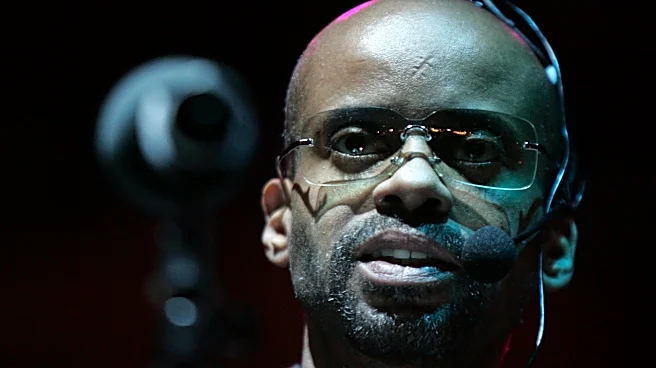









Techno pioneer Juan Atkins, who helped reshape global music by fusing Detroit soul with cutting-edge electronic sounds, died Saturday, Oct. 31, at age 64.
Greensmith Artists, Atkins' management company, confirmed his death on social media Sunday. Atkins, who was in Mexico City for a DJ gig, died in his sleep, several of his friends and colleagues on the Detroit techno scene told the Detroit Free Press, part of the USA TODAY Network.
Atkins was found unresponsive in his hotel room before being rushed to the hospital, per a statement the company gave to dance music outlet Resident Advisor, which did not share a cause of death.
USA TODAY has reached out to Greensmith Artists for more information.
Word of Atkins' death sent shockwaves Sunday through
the local and worldwide electronic music community.
"He died like a rock star, didn't he — in his hotel room, waiting to go play a show," said fellow Detroit DJ Derrick May, a friend of many decades.

The Detroit native was famously associated with a trio of artists known as the Belleville Three, alongside his school friends May and Kevin Saunderson. Together, they and artists such as Eddie Fowlkes turned homegrown techno into a global phenomenon.
"It’s very simple: If it wasn't for Juan, there wouldn't be me, a Derrick, a Kevin," said Fowlkes. "His dream was my dream in a sense."
Atkins had battled health issues in recent years, including diabetes-related complications.
"He fought through it, and he played, and he didn't complain. He didn’t ask for favors," said May. "People would see him onstage and maybe wonder what was going on with him, but he never once complained. He never once asked for sympathy from anybody."
In a statement Sunday, Detroit Mayor Mary Sheffield described Atkins as one of the city's "true originals," a musical groundbreaker who "opened doors for generations of Detroit artists who followed him."
"Today, millions of people dance to music that traces back to him and to our city," Sheffield said. "That is a Detroit story: genius, grit, and invention, from neighborhoods the world too often overlooked."

In person, Atkins was a quiet, low-key figure. But his creative repercussions were loud: His music, imbued with sci-fi futurism and released under monikers including Cybotron and Model 500, broke from Detroit's underground to penetrate the wider club culture in the 1980s.
'Juan imagined techno before any of us': Juan Atkins' trailblazing role
Along with its immediate impact on the Detroit scene, the work of Atkins and his peers proved deeply influential to several generations of European producers and DJs, inspiring rave culture and ultimately transforming the very sound of mainstream pop music.
Richie Hawtin, who was among a second wave of Detroit techno artists to find success in the 1990s, paid tribute to Atkins in a statement to the Detroit Free Press.
"Juan imagined techno before any of us," Hawtin said. "Without him, our music wouldn't sound the way it does – if it existed at all."
In the 1980s, for young Black Detroiters such as Keith Tucker, Atkins was a guiding light who had laid down the standard for aspiring artists: "This is Detroit techno – it has to be of a certain caliber. Who would think this music came from Black kids in the 'hood'?
"We were trying to go someplace else, to be in the future," said Tucker, an original member of the group AUX 88. "Being from the hood, it was an outlet. Juan showed us we could do anything."
Despite his ill health over the past several years, Atkins maintained a busy gig schedule, traveling the globe for bookings.
He was among the most prolific performers in the 26-year history of Detroit's annual Memorial Day weekend techno festival, known now as Movement. Atkins regularly switched up his approach for those high-profile hometown appearances, presenting a new theme onstage each year.
"He's the one person, without a doubt, that everyone in electronic music has been influenced by," said Jason Huvaere of Paxahau, producer of the annual riverside fest. "He was really the end of the road when it comes to techno and what started all this. There’s no one that hasn't been touched by him."
Atkins, born in Detroit in 1962, was musically inclined from a young age, learning guitar and drums while playing in neighborhood bands. He began experimenting with electronic sounds in junior high after his family's move to Belleville, Michigan, west of the city, working in his basement with a $400 synthesizer.

In his mind, he'd conceived a sound that was "urban, industrial and in sync with Detroit," as the Free Press described it in a lengthy profile of Atkins in 1990, when his name and music were blossoming around the world.
"When you first start listening to music at 7 or 8, and really take notice of it, you very rarely hear something you don't like because it's all so new," he told the Free Press. "Once you get knowledge, it got to the point where – I don't know if times changed or I got older and I changed – music started getting boring to me. … Radio is the last place you go to hear new music, and I got fed up with that."
With friend and musical mentor Richard Davis, Atkins formed Cybotron in 1980, crafting a visionary take on electro-funk that yielded tracks such as "Alleys of Your Mind," "Clear" and "Cosmic Cars," which were embraced by the influential late-night radio personality Electrifying Mojo.
As house music simultaneously exploded out of Chicago, Detroit techno had found its foothold. Atkins went on to launch his own label, Metroplex, in the mid-1980s while creating records under aliases such as Model 500, establishing himself as a force for decades to follow.
Juan Atkins bonded Detroit techno and Chicago house music
Detroit techno and Chicago house have sometimes been portrayed as music rivals, but that wasn't the reality on the ground. Chicago producer Tyree Cooper said Atkins was a key bonding agent for the two Midwest scenes.
Atkins' 1985 track "No UFO's" was a particular favorite for Cooper, who described Atkins as a Motor City big brother who represented "the true essence of our culture."
"We appreciated what they did [in Detroit], and they appreciated what we did," Cooper said. "We vibed with each other."

Atkins spent a stretch in the 2000s living in Los Angeles but eventually returned to his hometown, where he resided on the city's west side. In recent years, one of Atkins' main passions was the music career of his daughter, Milan Ariel, a vocalist who blends elements of R&B and techno.
For those who worked closely with him, Atkins was known as an affable figure whose mind teemed with forward-thinking, philosophical concepts.
"Juan could be really hilarious, making jokes and laughing at everything. And he was very approachable," said Adriel Thornton, a veteran Detroit event promoter. "But he wasn't light – he was a serious guy. We could talk all day about different ideas."
Annie Houston, a longtime behind-the-scenes fixture on Detroit's underground music scene, saluted Atkins' prodigious role in techno, calling him "the quiet giant behind the whole thing."
"Juan is an icon, and he's been a stable and leading force for so many years in the techno and house community," Houston said. "He just kept the music going forward. He was genuinely the head of a movement."
Contact Detroit Free Press music writer Brian McCollum: bmccollum@freepress.com.
This article originally appeared on Detroit Free Press: Juan Atkins, techno music pioneer, dies at 64